A remedy older than chemistry
For thousands of years, people chewed willow bark or drank willow tea to ease pain and bring down fevers. In 1763 an English clergyman, Edward Stone, tested powdered willow bark on about fifty patients with “agues” (fevers) and reported his success to the Royal Society: one of the first written accounts of a clinical trial of a natural product.
Finding the active molecule
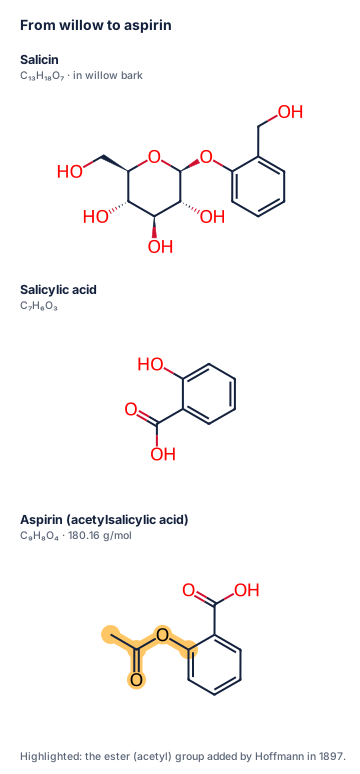
In the nineteenth century, chemists set out to find which substance in the bark did the work. In 1828 Johann Buchner isolated salicin, and in 1838 Raffaele Piria converted it into salicylic acid, a stronger medicine. Salicylic acid worked, but it had a serious drawback: taken in large doses, it irritated the mouth and stomach badly.
Key idea
Most natural-product drugs follow the same path: a traditional remedy, then isolation of the active compound, then structure determination, then chemical modification to make a safer or more effective medicine.
A small change with a big effect
Salicylic acid has two functional groups: a carboxylic acid (–COOH) and a phenol (–OH on a benzene ring). In 1897 Felix Hoffmann at the Bayer company converted the phenol group into an ester by reacting it with ethanoic (acetic) anhydride:
salicylic acid + ethanoic anhydride → acetylsalicylic acid + ethanoic acid. The product, sold as Aspirin from 1899, was gentler on the stomach. The name comes from a (acetyl) + spir (from Spiraea, the old name for meadowsweet, another source of salicylates) + in.
Worked example: How much aspirin can you make?
Question: In a school preparation, 2.00 g of salicylic acid (138.12 g/mol) reacts with excess ethanoic anhydride, and 2.12 g of dry aspirin (180.16 g/mol) is collected. Find the percent yield.
- 1 : 1 ratio, so the theoretical yield is
- Percent yield 81.3 %
How does it work?
For 70 years nobody knew. In 1971 John Vane showed that aspirin stops the body making prostaglandins, signalling molecules that cause pain, fever and inflammation. Aspirin transfers its acetyl group to the enzyme cyclo-oxygenase (COX), permanently blocking it. Because platelets cannot make new enzyme, a small daily dose also makes blood less likely to clot, which is why low-dose aspirin is used to prevent heart attacks and strokes in some patients (only on medical advice). Vane shared the 1982 Nobel Prize in Physiology or Medicine.
More precisely
Aspirin is a prodrug in part: in the body its ester group is hydrolysed back to salicylate, which also has anti-inflammatory activity. The irreversible acetylation of COX is what makes aspirin different from other painkillers such as ibuprofen, which block the enzyme only temporarily. Historians still debate how much of the 1897 discovery was due to Hoffmann and how much to his supervisor Arthur Eichengrün.
Why it matters for chemists
Aspirin shows how understanding functional groups lets chemists improve a natural molecule. Turning one –OH group into an ester changed how the drug behaves in the body, and the same strategy (modifying a natural lead compound) is still central to drug discovery today.
Timeline
- c. 1500 BCEAncient Egyptian medical texts describe willow as a remedy.
- c. 400 BCEWritings attributed to Hippocrates recommend willow bark and leaves for pain and fever, including in childbirth.
- 1763Edward Stone reports to the Royal Society that powdered willow bark relieves fevers ("agues").
- 1828Johann Buchner in Munich isolates a bitter yellow substance from willow bark and names it salicin.
- 1829Henri Leroux obtains salicin in crystalline form.
- 1838Raffaele Piria converts salicin into salicylic acid.
- 1853Charles Gerhardt first prepares acetylsalicylic acid, but in impure form, and does not pursue it.
- 1860Hermann Kolbe publishes a synthesis of salicylic acid from phenol and carbon dioxide.
- 1874Friedrich von Heyden begins making salicylic acid on an industrial scale, making it cheap.
- 1897Felix Hoffmann at Bayer makes pure, stable acetylsalicylic acid (10 August 1897, laboratory notebook).
- 1899Bayer registers the trademark "Aspirin" and begins selling it.
- 1971John Vane shows that aspirin blocks the production of prostaglandins.
- 1982Vane shares the Nobel Prize in Physiology or Medicine with Sune Bergström and Bengt Samuelsson for work on prostaglandins.
Sources and further reading
Explore next
1928 Penicillin discovered
Penicillin: The Miracle of Blue Mould
The first natural antibiotic, from a contaminated dish in 1928 to the medicine that changed the course of the Second World War.
How Fleming noticed penicillin in 1928, how Florey, Chain and Heatley turned it into a drug, why its β-lactam ring kills bacteria, and how resistance arose.
1804 Morphine isolated from opium
Morphine: The Gift of the Poppy
The first alkaloid ever isolated from a plant, still one of the most important painkillers in medicine.
From opium in ancient Mesopotamia to Sertürner's isolation of morphine in 1804, its complex structure (1925) and synthesis (1952), how it relieves pain, and why it is addictive.
Spotted a mistake? Let us know and we'll fix it.