What is it?
Organic reactions look complicated, but almost all of them fall into a few types. Once you know the functional group in a molecule, you can predict which type of reaction it undergoes and what the product will be.
| Type | What happens | Typical example |
|---|---|---|
| Addition | two molecules join to make one; a C=C becomes C–C | alkene + |
| Substitution | one atom or group swaps for another | alkane + |
| Elimination | a small molecule (often ) is removed, forming C=C | alcohol → alkene |
| Oxidation | gain of O or loss of H | alcohol → aldehyde → acid |
| Condensation | two molecules join and release a small molecule () | acid + alcohol → ester |
Key idea
The functional group decides the reaction. Alkenes add across the C=C; alkanes and haloalkanes substitute; alcohols can be oxidized, eliminated (dehydrated) or condensed with acids. Learn one example of each and you can apply it to the whole family.
Why does it matter?
- Making things. Medicines, plastics, dyes and fuels are made by chains of these reactions, converting one functional group into another.
- Everyday chemistry. Margarine is made by adding hydrogen to vegetable oils; wine turns to vinegar by oxidation; the breathalyser test once relied on dichromate turning green.
- Analysis. Simple colour tests (bromine water, acidified dichromate) tell you which functional groups a compound contains.
How does it work?
1. Addition reactions of alkenes
The C=C double bond opens, and one atom or group adds to each carbon:
- Hydrogen (with a nickel catalyst, about 150 °C):
- Bromine: (1,2-dibromoethane)
- Hydrogen bromide:
- Water (steam, acid catalyst): , the industrial route to ethanol.
Test for C=C: shake with orange-brown bromine water. An alkene decolourises it (the bromine adds across the double bond); an alkane does not.
2. Substitution reactions
- Alkanes + halogens in ultraviolet light: . A hydrogen is swapped for a chlorine. Further substitution gives a mixture (, , ).
- Haloalkanes + hydroxide ions (warm, aqueous): . The halogen is replaced by –OH, giving an alcohol.
3. Elimination: dehydrating alcohols
Heating an alcohol with concentrated sulfuric acid (or passing its vapour over hot aluminium oxide) removes water and forms an alkene:
4. Oxidation of alcohols
Warming with acidified potassium dichromate oxidizes alcohols; the orange dichromate turns green as it is reduced to . Writing [O] for the oxidizing agent:
- Primary alcohol (–OH on an end carbon) → aldehyde (if distilled off at once) → carboxylic acid (if heated under reflux):
- Secondary alcohol → ketone:
- Tertiary alcohol (–OH on a carbon with no hydrogen): not oxidized, so the dichromate stays orange.
5. Condensation
A carboxylic acid and an alcohol, with an acid catalyst, condense to an ester and water (see Functional Groups). Repeating condensation many times builds polymers such as polyesters and nylon.
Think of it like this
Think of the reaction types as moves in a game of building blocks. Addition snaps a new piece onto an open slot (the C=C). Substitution swaps one piece for another. Elimination pulls two pieces off and leaves a new open slot. Condensation clicks two models together and drops a small spare piece (water).
More precisely
When an unsymmetrical reagent such as HBr adds to an unsymmetrical alkene such as propene, two products are possible. The major product follows Markovnikov’s rule: the hydrogen adds to the carbon that already has more hydrogens, giving mostly 2-bromopropane. Substitution of haloalkanes is a nucleophilic substitution: the electron-rich attacks the carbon bonded to the electronegative halogen. Oxidation of alcohols is a redox reaction: carbon’s oxidation number rises while chromium’s falls from +6 to +3.
Visualise it
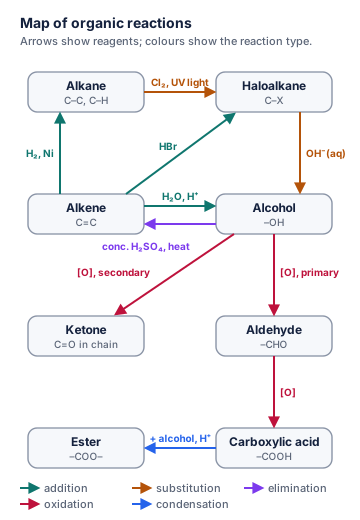
Worked example
Worked example: Predicting products
Question: Give the product, its name and the type of reaction: (a) propene + bromine (b) ethanol heated with concentrated sulfuric acid (c) propan-2-ol warmed with acidified potassium dichromate.
- (a) Bromine adds across the C=C: , 1,2-dibromopropane; addition.
- (b) Water is removed: , ethene; elimination (dehydration).
- (c) A secondary alcohol is oxidized to a ketone: propanone, ; oxidation (orange to green).
Worked example: Telling an alkane from an alkene
Question: Two colourless liquids are hexane and hex-1-ene. How can you tell them apart?
- Add a few drops of orange-brown bromine water to each and shake.
- Hex-1-ene decolourises it: (addition across the C=C, giving 1,2-dibromohexane).
- Hexane has no C=C, so the orange colour stays (substitution needs UV light).
Worked example: Mass of bromine that reacts
Question: What mass of bromine reacts completely with 5.00 g of hex-1-ene? ( = 84.16 g/mol; = 159.80 g/mol)
- Equation: (1 : 1)
- 9.49 g
Common mistake
Common mistake: Expecting alkanes to react with bromine water
Alkanes have no C=C, so they cannot undergo addition. They react with halogens only by substitution, and only in ultraviolet light. A colour change with bromine water in the dark means a C=C is present.
Common mistake: Oxidizing a tertiary alcohol
A tertiary alcohol has no hydrogen on the carbon bearing the –OH, so acidified dichromate cannot oxidize it: the solution stays orange. Only primary alcohols give aldehydes and acids; secondary alcohols give ketones.
Common mistake: Confusing addition and substitution products
Addition puts both parts of the reagent into one product (). Substitution gives two products, because the atom that is replaced leaves ().
Notation note
- [O] means “oxygen from an oxidizing agent”; [H] is sometimes used for a reducing agent.
- Conditions are written over the arrow in many books, for example UV light, Ni catalyst or reflux.
- Primary, secondary and tertiary (1°, 2°, 3°) describe how many carbons are bonded to the carbon carrying the –OH: one, two or three.
Remember this
Remember this
- Addition (alkenes): + H₂ (Ni), + Br₂, + HBr, + H₂O (H⁺). Bromine water decolourised = C=C present.
- Substitution: alkane + Cl₂ (UV); haloalkane + OH⁻ → alcohol.
- Elimination: alcohol + conc. H₂SO₄, heat → alkene + water.
- Oxidation (acidified dichromate, orange → green): 1° alcohol → aldehyde → acid; 2° → ketone; 3° → no reaction.
- Condensation: acid + alcohol ⇌ ester + water; repeated, it makes polymers.
Test yourself
Check your understanding before moving on.
Flashcards
Reactions of Organic Compounds: Flashcards
- QuestionWhat is an addition reaction?Answer
Two molecules join to form one; in alkenes the C=C opens and an atom or group adds to each carbon.
- QuestionWhat is a substitution reaction?Answer
One atom or group is replaced by another, e.g. CH₄ + Cl₂ → CH₃Cl + HCl (in UV light).
- QuestionWhat is an elimination reaction?Answer
A small molecule is removed and a C=C forms, e.g. ethanol → ethene + water (conc. H₂SO₄, heat).
- QuestionTest for a C=C double bond?Answer
Orange-brown bromine water is decolourised by an alkene (addition). Alkanes leave it orange.
- QuestionProducts of ethene with H₂ (Ni), HBr and steam (H⁺)?Answer
Ethane, bromoethane and ethanol (all addition).
- QuestionWhat does a haloalkane give with aqueous OH⁻?Answer
An alcohol (substitution), e.g. CH₃CH₂Br + OH⁻ → CH₃CH₂OH + Br⁻.
- QuestionOxidation of a primary alcohol with acidified dichromate?Answer
Aldehyde (distil off at once), then carboxylic acid (heat under reflux). Orange → green.
- QuestionOxidation of secondary and tertiary alcohols?Answer
Secondary → ketone. Tertiary → no reaction (dichromate stays orange).
- QuestionWhat is a condensation reaction?Answer
Two molecules join and release a small molecule, usually water, e.g. acid + alcohol ⇌ ester + water.
- QuestionState Markovnikov's rule.Answer
When HX adds to an unsymmetrical alkene, H goes to the carbon that already has more H atoms: propene + HBr gives mainly 2-bromopropane.
Tip: press Space to flip and ← → to move between cards.
Quiz
Reactions of Organic Compounds: Quiz
7 questions
Two molecules join to form one product and the C=C becomes C–C.
Show answer
Answer: addition
Two molecules join to form one product and the C=C becomes C–C.
Only the alkene has a C=C, which adds bromine.
Show answer
Answer: hex-1-ene
Only the alkene has a C=C, which adds bromine.
Propan-2-ol is a secondary alcohol, so it is oxidized to a ketone: propanone.
Show answer
Answer: propanone
Propan-2-ol is a secondary alcohol, so it is oxidized to a ketone: propanone.
This is elimination (dehydration): water is removed and a C=C forms.
Show answer
Answer: concentrated H₂SO₄, heat
This is elimination (dehydration): water is removed and a C=C forms.
It is a tertiary alcohol: the carbon bearing the –OH has no hydrogen, so it cannot be oxidized.
Show answer
Answer: 2-methylpropan-2-ol
It is a tertiary alcohol: the carbon bearing the –OH has no hydrogen, so it cannot be oxidized.
Markovnikov's rule: H adds to the end carbon (which has more H), and Br to the middle carbon.
Show answer
Answer: 2-bromopropane
Markovnikov's rule: H adds to the end carbon (which has more H), and Br to the middle carbon.
One C=C adds one Br₂ (1 : 1), so 0.200 mol C₄H₈ reacts with 0.200 mol Br₂.
Show answer
Answer: 0.200 mol
One C=C adds one Br₂ (1 : 1), so 0.200 mol C₄H₈ reacts with 0.200 mol Br₂.
Notes and downloads
Worksheet
Reactions of Organic Compounds Worksheet
9 questions on reaction types, predicting products, chemical tests, Markovnikov addition, yields and a multi-step synthesis. Answer key included.
References
- Brown, T. L.; LeMay, H. E., Jr.; Bursten, B. E.; Murphy, C. J.; Woodward, P. M.; Stoltzfus, M. W. Chemistry: The Central Science, 15th ed.; Pearson, 2022.
Practise this topic with flashcards and a quiz at chemistryclarity.com/chemistry/organic-reactions/
Spotted a mistake? Let us know and we'll fix it.