A lucky accident
In September 1928 the Scottish bacteriologist Alexander Fleming came back from holiday to his laboratory at St Mary’s Hospital, London. A dish of Staphylococcus bacteria had been contaminated by a blue-green mould, and around the mould the bacteria had died. Fleming realized the mould was releasing a substance that killed bacteria, and he called it penicillin. He published his results in 1929 but could not purify the unstable compound, and for ten years little happened.
From mould juice to medicine
In 1939 a team at Oxford led by Howard Florey, with the biochemist Ernst Chain and the ingenious Norman Heatley, took up the problem. Heatley devised a way to extract penicillin into an organic solvent and back into water, concentrating it. In May 1940 mice infected with deadly bacteria survived when given penicillin. In 1941 the first patient, Albert Alexander, recovered rapidly, but there was not enough penicillin to finish his treatment, and he died: a stark lesson in the need for mass production.
Production moved to the United States, where a high-yielding mould from a cantaloupe melon in Peoria, Illinois, and deep-tank fermentation produced penicillin on an industrial scale by 1944, in time to treat soldiers wounded in the D-Day landings.
Key idea
Discovery is only the first step. Turning penicillin into a medicine needed extraction and purification (chemistry), biological testing (pharmacology) and large-scale fermentation (chemical engineering).
The β-lactam ring
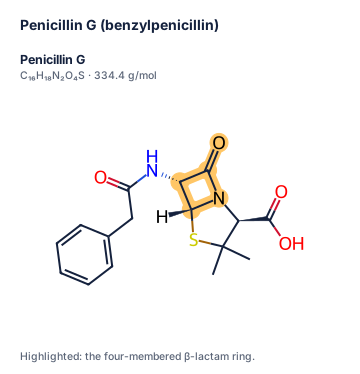
Penicillin’s structure was argued over until Dorothy Hodgkin settled it by X-ray crystallography in 1945. Its key feature is the β-lactam: a four-membered ring containing an amide group. Bond angles in a four-membered ring are squeezed to about 90°, far from the normal 109.5° or 120°, so the ring is strained and reactive.
Bacteria build their cell walls with enzymes (transpeptidases) that cross-link the wall. Penicillin looks enough like the enzyme’s normal substrate to enter the active site, where the strained β-lactam ring opens and bonds permanently to the enzyme. Without cross-links the cell wall weakens and the bacterium bursts. Human cells have no cell wall, which is why penicillin is relatively safe for people.
Worked example: How many molecules in a dose?
Question: A typical dose contains 600 mg of penicillin G (334.4 g/mol). How many moles is this?
- That is 1.79 mmol, about molecules ().
Resistance
Some bacteria make β-lactamase enzymes that break open the β-lactam ring before it can act. Fleming warned of resistance in his 1945 Nobel lecture. Chemists responded with semi-synthetic penicillins (from the penicillin core, 6-APA, isolated in 1958), and with β-lactamase inhibitors such as clavulanic acid. Using antibiotics only when needed, and finishing the course, helps slow resistance.
More precisely
Fleming’s mould was long called Penicillium notatum; genetic studies have since reclassified it as P. rubens. Industrial penicillin today comes from improved strains of P. chrysogenum. Penicillin opened the antibiotic era: streptomycin (1943), tetracyclines and many others followed, most of them also natural products from microbes.
Timeline
- 1928Alexander Fleming returns from holiday to find that a mould contaminating a dish of Staphylococcus bacteria has killed the colonies around it.
- 1929Fleming publishes his findings and names the active substance "penicillin", but cannot purify it.
- 1939Howard Florey, Ernst Chain and Norman Heatley in Oxford begin work to purify penicillin and test it.
- 1940Penicillin protects mice from a lethal bacterial infection in the Oxford experiment of May 1940.
- 1941The first patient, police officer Albert Alexander, improves dramatically, but supplies run out and he dies.
- 1943A more productive strain is found on a mouldy cantaloupe melon in Peoria, Illinois; deep-tank fermentation scales up production in the United States.
- 1944Enough penicillin is available to treat Allied soldiers wounded in the D-Day landings.
- 1945Dorothy Hodgkin determines the structure by X-ray crystallography; Fleming, Chain and Florey share the Nobel Prize.
- 1957John Sheehan completes the first total synthesis of penicillin V.
- 1958Beecham chemists isolate the penicillin core (6-APA), opening the way to new semi-synthetic penicillins such as ampicillin.
Sources and further reading
Explore next
1897 Aspirin first made in pure form
Aspirin: From Willow Bark to Wonder Drug
How a folk remedy for fever became one of the most widely used medicines in the world.
The 3500-year journey of aspirin: willow bark, salicin and salicylic acid, Bayer's acetylated version of 1897, and how its mechanism was finally explained in 1971.
Dorothy Crowfoot Hodgkin
1910–1994
Dorothy Hodgkin (1910–1994) used X-ray crystallography to solve the structures of penicillin, vitamin B12 and insulin, and won the 1964 Nobel Prize in Chemistry.
Spotted a mistake? Let us know and we'll fix it.