What is it?
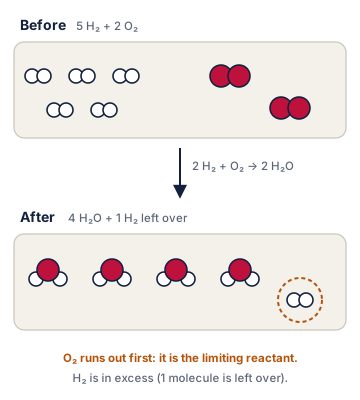
In most real reactions the reactants are not mixed in exactly the ratio of the balanced equation. One of them runs out first.
- The limiting reactant is the reactant that is used up first. It limits how much product can form.
- Any other reactant is in excess: some of it is left over when the reaction stops.
- The theoretical yield is the maximum amount of product, calculated from the limiting reactant.
- The actual yield is the amount of product really obtained in an experiment.
- The percent yield compares the two.
Key idea
The amount of product depends only on the reactant that runs out first, the limiting reactant, not on how much of the other reactants you add.
Why does it matter?
- Chemists choose the limiting reactant on purpose. The most expensive or hardest-to-make reactant is often the limiting one, while a cheap one (such as oxygen from air) is used in excess so that none of the valuable reactant is wasted.
- Percent yield measures efficiency. In the lab and in industry, a low yield means wasted materials, money and energy.
- Excess reactant must be dealt with. Leftover reactant often has to be separated from the product, recycled or disposed of safely.
How does it work?
Finding the limiting reactant
- Convert the amount of each reactant into moles.
- For each reactant, calculate how much product it could make on its own, using the mole ratio from the balanced equation.
- The reactant that gives the smaller amount of product is the limiting reactant. That smaller amount is the theoretical yield.
An equivalent method: take one reactant, calculate how much of the other it needs, and compare that with how much you actually have.
Excess reactant left over
Use the limiting reactant to calculate how much of the excess reactant is used up, then subtract that from the amount you started with.
Percent yield
Both yields must be in the same units (usually grams).
Think of it like this
Making sandwiches needs 2 slices of bread + 1 slice of cheese → 1 sandwich. You have 10 slices of bread but only 3 slices of cheese. The cheese runs out after 3 sandwiches, with 4 slices of bread left over. The cheese is the limiting “reactant”, even though you have fewer slices of it. If you drop one sandwich on the floor and only 2 are eaten, your “percent yield” is 2 ÷ 3 × 100% = 67%.
More precisely
Percent yields are usually below 100% because reactions may not go to completion, side reactions can make unwanted products, and some product is lost while it is separated and purified. A yield above 100% doesn’t mean extra product was created. It signals a problem, for example a product that is still wet or contains impurities.
Visualise it
Worked example
Worked example: Limiting reactant, theoretical yield and excess
Question: 28.0 g of nitrogen and 9.00 g of hydrogen react to make ammonia. Which is the limiting reactant? What mass of ammonia can form, and what mass of the excess reactant is left over? (N = 14.01, H = 1.008)
- Moles: : mol; : mol
- Hydrogen needed by all the nitrogen: mol. We have 4.464 mol, which is more than enough, so nitrogen is the limiting reactant.
- Theoretical yield: mol , and g, which is 34.0 g
- Hydrogen left over: mol, and 2.96 g
Check: 28.0 g + 9.00 g = 37.0 g of reactants, and 34.0 g + 2.96 g = 37.0 g of products and leftovers.
Worked example: Percent yield
Question: In the reaction above, the chemist actually collects 27.2 g of ammonia. What is the percent yield?
- Actual yield = 27.2 g; theoretical yield = 34.04 g (use the unrounded value from the previous calculation)
- Percent yield =
Answer: the percent yield is 79.9%.
Common mistake
Common mistake: Picking the reactant with the smaller mass
In the example, there are 28.0 g of nitrogen but only 9.00 g of hydrogen, yet nitrogen is the limiting reactant. Mass alone tells you nothing; you must compare moles, using the mole ratio.
Common mistake: Picking the reactant with fewer moles
Even fewer moles doesn’t automatically mean limiting. In with 1.0 mol of and 0.6 mol of , the hydrogen needs only 0.50 mol of oxygen, so hydrogen is limiting, even though there are fewer moles of oxygen. Always use the ratio from the balanced equation.
Common mistake: Calculating the yield from the excess reactant
The theoretical yield must come from the limiting reactant. Using the excess reactant overestimates it (in the example, hydrogen alone could make 50.7 g of ammonia, but only 34.0 g can form).
Notation note
- The limiting reactant is also called the limiting reagent; an excess reactant is also called an excess reagent.
- “Yield” can be given as a mass, an amount in moles, or a percentage. Check which one a question asks for.
Remember this
Remember this
- The limiting reactant runs out first and decides how much product forms.
- Compare reactants in moles using the mole ratio, never by mass alone.
- Theoretical yield comes from the limiting reactant.
- Percent yield = actual ÷ theoretical × 100%.
Test yourself
Check your understanding before moving on.
Flashcards
Limiting Reactants: Flashcards
- QuestionWhat is the limiting reactant?Answer
The reactant that is used up first. It limits how much product can form.
- QuestionWhat is an excess reactant?Answer
A reactant that is not used up completely; some is left over when the reaction stops.
- QuestionHow do you find the limiting reactant?Answer
Convert each reactant to moles, calculate how much product each could make, and pick the one that gives less product.
- QuestionWhat is the theoretical yield?Answer
The maximum amount of product that can form, calculated from the limiting reactant.
- QuestionWhat is the formula for percent yield?Answer
Percent yield = (actual yield ÷ theoretical yield) × 100%
- QuestionIs the reactant with the smaller mass always the limiting reactant?Answer
No. Compare moles, using the mole ratio from the balanced equation. Mass alone tells you nothing.
- QuestionIn , 1.0 mol of mixes with 0.6 mol of . Which is limiting?Answer
. It needs only 0.50 mol of , and 0.6 mol is available, so oxygen is in excess.
- QuestionGive three reasons why a percent yield is usually less than 100%.Answer
The reaction may not go to completion; side reactions make other products; some product is lost during separation and purification.
- QuestionWhat does a percent yield above 100% suggest?Answer
An error, for example the product is still wet or contains impurities. Extra product cannot be created.
Tip: press Space to flip and ← → to move between cards.
Quiz
Limiting Reactants: Quiz
7 questions
The limiting reactant runs out first, so it decides how much product can form. The reactant left over at the end is the excess reactant.
Show answer
Answer: The reactant that is used up first
The limiting reactant runs out first, so it decides how much product can form. The reactant left over at the end is the excess reactant.
1.0 mol of needs mol of . There is 0.6 mol available, so oxygen is in excess and hydrogen runs out first, even though there are fewer moles of oxygen.
Show answer
Answer:
1.0 mol of needs mol of . There is 0.6 mol available, so oxygen is in excess and hydrogen runs out first, even though there are fewer moles of oxygen.
All the would need 6.0 mol of , but only 3.0 mol is available, so is limiting: mol of . The answer 4.0 mol uses the excess reactant.
Show answer
Answer: 2.0 mol
All the would need 6.0 mol of , but only 3.0 mol is available, so is limiting: mol of . The answer 4.0 mol uses the excess reactant.
Percent yield = . The answer 118% divides the wrong way round.
Show answer
Answer: 85.0%
Percent yield = . The answer 118% divides the wrong way round.
4.0 mol of needs only 2.0 mol of , so hydrogen is limiting. Oxygen left over = 3.0 − 2.0 = 1.0 mol.
Show answer
Answer: 1.0 mol of
4.0 mol of needs only 2.0 mol of , so hydrogen is limiting. Oxygen left over = 3.0 − 2.0 = 1.0 mol.
Moles: = 16.0 ÷ 16.04 = 0.9974 mol; = 48.0 ÷ 32.00 = 1.50 mol. The methane would need 1.995 mol of , so oxygen is limiting. = 1.50 ÷ 2 = 0.750 mol, and 0.750 × 44.01 = 33.0 g. The answer 43.9 g uses the excess reactant (methane).
Show answer
Answer: 33.0 g
Moles: = 16.0 ÷ 16.04 = 0.9974 mol; = 48.0 ÷ 32.00 = 1.50 mol. The methane would need 1.995 mol of , so oxygen is limiting. = 1.50 ÷ 2 = 0.750 mol, and 0.750 × 44.01 = 33.0 g. The answer 43.9 g uses the excess reactant (methane).
Mass cannot be created, so a yield above 100% signals an error, most often a product that still contains water (solvent) or other substances.
Show answer
Answer: The product was still wet or contained impurities
Mass cannot be created, so a yield above 100% signals an error, most often a product that still contains water (solvent) or other substances.
Notes and downloads
Worksheet
Limiting Reactants Worksheet
8 questions on limiting and excess reactants, theoretical yield and percent yield, in moles and grams. Answer key included.
References
- Brown, T. L.; LeMay, H. E., Jr.; Bursten, B. E.; Murphy, C. J.; Woodward, P. M.; Stoltzfus, M. W. Chemistry: The Central Science, 15th ed.; Pearson, 2022.
Practise this topic with flashcards and a quiz at chemistryclarity.com/chemistry/limiting-reactant/
Spotted a mistake? Let us know and we'll fix it.