What is it?
A redox reaction is one in which electrons are transferred from one substance to another. It always has two halves:
- Oxidation: a loss of electrons. The oxidation number increases.
- Reduction: a gain of electrons. The oxidation number decreases.
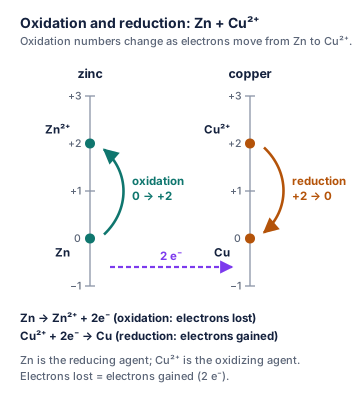
Zinc loses 2 electrons (oxidized); each ion gains 2 electrons (reduced). Oxidation and reduction always happen together: electrons lost by one substance are gained by another.
Key idea
OIL RIG: Oxidation Is Loss, Reduction Is Gain (of electrons). The substance that is oxidized is the reducing agent; the substance that is reduced is the oxidizing agent.
Why does it matter?
- Energy. Batteries, fuel cells, combustion and respiration are all redox reactions.
- Materials. Extracting metals from ores, rusting and corrosion protection depend on redox chemistry.
- Analysis. Redox titrations (for example with potassium permanganate) measure iron, vitamin C and many other substances.
How does it work?
1. Rules for oxidation numbers
An oxidation number is the charge an atom would have if all its bonds were ionic. Apply these rules in order:
- An uncombined element has oxidation number 0 (Zn, , ).
- A monatomic ion has an oxidation number equal to its charge (: +1; : −1).
- Fluorine is always −1. Group 1 metals are +1 and group 2 metals are +2 in compounds.
- Hydrogen is usually +1 (but −1 in metal hydrides such as NaH).
- Oxygen is usually −2 (but −1 in peroxides such as ).
- The oxidation numbers add up to 0 in a neutral compound and to the charge in an ion.
2. Half-equations
Each half-reaction can be written separately, with electrons shown:
- Oxidation:
- Reduction:
Electrons appear on the product side of an oxidation and the reactant side of a reduction.
3. Balancing redox equations in acidic solution
- Split the reaction into two half-equations.
- Balance atoms other than O and H.
- Balance O by adding .
- Balance H by adding .
- Balance charge by adding electrons.
- Multiply the half-equations so the electrons lost = electrons gained, then add them and cancel.
- Check that atoms and charge both balance.
Think of it like this
A redox reaction is like a sale: one person can only sell (give) something if another buys (takes) it. The seller is the reducing agent, giving away electrons; the buyer is the oxidizing agent, taking them. The number of items sold must equal the number bought.
More precisely
Oxidation numbers are a bookkeeping tool, not real charges: in covalent molecules the electrons are shared, not transferred. Some reactions are disproportionations, in which the same element is both oxidized and reduced; for example, in , oxygen goes from −1 to −2 and to 0. In basic solution, balance as in acid and then add to both sides to neutralize the .
Visualise it
Worked example
Worked example: Assigning oxidation numbers
Question: Find the oxidation number of (a) S in (b) Mn in .
- (a) H is +1 and O is −2; the compound is neutral: , so +6.
- (b) O is −2; the ion has charge −1: , so +7.
Worked example: Identifying the agents
Question: In , which species is oxidized and which is the oxidizing agent?
- Al: 0 → +3. The oxidation number increases, so Al is oxidized (it is the reducing agent).
- Cu: +2 → 0. It decreases, so is reduced: is the oxidizing agent.
- Check: 2 Al lose 2 × 3 = 6 electrons; 3 gain 3 × 2 = 6 electrons. ✓
Worked example: Balancing in acidic solution
Question: Balance in acid.
-
Oxidation:
-
Reduction: . Add 4 for oxygen, then 8 for hydrogen, then 5 electrons for charge:
-
Multiply the oxidation by 5 so that 5 electrons are lost and 5 gained, then add:
-
Check charge: left −1 + 8 + 10 = +17; right +2 + 15 = +17. ✓
Common mistake
Common mistake: Mixing up oxidation and reduction
Reduction is a gain of electrons, even though the oxidation number goes down. Use OIL RIG, and remember that the oxidizing agent is itself reduced.
Common mistake: Balancing atoms but not charge
has balanced atoms but not charge (+3 on the left, +4 on the right). The correct equation is .
Common mistake: Assuming oxygen is always −2
In peroxides such as , oxygen is −1; in it is +2, because fluorine always takes −1.
Notation note
- Oxidation numbers are written sign first (+2); ionic charges are written number first (2+).
- Some books use Roman numerals for oxidation numbers in names: iron(III) chloride is , with Fe at +3.
- “e⁻” stands for an electron.
Remember this
Remember this
- OIL RIG: oxidation is loss of electrons (oxidation number up); reduction is gain (oxidation number down).
- Reducing agent = oxidized; oxidizing agent = reduced.
- Oxidation numbers: element 0; ion = charge; F −1; H +1; O −2; sum = overall charge.
- Balance in acid: atoms, then O with H₂O, H with H⁺, charge with e⁻; equalize electrons; check charge.
Test yourself
Check your understanding before moving on.
Flashcards
Oxidation Numbers and Redox Reactions: Flashcards
- QuestionWhat does OIL RIG stand for?Answer
Oxidation Is Loss (of electrons), Reduction Is Gain (of electrons).
- QuestionWhat happens to the oxidation number in oxidation and in reduction?Answer
Oxidation: it increases. Reduction: it decreases.
- QuestionWhat is the oxidation number of an uncombined element, e.g. O₂ or Zn?Answer
0
- QuestionOxidation number of S in H₂SO₄?Answer
+6: 2(+1) + x + 4(−2) = 0
- QuestionOxidation number of Mn in MnO₄⁻?Answer
+7: x + 4(−2) = −1
- QuestionWhat is a reducing agent?Answer
The substance that gives electrons to another; it is itself oxidized.
- QuestionWhat is an oxidizing agent?Answer
The substance that takes electrons from another; it is itself reduced.
- QuestionWrite the half-equation for zinc being oxidized.Answer
- QuestionIn acid, how do you balance O and H in a half-equation?Answer
Add H₂O to balance O, then H⁺ to balance H, then electrons to balance charge.
- QuestionWhat must be checked at the end of balancing a redox equation?Answer
Both atoms and total charge balance, and electrons lost = electrons gained.
Tip: press Space to flip and ← → to move between cards.
Quiz
Oxidation Numbers and Redox Reactions: Quiz
7 questions
(+1) + x + 3(−2) = 0, so x = +5.
Show answer
Answer: +5
(+1) + x + 3(−2) = 0, so x = +5.
Cu²⁺ gains electrons (+2 → 0), so it is reduced and acts as the oxidizing agent. Zn is the reducing agent.
Show answer
Answer: Cu²⁺
Cu²⁺ gains electrons (+2 → 0), so it is reduced and acts as the oxidizing agent. Zn is the reducing agent.
2x + 7(−2) = −2, so 2x = +12 and x = +6. The answer +12 is the total for both Cr atoms.
Show answer
Answer: +6
2x + 7(−2) = −2, so 2x = +12 and x = +6. The answer +12 is the total for both Cr atoms.
In neutralization no oxidation number changes (Na +1, O −2, H +1, Cl −1 throughout). The others all transfer electrons.
Show answer
Answer: NaOH + HCl → NaCl + H₂O
In neutralization no oxidation number changes (Na +1, O −2, H +1, Cl −1 throughout). The others all transfer electrons.
Cu loses 2 electrons and each Fe³⁺ gains 1, so 2 Fe³⁺ are needed. Charge: +6 on the left, +4 + 2 = +6 on the right.
Show answer
Answer: 2Fe³⁺ + Cu → 2Fe²⁺ + Cu²⁺
Cu loses 2 electrons and each Fe³⁺ gains 1, so 2 Fe³⁺ are needed. Charge: +6 on the left, +4 + 2 = +6 on the right.
Mn goes from +7 to +2 (gains 5 electrons); each of the 5 Fe²⁺ loses 1 electron.
Show answer
Answer: 5
Mn goes from +7 to +2 (gains 5 electrons); each of the 5 Fe²⁺ loses 1 electron.
H₂O₂ is a peroxide: 2(+1) + 2x = 0, so x = −1.
Show answer
Answer: −1
H₂O₂ is a peroxide: 2(+1) + 2x = 0, so x = −1.
Notes and downloads
Worksheet
Oxidation Numbers and Redox Reactions Worksheet
9 questions on oxidation numbers, oxidizing and reducing agents, half-equations, balancing redox equations in acid and a redox titration. Answer key included.
References
- Brown, T. L.; LeMay, H. E., Jr.; Bursten, B. E.; Murphy, C. J.; Woodward, P. M.; Stoltzfus, M. W. Chemistry: The Central Science, 15th ed.; Pearson, 2022.
Practise this topic with flashcards and a quiz at chemistryclarity.com/chemistry/redox-reactions/
Spotted a mistake? Let us know and we'll fix it.