What is it?
A chemical equation describes a reaction using formulas. Reactants go on the left of the arrow and products on the right:
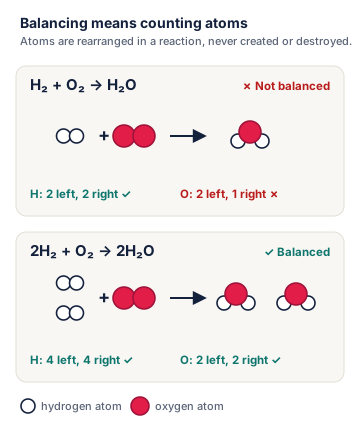
An equation is balanced when every element has the same number of atoms on both sides. You balance an equation by placing whole-number coefficients (the big numbers in front of formulas).
Key idea
In a chemical reaction, atoms are rearranged, never created or destroyed (the law of conservation of mass). A balanced equation shows this: the atoms you start with are exactly the atoms you end with.
Why does it matter?
- It obeys a law of nature. Mass is conserved in every chemical reaction; an unbalanced equation describes something impossible.
- It’s the starting point for calculations. The coefficients give the mole ratios used in stoichiometry. An unbalanced equation gives wrong answers.
- It shows the recipe. tells you hydrogen and oxygen react in a 2 : 1 ratio by molecules (and by moles).
How does it work?
1. Coefficients, not subscripts
- A subscript is part of the formula. It defines which substance it is: is water, is hydrogen peroxide.
- A coefficient says how many units of that substance: means two water molecules, containing 4 H and 2 O atoms in total.
Never change subscripts to balance an equation. That changes the substances, not the amounts.
2. Counting atoms
Multiply the coefficient by each subscript. Brackets multiply everything inside:
- : 3 C and 3 × 2 = 6 O
- : 1 Ca, 2 N and 2 × 3 = 6 O
- : 4 Al, 6 S and 2 × 3 × 4 = 24 O
3. The step-by-step method
- Write the correct formulas of all reactants and products.
- Count the atoms of each element on each side.
- Balance one element at a time by changing coefficients. Start with an element that appears in only one substance on each side, usually a metal. Leave hydrogen and oxygen until last, and leave any element on its own (such as or ) to the very end.
- Re-count every element. Changing one coefficient can unbalance another element.
- Check the coefficients are the smallest whole numbers. If they all share a factor, divide by it.
4. Useful tricks
- Polyatomic ions: if an ion such as or appears unchanged on both sides, balance it as one unit instead of counting S and O separately.
- Odd–even trick: if one side has an odd number of an atom and the other side must be even (as with ), double everything else first.
- Fractions: you can use a fraction such as temporarily, then multiply the whole equation to clear it.
Think of it like this
Balancing an equation is like checking a recipe for building toy models from Lego bricks. You can make more copies of a model (change a coefficient), but you can’t change the design of a model (a subscript). When you’re done, every brick you started with must be used, with none left over and none missing.
More precisely
Coefficients count particles (molecules, atoms or formula units) and therefore also moles. They do not give the ratio of masses: in , about 4 g of hydrogen reacts with 32 g of oxygen, not in a 2 : 1 ratio by mass. Equations can also include state symbols: (s) solid, (l) liquid, (g) gas and (aq) dissolved in water, e.g. . Ionic equations must also balance charge.
Visualise it
Worked example
Worked example: Burning propane
Question: Balance .
- C: 3 on the left, so put 3 in front of :
- H: 8 on the left, so put 4 in front of (4 × 2 = 8):
- O (last, because is an element on its own): right side has 3 × 2 + 4 × 1 = 10 O, so put 5 in front of .
- Balanced: . Check: C 3 = 3, H 8 = 8, O 10 = 10 ✓
Worked example: A polyatomic ion
Question: Balance .
- Pb is already balanced (1 = 1).
- Treat as one unit: 2 on the left, 1 on the right, so put 2 in front of .
- Now K is 2 on the right, so put 2 in front of . That also balances I (2 = 2).
- Balanced: ✓
Worked example: Using the odd–even trick
Question: Balance .
- O: 2 on the left but 3 on the right. Odd and even don’t match, so make the right side even: put 2 in front of (6 O).
- O: 6 on the right, so put 3 in front of .
- Fe: 2 × 2 = 4 on the right, so put 4 in front of .
- Balanced: . Check: Fe 4 = 4, O 6 = 6 ✓
Common mistake
Common mistake: Changing a subscript
To “balance” , writing makes the atoms match, but it turns the product into hydrogen peroxide. Change coefficients only: .
Common mistake: Forgetting to multiply through brackets
contains 3 Ca, 6 O and 6 H, not 3 O and 3 H.
Common mistake: Stopping before re-counting everything
After each change, re-count all the elements. Fixing one element often unbalances another.
Common mistake: Leaving coefficients that can be simplified
has equal atom counts, but it should be simplified to . Use the smallest whole numbers.
Notation note
- A coefficient of 1 is not written: has a coefficient of 1 in front of and .
- Some courses write ”=” or ”⟶” instead of ”→” in equations.
Remember this
Remember this
- Balanced = same number of atoms of each element on both sides (conservation of mass).
- Change coefficients, never subscripts.
- Balance metals and other elements first, then H, then O; leave free elements (e.g. ) to last.
- Treat unchanged polyatomic ions as one unit; use the smallest whole-number coefficients.
Test yourself
Check your understanding before moving on.
Flashcards
Balancing Chemical Equations: Flashcards
- QuestionWhat does it mean for a chemical equation to be balanced?Answer
Every element has the same number of atoms on both sides of the arrow.
- QuestionWhich law requires equations to be balanced?Answer
The law of conservation of mass: atoms are rearranged, never created or destroyed.
- QuestionWhen balancing, do you change coefficients or subscripts?Answer
Coefficients only. Changing a subscript changes the substance.
- QuestionHow many O atoms are in ?Answer
3 × 2 = 6
- QuestionHow many O atoms are in ?Answer
2 × 3 = 6
- QuestionBalance:Answer
- QuestionBalance:Answer
- QuestionBalance:Answer
- QuestionWhich elements are usually best left until last when balancing?Answer
Hydrogen and oxygen, and any element on its own such as or .
- QuestionWhat do the coefficients in a balanced equation tell you?Answer
The ratio of particles (and of moles) that react and form. They do not give the ratio of masses.
Tip: press Space to flip and ← → to move between cards.
Quiz
Balancing Chemical Equations: Quiz
7 questions
This is the law of conservation of mass. The number of molecules can change (2H₂ + O₂ → 2H₂O: 3 molecules become 2), but the atoms cannot.
Show answer
Answer: Atoms are not created or destroyed in a reaction
This is the law of conservation of mass. The number of molecules can change (2H₂ + O₂ → 2H₂O: 3 molecules become 2), but the atoms cannot.
2 × 3 × 4 = 24. The coefficient multiplies the whole formula, and the subscript 3 multiplies everything in the bracket.
Show answer
Answer: 24
2 × 3 × 4 = 24. The coefficient multiplies the whole formula, and the subscript 3 multiplies everything in the bracket.
Cl: 2 on the left, so 2NaCl; then Na: 2 on the right, so 2Na. Changing NaCl to NaCl₂ changes a subscript, which is not allowed.
Show answer
Answer:
Cl: 2 on the left, so 2NaCl; then Na: 2 on the right, so 2Na. Changing NaCl to NaCl₂ changes a subscript, which is not allowed.
C₃H₈ + 5O₂ → 3CO₂ + 4H₂O. The right side has 3 × 2 + 4 × 1 = 10 O atoms, which need 5 O₂.
Show answer
Answer: 5
C₃H₈ + 5O₂ → 3CO₂ + 4H₂O. The right side has 3 × 2 + 4 × 1 = 10 O atoms, which need 5 O₂.
Zn 1 = 1, H 2 = 2, Cl 2 = 2. The others need coefficients: 2HCl, 2Mg + O₂ → 2MgO, and 2H₂O₂ → 2H₂O + O₂.
Show answer
Answer:
Zn 1 = 1, H 2 = 2, Cl 2 = 2. The others need coefficients: 2HCl, 2Mg + O₂ → 2MgO, and 2H₂O₂ → 2H₂O + O₂.
4Al + 3O₂ → 2Al₂O₃: Al 4 = 4 and O 6 = 6. Using 2, 3, 1 leaves O at 6 on the left but only 3 on the right.
Show answer
Answer: 4, 3, 2
4Al + 3O₂ → 2Al₂O₃: Al 4 = 4 and O 6 = 6. Using 2, 3, 1 leaves O at 6 on the left but only 3 on the right.
H₂O₂ is hydrogen peroxide, not water. The correct answer changes coefficients only: 2H₂ + O₂ → 2H₂O.
Show answer
Answer: They changed a subscript, so the product is now a different substance
H₂O₂ is hydrogen peroxide, not water. The correct answer changes coefficients only: 2H₂ + O₂ → 2H₂O.
Notes and downloads
Worksheet
Balancing Chemical Equations Worksheet
9 questions on counting atoms, balancing equations, combustion, polyatomic ions and word equations. Answer key included.
References
- Brown, T. L.; LeMay, H. E., Jr.; Bursten, B. E.; Murphy, C. J.; Woodward, P. M.; Stoltzfus, M. W. Chemistry: The Central Science, 15th ed.; Pearson, 2022.
Practise this topic with flashcards and a quiz at chemistryclarity.com/chemistry/balancing-equations/
Spotted a mistake? Let us know and we'll fix it.