What is it?
Density is the mass of a substance per unit volume. It tells you how tightly matter is packed:
where (the Greek letter rho) is density, is mass and is volume. In chemistry, density is usually given in g/cm³ for solids and g/mL for liquids (these are the same, since 1 mL = 1 cm³). The SI unit is kg/m³, and 1 g/cm³ = 1000 kg/m³.
| Substance (20 °C) | Density (g/cm³) |
|---|---|
| Air | 0.00120 |
| Ethanol | 0.789 |
| Ice (0 °C) | 0.917 |
| Water | 0.998 |
| Aluminium | 2.70 |
| Iron | 7.87 |
| Copper | 8.96 |
| Lead | 11.3 |
| Gold | 19.3 |
Key idea
Density is a property of the substance, not of the object. A paper clip and a steel girder have very different masses, but the same density. That’s why density helps to identify a substance.
Why does it matter?
- Identifying substances. Measuring density is a quick test of what a material is, or whether it is pure: an alloy or a diluted liquid has a different density.
- Floating and sinking. An object floats in a liquid if it is less dense than the liquid. Ice floats on water, oil floats on vinegar, and a ship floats because its average density, including the air inside, is less than that of water.
- Converting between mass and volume. Density is a conversion factor: from a volume of liquid you can find its mass without weighing it, and the reverse.
How does it work?
1. Calculating density
Measure the mass on a balance and the volume by one of the methods below, then divide. Rearranging the formula gives the other two forms:
2. Measuring volume
- Regular solid (cube, block, cylinder): measure the dimensions and calculate. For a block, .
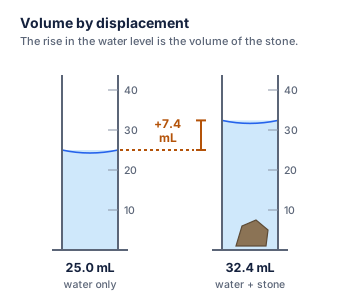
- Irregular solid (a stone, a key): use displacement. Part-fill a measuring cylinder with water, read the volume, lower the object in and read again. The rise in volume equals the volume of the object.
- Liquid: measure a volume accurately with a pipette or measuring cylinder, and weigh it.
3. Floating and sinking
Compare densities. If the object floats; if it sinks. Liquids that don’t mix form layers, with the densest at the bottom.
4. Replicate measurements
As with any measurement, repeat it at least three times (triplicate), then report the mean and the standard deviation. Compare the mean with the accepted value to judge accuracy, and use the standard deviation to judge precision (see Significant Figures and Measurement).
Think of it like this
Think of a lift. Ten people in a big lift and ten people in a small lift are the same “mass”, but the small lift is more crowded. Density is how crowded the matter is: the same mass squeezed into a smaller volume means a higher density.
More precisely
Density changes with temperature, because most substances expand when heated: their volume increases while their mass stays the same. That’s why careful work states the temperature. Water is unusual: it is densest at about 4 °C (1.000 g/mL), and ice is less dense than liquid water, so lakes freeze from the top down and fish survive the winter underneath. Gases are about a thousand times less dense than liquids, and their density depends strongly on pressure too.
Visualise it
Worked example
Worked example: A regular solid
Question: A metal block measures 2.00 cm × 3.00 cm × 5.00 cm and has a mass of 81.0 g. Find its density and suggest which metal it is.
-
Volume:
-
Density:
-
This matches aluminium (2.70 g/cm³).
Worked example: An irregular solid, by displacement
Question: A measuring cylinder holds 25.0 mL of water. A stone of mass 18.5 g is lowered in and the level rises to 32.4 mL. Find the density of the stone.
-
Volume of the stone = rise in level:
-
Density:
-
The volume has only 2 significant figures, so the answer is 2.5 g/cm³.
Worked example: Using density to find a volume
Question: What volume does 500. g of gold occupy? (density 19.3 g/cm³)
Half a kilogram of gold is smaller than a matchbox.
Worked example: Replicate measurements of a liquid
Question: A student weighs three separate 10.00 mL samples of a colourless liquid at 20 °C and calculates densities of 0.791 g/mL, 0.789 g/mL and 0.792 g/mL. Report the result and decide whether the liquid could be ethanol (0.789 g/mL).
-
Mean:
-
Standard deviation, from the deviations +0.0003 g/mL, −0.0017 g/mL and +0.0013 g/mL:
-
Result: 0.791 ± 0.002 g/mL (n = 3). The difference from ethanol, 0.791 g/mL − 0.789 g/mL = 0.002 g/mL, is about the size of the standard deviation, so the result is consistent with ethanol.
Worked example: Will it float?
Question: A plastic toy has a mass of 50.0 g and a volume of 62.5 cm³. Does it float in water (0.998 g/cm³)?
0.800 g/cm³ is less than 0.998 g/cm³, so it floats.
Common mistake
Common mistake: Dividing the wrong way round
Density is mass ÷ volume, not volume ÷ mass. Check the units: the answer must come out in g/cm³ (mass on top). If you get cm³/g, the fraction is upside down.
Common mistake: Using the final reading as the volume
In displacement, the volume of the object is the difference between the two readings (32.4 mL − 25.0 mL), not the final reading of 32.4 mL.
Common mistake: Confusing heavy with dense
A large log is heavier than a small iron nail, yet the log floats and the nail sinks. Floating depends on density, not on mass.
Notation note
- g/cm³ can also be written g cm⁻³; g/mL and g/cm³ are numerically identical.
- Always state the temperature with a precise density, for example “0.998 g/mL at 20 °C”.
Remember this
Remember this
- ; rearranged, and .
- 1 mL = 1 cm³, so g/mL = g/cm³; 1 g/cm³ = 1000 kg/m³.
- Volume of an irregular solid = rise in level when it is submerged (displacement).
- Less dense than the liquid: floats. Denser: sinks.
- Density depends on temperature: state it, and measure in replicate (mean ± standard deviation).
Test yourself
Check your understanding before moving on.
Flashcards
Density: Flashcards
- QuestionWhat is density?Answer
Mass per unit volume:
- QuestionRearrange to give mass and volume.Answer
and
- QuestionWhich units are used for density in chemistry?Answer
g/cm³ for solids and g/mL for liquids (the same, since 1 mL = 1 cm³). SI unit: kg/m³.
- QuestionConvert 1 g/cm³ to kg/m³.Answer
1 g/cm³ = 1000 kg/m³
- QuestionHow do you measure the volume of an irregular solid?Answer
By displacement: the rise in the water level in a measuring cylinder when the object is submerged.
- QuestionWhen does an object float in a liquid?Answer
When its density is less than the density of the liquid.
- QuestionA block of 81.0 g measures 2.00 cm × 3.00 cm × 5.00 cm. What is its density?Answer
81.0 g ÷ 30.0 cm³ = 2.70 g/cm³ (aluminium)
- QuestionWhy must you state the temperature with a precise density?Answer
Most substances expand when heated, so their volume rises and their density falls.
- QuestionAt what temperature is water densest?Answer
About 4 °C (1.000 g/mL). Ice (0.917 g/cm³) is less dense than water, so it floats.
- QuestionHow should a measured density be reported?Answer
As the mean ± standard deviation of replicate measurements (at least three), with n and the temperature.
Tip: press Space to flip and ← → to move between cards.
Quiz
Density: Quiz
7 questions
Density is mass per unit volume, so ρ = m / V. Check the units: g ÷ cm³ gives g/cm³.
Show answer
Answer: ρ = m / V
Density is mass per unit volume, so ρ = m / V. Check the units: g ÷ cm³ gives g/cm³.
ρ = 54.0 g ÷ 20.0 cm³ = 2.70 g/cm³. 0.370 is the fraction upside down (cm³/g).
Show answer
Answer: 2.70 g/cm³
ρ = 54.0 g ÷ 20.0 cm³ = 2.70 g/cm³. 0.370 is the fraction upside down (cm³/g).
The volume of the object is the rise in level: 45.2 mL − 30.0 mL = 15.2 mL (= 15.2 cm³).
Show answer
Answer: 15.2 mL
The volume of the object is the rise in level: 45.2 mL − 30.0 mL = 15.2 mL (= 15.2 cm³).
20.0 g ÷ 25.0 cm³ = 0.800 g/cm³, less than water, so it floats. The others are 1.20 g/cm³, 5.00 g/cm³ and 3.00 g/cm³: all sink.
Show answer
Answer: Mass 20.0 g, volume 25.0 cm³
20.0 g ÷ 25.0 cm³ = 0.800 g/cm³, less than water, so it floats. The others are 1.20 g/cm³, 5.00 g/cm³ and 3.00 g/cm³: all sink.
m = ρV = 0.789 g/mL × 200. mL = 157.8 g, which is 158 g to 3 significant figures. 253 g comes from dividing (200. ÷ 0.789).
Show answer
Answer: 158 g
m = ρV = 0.789 g/mL × 200. mL = 157.8 g, which is 158 g to 3 significant figures. 253 g comes from dividing (200. ÷ 0.789).
Ice (0.917 g/cm³) is less dense than liquid water (about 1.00 g/mL) because water molecules are held further apart in the ice structure. Floating depends on density, not on mass.
Show answer
Answer: Ice is less dense than liquid water
Ice (0.917 g/cm³) is less dense than liquid water (about 1.00 g/mL) because water molecules are held further apart in the ice structure. Floating depends on density, not on mass.
Mean = 13.50 g/cm³ ÷ 5 = 2.70 g/cm³. Sample standard deviation s = 0.016 g/cm³, which rounds to 0.02 g/cm³. ±0.04 is the range (2.72 − 2.68), not the standard deviation.
Show answer
Answer: 2.70 ± 0.02 g/cm³ (n = 5)
Mean = 13.50 g/cm³ ÷ 5 = 2.70 g/cm³. Sample standard deviation s = 0.016 g/cm³, which rounds to 0.02 g/cm³. ±0.04 is the range (2.72 − 2.68), not the standard deviation.
Notes and downloads
Worksheet
Density Worksheet
8 questions on calculating density, displacement, floating and sinking, using density as a conversion factor and replicate measurements. Answer key included.
References
- Bureau International des Poids et Mesures (BIPM). The International System of Units (SI), 9th ed.; BIPM, 2019. Link
- Brown, T. L.; LeMay, H. E., Jr.; Bursten, B. E.; Murphy, C. J.; Woodward, P. M.; Stoltzfus, M. W. Chemistry: The Central Science, 15th ed.; Pearson, 2022.
Practise this topic with flashcards and a quiz at chemistryclarity.com/chemistry/density/
Spotted a mistake? Let us know and we'll fix it.