What is it?
Every measurement has some uncertainty. A balance that reads 12.47 g is certain about 12.4 and estimates the last digit, 7. The significant figures (sig figs) in a number are all the digits known with certainty plus one estimated digit.
A measurement therefore has three parts: a number, a unit, and an implied uncertainty. 12.47 g and 12.5 g describe the same object, but the first was measured more precisely.
Key idea
The number of significant figures shows how precisely something was measured. A calculated answer can never be more precise than the measurements it came from.
Why does it matter?
- Honest results. Writing 2.8409090 g/mL when your data supports only 2.84 g/mL claims a precision you don’t have.
- Comparing data. Significant figures tell another scientist how far to trust your numbers.
- Exams and lab reports. Answers are expected to the correct number of significant figures, with units.
How does it work?
1. Counting significant figures
| Rule | Example | Sig figs |
|---|---|---|
| Non-zero digits are always significant | 4.56 g | 3 |
| Zeros between non-zero digits are significant | 1.05 m | 3 |
| Leading zeros (before the first non-zero digit) are not | 0.0042 L | 2 |
| Trailing zeros after a decimal point are significant | 2.500 mL | 4 |
| Trailing zeros in a whole number with no decimal point are ambiguous | 1200 m | 2, 3 or 4 |
Exact numbers have unlimited significant figures: counted numbers (3 beakers) and defined relationships (1 km = 1000 m; 1 in = 2.54 cm exactly). They never limit an answer.
2. Scientific notation
Scientific notation removes the ambiguity: every digit written in the first part is significant.
- 0.000 520 m = m (3 sig figs)
- 1200 m to 3 sig figs = m
3. Calculations
| Operation | Rule | Example |
|---|---|---|
| × and ÷ | answer has the fewest significant figures of the inputs | 4.56 cm × 1.4 cm = 6.384 cm² → 6.4 cm² (2 s.f.) |
| + and − | answer has the fewest decimal places of the inputs | 25.12 g + 3.4 g = 28.52 g → 28.5 g (1 d.p.) |
In a calculation with several steps, keep extra digits in the intermediate results and round only the final answer.
4. Rounding
Look at the digits you are dropping:
| Dropped part | Rule | Example (to 3 s.f.) |
|---|---|---|
| less than half (starts with 0–4) | keep the last digit | 0.0012349 m → 0.00123 m |
| more than half (5 followed by any non-zero digit, or 6–9) | round up | 2.4562 g → 2.46 g |
| exactly half (5, 50, 500…) | round to the even digit | 2.345 g → 2.34 g; 2.355 g → 2.36 g |
The “round half to even” rule means that, over many results, exact halves are rounded up and down equally often, so averages are not pushed upward. Note that most calculators and spreadsheet ROUND functions always round an exact 5 up, so apply this rule yourself.
5. Accuracy, precision and replicate measurements
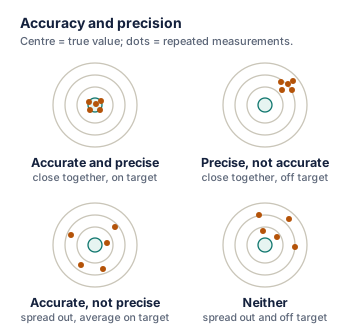
- Accuracy: how close a result is to the true (accepted) value.
- Precision: how close repeated measurements are to each other.
A single measurement cannot show its own precision. That’s why careful work uses replicate measurements: the same measurement repeated, usually in triplicate (3 times) or quintuplicate (5 times), or more. From the replicates:
- The mean, , is the best estimate of the value. Comparing it with the accepted value, , measures accuracy: error , and percent error .
- The standard deviation, , measures precision: a small means the replicates agree closely. The relative standard deviation (RSD) lets you compare the precision of results of different sizes.
Two kinds of error affect results. Random errors scatter replicates on both sides of the mean and lower precision. Systematic errors (for example a badly calibrated balance) shift every result the same way and lower accuracy, even when the precision is excellent.
Think of it like this
Measuring with a ruler marked only in centimetres is like reading a clock with only an hour hand: you can estimate “about half past”, but not the exact minute. A ruler marked in millimetres lets you estimate one more digit, so your measurement has one more significant figure.
More precisely
Significant figures are a simple way to show uncertainty. In research, uncertainty is stated explicitly, usually as the mean ± the standard deviation (for example 10.04 ± 0.02 mL, n = 5), and is combined through calculations using statistics. The standard deviation uses (the “sample” standard deviation) because the mean was calculated from the same data. With only two measurements it means little, which is why at least three replicates are recommended.
Visualise it
Worked example
Worked example: Counting significant figures
Question: How many significant figures are in (a) 0.00420 g (b) 105.0 mL (c) J?
- 0.00420 g: leading zeros don’t count; the trailing zero after the decimal point does: 3.
- 105.0 mL: the zero between 1 and 5 counts, and so does the trailing zero after the decimal point: 4.
- J: every digit in 3.010 counts: 4.
Worked example: Multiplying and dividing
Question: A sample has a mass of 10.0 g and a volume of 3.52 mL. What is its density?
- Both inputs have 3 sig figs, so the answer has 3: 2.84 g/mL.
Worked example: Adding
Question: Masses of 12.0 g, 0.335 g and 4.5 g are added to a beaker. What is the total mass?
- The fewest decimal places is one (12.0 g and 4.5 g), so the answer is 16.8 g.
Worked example: Assessing accuracy and precision from replicates
Question: A student checks a 10.00 mL pipette by delivering water five times (quintuplicate) and finds the volumes 10.05 mL, 10.02 mL, 10.06 mL, 10.03 mL and 10.04 mL. Assess the accuracy and precision.
-
Mean: the sum is 10.05 mL + 10.02 mL + 10.06 mL + 10.03 mL + 10.04 mL = 50.20 mL, so
-
Deviations from the mean: +0.01 mL, −0.02 mL, +0.02 mL, −0.01 mL and 0.00 mL. Their squares are 0.0001 mL², 0.0004 mL², 0.0004 mL², 0.0001 mL² and 0.0000 mL², which add up to 0.0010 mL².
-
Standard deviation:
-
RSD (the units of mL cancel): very precise.
-
Error , a percent error of . The error is more than twice the standard deviation, so the pipette has a small systematic error: it delivers slightly too much.
Answer: mL (n = 5): precise, but slightly inaccurate.
Common mistake
Common mistake: Copying every digit from the calculator
, but 3.0 mL has only 2 sig figs, so the answer is 33 g/mL.
Common mistake: Using the sig-fig rule for addition
For addition and subtraction, count decimal places, not significant figures: 6.38 cm − 2.1 cm = 4.28 cm → 4.3 cm.
Common mistake: Dropping significant zeros
A volume of a cube with side 2.00 cm is , not 8 cm³. The zeros show the precision.
Notation note
- “s.f.” or “sig figs” = significant figures; “d.p.” = decimal places.
- A decimal point after a whole number, as in “100.” or “500. nm”, shows that the trailing zeros are significant (3 sig figs).
Remember this
Remember this
- Sig figs = certain digits + one estimated digit. Leading zeros never count; trailing zeros after a decimal point always do.
- × and ÷: fewest significant figures. + and −: fewest decimal places.
- Exact numbers (counts, definitions) don’t limit precision. Round only the final answer; round an exact 5 to the even digit.
- Accuracy: mean close to the true value (error). Precision: replicates close to each other (standard deviation).
- Measure in replicate (at least triplicate) and report mean ± standard deviation with the number of measurements.
Test yourself
Check your understanding before moving on.
Flashcards
Significant Figures: Flashcards
- QuestionWhat are significant figures?Answer
The digits in a measurement that are known with certainty, plus one estimated digit.
- QuestionHow many significant figures in 0.0042 L?Answer
2 (leading zeros are not significant)
- QuestionHow many significant figures in 2.500 mL?Answer
4 (trailing zeros after a decimal point are significant)
- QuestionHow many significant figures in 1.05 m?Answer
3 (a zero between non-zero digits is significant)
- QuestionRule for multiplying and dividing?Answer
The answer has the fewest significant figures of the measured inputs.
- QuestionRule for adding and subtracting?Answer
The answer has the fewest decimal places of the measured inputs.
- QuestionWrite 0.000 520 m in scientific notation.Answer
m (3 significant figures)
- QuestionDo exact numbers (such as 1 km = 1000 m) limit significant figures?Answer
No. Exact numbers have unlimited significant figures.
- QuestionWhat is the difference between accuracy and precision?Answer
Accuracy: closeness to the true value. Precision: closeness of repeated measurements to each other.
- Question25.12 g + 3.4 g = ?Answer
28.5 g (one decimal place, like 3.4 g)
- QuestionRound 2.345 g and 2.355 g to three significant figures.Answer
2.34 g and 2.36 g. An exact 5 is rounded to the even digit (round half to even).
- QuestionWhy are measurements made in replicate (e.g. triplicate or quintuplicate)?Answer
One measurement cannot show its precision. Replicates give a mean (best value) and a standard deviation (precision).
- QuestionWhich statistic measures accuracy and which measures precision?Answer
Accuracy: the error, mean − true value. Precision: the standard deviation (or relative standard deviation).
- QuestionWhich kind of error lowers accuracy but not precision?Answer
A systematic error, e.g. a badly calibrated balance shifts every result the same way.
Tip: press Space to flip and ← → to move between cards.
Quiz
Significant Figures: Quiz
9 questions
Leading zeros (0.0) do not count. 3, 0 (between non-zero digits), 5 and the trailing 0 after the decimal point do: 4.
Show answer
Answer: 4
Leading zeros (0.0) do not count. 3, 0 (between non-zero digits), 5 and the trailing 0 after the decimal point do: 4.
4.56 cm × 1.4 cm = 6.384 cm². For multiplication, use the fewest significant figures: 1.4 cm has 2, so 6.4 cm².
Show answer
Answer: 6.4 cm²
4.56 cm × 1.4 cm = 6.384 cm². For multiplication, use the fewest significant figures: 1.4 cm has 2, so 6.4 cm².
For subtraction, use the fewest decimal places: 2.1 cm has one, so 4.28 cm rounds to 4.3 cm.
Show answer
Answer: 4.3 cm
For subtraction, use the fewest decimal places: 2.1 cm has one, so 4.28 cm rounds to 4.3 cm.
The first three significant digits are 1, 2, 3. The next digit is 4 (less than 5), so the 3 stays: 0.00123 m.
Show answer
Answer: 0.00123 m
The first three significant digits are 1, 2, 3. The next digit is 4 (less than 5), so the 3 stays: 0.00123 m.
10.0 g ÷ 3.52 mL = 2.8409 g/mL. Both inputs have 3 significant figures, so 2.84 g/mL.
Show answer
Answer: 2.84 g/mL
10.0 g ÷ 3.52 mL = 2.8409 g/mL. Both inputs have 3 significant figures, so 2.84 g/mL.
Mean = 4.81 g and standard deviation = 0.008 g, so the readings agree closely (precise). But the error is 4.81 g − 5.000 g = −0.19 g, far larger than the standard deviation (not accurate): a systematic error such as poor calibration.
Show answer
Answer: precise but not accurate
Mean = 4.81 g and standard deviation = 0.008 g, so the readings agree closely (precise). But the error is 4.81 g − 5.000 g = −0.19 g, far larger than the standard deviation (not accurate): a systematic error such as poor calibration.
In scientific notation every written digit counts: 3.00 has 3. "300 m" is ambiguous, 0.3 m has 1, and "3000." has 4.
Show answer
Answer: 3.00 × 10² m
In scientific notation every written digit counts: 3.00 has 3. "300 m" is ambiguous, 0.3 m has 1, and "3000." has 4.
The dropped part is exactly 5, and the last kept digit (6) is already even, so it stays: 4.36 g. (4.375 g would round to 4.38 g.)
Show answer
Answer: 4.36 g
The dropped part is exactly 5, and the last kept digit (6) is already even, so it stays: 4.36 g. (4.375 g would round to 4.38 g.)
Replicates reveal random scatter (precision) and give a better mean. They cannot remove a systematic error: that needs calibration against an accepted value.
Show answer
Answer: To calculate a mean and a standard deviation, which show the best value and the precision
Replicates reveal random scatter (precision) and give a better mean. They cannot remove a systematic error: that needs calibration against an accepted value.
Notes and downloads
Worksheet
Significant Figures Worksheet
9 questions on counting significant figures, scientific notation, rounding and calculations with measurements. Answer key included.
References
- Brown, T. L.; LeMay, H. E., Jr.; Bursten, B. E.; Murphy, C. J.; Woodward, P. M.; Stoltzfus, M. W. Chemistry: The Central Science, 15th ed.; Pearson, 2022.
Practise this topic with flashcards and a quiz at chemistryclarity.com/chemistry/significant-figures/
Spotted a mistake? Let us know and we'll fix it.