Worksheet
Temperature Scales Worksheet
9 questions on converting between °C, °F and K, temperature changes, and where the scales meet. Answer key included.
- Type
- Worksheet
- Level
- Beginner
- Format
- PDF, ready to print
Preview the questions
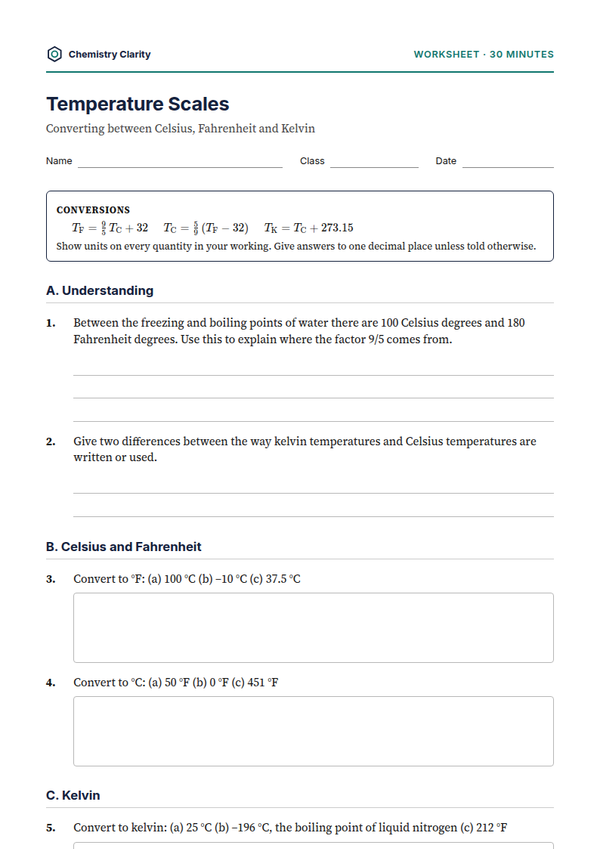
All the questions on this worksheet (about 30 minutes). Download the PDF to print it with space for working; the free answer key has full worked solutions.
A. Understanding
1.
Between the freezing and boiling points of water there are 100 Celsius degrees and 180 Fahrenheit degrees. Use this to explain where the factor 9/5 comes from.
2.
Give two differences between the way kelvin temperatures and Celsius temperatures are written or used.
B. Celsius and Fahrenheit
3.
Convert to °F: (a) 100 °C (b) −10 °C (c) 37.5 °C
4.
Convert to °C: (a) 50 °F (b) 0 °F (c) 451 °F
C. Kelvin
5.
Convert to kelvin: (a) 25 °C (b) −196 °C, the boiling point of liquid nitrogen (c) 212 °F
6.
A gas is at 300 K. Express this temperature in °C and in °F.
D. Temperature changes
7.
During a day the temperature rises by 15 °C. What is this rise in kelvin and in °F?
E. Where the scales meet
8.
Show algebraically that the Celsius and Fahrenheit scales give the same number at −40. Then check your answer by converting −40 °C to °F.
9.
Challenge: there is also a temperature at which the kelvin and Fahrenheit numbers are equal. Find it, and give it in °C. Is there a temperature at which kelvin and Celsius numbers are equal? Explain.