What is it?
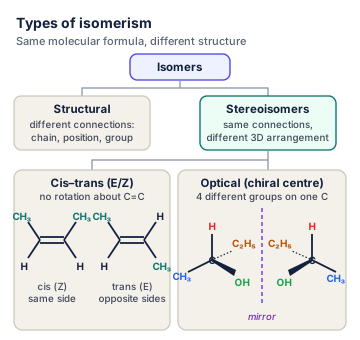
Isomers are compounds with the same molecular formula but different structures. There are two main kinds:
- Structural isomers have their atoms joined in a different order (different chains, positions of a group, or functional groups), for example butane and methylpropane.
- Stereoisomers have the atoms joined in the same order, but arranged differently in space.
There are two types of stereoisomerism:
- Cis–trans (geometric, E/Z) isomerism, caused by restricted rotation around a C=C double bond (or a ring).
- Optical isomerism, caused by a chiral centre: a carbon atom bonded to four different groups.
Key idea
Stereoisomers can only be told apart in three dimensions. Cis–trans isomers exist because a C=C double bond cannot rotate; optical isomers exist because a carbon with four different groups has two mirror-image arrangements that cannot be superimposed, like a left and a right hand.
Why does it matter?
- Medicines. Many drugs work like a key in a lock: only one mirror-image form fits the target in the body. The active form of ibuprofen is one enantiomer; the tragedy of thalidomide (1950s–60s) involved two enantiomers with different effects.
- Smell and taste. One form of limonene smells of oranges, its mirror image of lemons; one form of carvone smells of spearmint, the other of caraway.
- Properties. Cis and trans isomers have different boiling points, melting points and shapes, which matters in fats (cis and trans fats).
How does it work?
1. Cis–trans isomerism
A C=C double bond contains a π bond, so the carbons cannot rotate relative to each other. If each carbon of the double bond carries two different groups, two isomers exist:
- cis: the two similar groups on the same side of the double bond;
- trans: on opposite sides.
But-2-ene () has cis and trans isomers. But-1-ene () does not, because one carbon carries two identical H atoms.
2. The E/Z system
When the groups are all different, “cis” and “trans” are ambiguous. The E/Z system ranks the two groups on each carbon separately, using the Cahn–Ingold–Prelog (CIP) priority rules (section 4). The first rule is simply: higher atomic number = higher priority.
- Z (zusammen, together): the two higher-priority groups are on the same side.
- E (entgegen, opposite): they are on opposite sides.
3. Optical isomerism
A carbon bonded to four different atoms or groups is a chiral centre (often marked with an asterisk, C*). The molecule and its mirror image are non-superimposable: they are enantiomers. Enantiomers have identical boiling points, melting points and most chemical reactions, but they:
- rotate the plane of plane-polarized light in opposite directions (they are optically active);
- can behave differently with other chiral molecules, such as enzymes and receptors in the body.
A 50 : 50 mixture of two enantiomers is a racemic mixture; it does not rotate polarized light, because the two effects cancel.
4. The Cahn–Ingold–Prelog (CIP) priority rules
Both E/Z and R/S labels depend on ranking groups. Apply these rules in order, stopping as soon as the groups are ranked:
- Look at the atom directly attached. Higher atomic number = higher priority: I > Br > Cl > S > F > O > N > C > H. (For isotopes, the heavier wins: D > H.)
- If there is a tie, move outwards. For each tied group, list the three atoms attached to that first atom, highest first, and compare the lists item by item. The first point of difference decides.
- is (C, H, H) and beats , which is (H, H, H).
- is (O, H, H) and beats , which is (C, C, H), because O beats C at the first comparison; you never add up the atoms.
- Count multiple bonds as duplicated atoms. A double bond counts as two single bonds to the same element: C=O is treated as C attached to (O, O); C≡N as (N, N, N).
- is (O, O, O); is (O, O, H); so beats .
5. Assigning R or S: step by step
Each chiral centre is labelled R or S, and the label becomes part of the name, for example (R)-butan-2-ol.
- Find the chiral centre: the carbon with four different groups.
- Rank the four groups 1 (highest) to 4 (lowest) with the CIP rules.
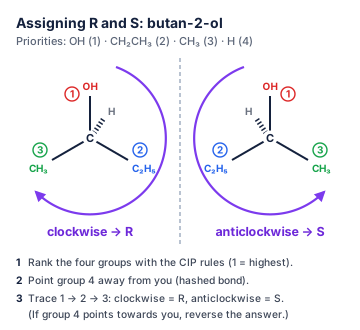
- Point group 4 away from you. In a wedge-and-dash drawing it should be on the hashed bond. (Group 4 is very often H.)
- Trace a path from 1 to 2 to 3, ignoring group 4.
- Read the direction: clockwise = R (rectus, right); anticlockwise = S (sinister, left).
- If group 4 points towards you (on a solid wedge), work out the direction as drawn and then reverse it: clockwise means S, anticlockwise means R.
A helpful check: swapping any two groups on a chiral centre turns R into S (and S into R).
Think of it like this
Your hands are the classic chiral objects: they are mirror images, but no matter how you turn them, a left hand never fits exactly over a right one. A left-hand glove won’t fit a right hand, just as one enantiomer of a drug may not fit its target in the body.
More precisely
R and S describe the arrangement in space; the sign of optical rotation, + or −, is measured with a polarimeter. The two are not linked: some R compounds rotate light to the right (+) and others to the left (−). Older books label amino acids and sugars D or L instead, a system based on comparison with glyceraldehyde. Molecules can have more than one chiral centre; a molecule with chiral centres can have up to stereoisomers.
Visualise it
Worked example
Worked example: Which alkenes show cis–trans isomerism?
Question: Which of these show cis–trans isomerism: (a) propene, (b) 1,2-dichloroethene, (c) 2-methylbut-2-ene, ?
- (a) The first carbon has two H atoms: no.
- (b) Each carbon has H and Cl (two different groups): yes, cis and trans forms. Their boiling points differ: cis 60 °C, trans 48 °C, because the cis isomer is polar.
- (c) One carbon has two groups: no.
Worked example: Assigning E or Z
Question: In , the Cl and Br atoms are on the same side of the double bond. Is this the E or the Z isomer?
- On one carbon, Cl (atomic number 17) outranks H (1).
- On the other carbon, Br (35) outranks H (1).
- The two higher-priority atoms, Cl and Br, are on the same side: Z.
Worked example: Finding a chiral centre
Question: Which carbon in butan-2-ol, , is a chiral centre?
Carbon 2 is bonded to four different groups: , , and . It is a chiral centre, so butan-2-ol exists as two enantiomers. No other carbon qualifies: each of the others carries at least two H atoms.
Worked example: Ranking groups with the CIP rules
Question: Rank the four groups on the chiral carbon of alanine, .
- Attached atoms: N (in ), C (in ), C (in ) and H.
- N has the highest atomic number: is 1. H is lowest: 4.
- Tie between the two carbons: is (O, O, O), counting C=O twice; is (H, H, H). So is 2 and is 3.
Worked example: Assigning R or S
Question: A drawing of butan-2-ol shows the chiral carbon with H on a hashed bond (pointing away), OH at the top, at the lower right and at the lower left. Is it R or S?
- Priorities: 1 (O); 2 (C, H, H); 3 (H, H, H); 4.
- Group 4 (H) already points away from you.
- Trace 1 → 2 → 3: top → lower right → lower left. That is clockwise, so the molecule is (R)-butan-2-ol (the left-hand molecule in the figure).
- If the same drawing had H on a solid wedge (towards you), the clockwise path would have to be reversed: it would be S.
Worked example: E or Z with a tie-break
Question: In 3-methylpent-2-ene, , the on carbon 2 and the on carbon 3 are on the same side. Is it E or Z?
- Carbon 2 carries and : has the higher priority.
- Carbon 3 carries and : both start with C, so move outwards: (C, H, H) beats (H, H, H), so has the higher priority.
- The two higher-priority groups are on the same side: Z.
Worked example: Amino acids
Question: Explain why alanine, , is chiral but glycine, , is not.
The central carbon in alanine carries , , and : four different groups, so it is chiral. In glycine, the central carbon carries two H atoms, so it is not.
Common mistake
Common mistake: Forgetting that both carbons need two different groups
Cis–trans isomerism needs two different groups on each carbon of the double bond. If either carbon has two identical groups (such as two H atoms), there is only one form.
Common mistake: Calling any carbon with four bonds chiral
A chiral centre needs four different groups. A or carbon is never chiral, because it has at least two identical H atoms.
Common mistake: Thinking E always means trans
E/Z depends on priority, not on which groups look alike. In some molecules the E isomer has the similar groups on the same side, so “E = trans” is only true when the two pairs of groups are the same.
Common mistake: Forgetting to reverse when group 4 points towards you
The clockwise = R rule only works when the lowest-priority group points away from you. If it is on a solid wedge, the answer you read off must be reversed.
Common mistake: Adding up atoms in a tie-break
CIP ranking compares atoms one at a time, highest first, and stops at the first difference. (O, H, H) beats (C, C, C), because O beats C straight away.
Common mistake: Thinking R means (+)
R and S come from the 3D arrangement; + and − come from an experiment with polarized light. There is no simple link between them.
Notation note
- Wedges (▲) point towards you; hashed wedges point away; plain lines lie in the page.
- A chiral centre is often marked with an asterisk: C*.
Remember this
Remember this
- Structural isomers: different connections. Stereoisomers: same connections, different 3D arrangement.
- Cis–trans needs a C=C (no rotation) with two different groups on each carbon.
- CIP rules: higher atomic number first; if tied, move outwards and compare at the first difference; multiple bonds count as duplicated atoms.
- E/Z: rank the two groups on each carbon; Z = higher priorities together; E = opposite.
- R/S: rank 1–4, point 4 away, trace 1 → 2 → 3: clockwise R, anticlockwise S (reverse if 4 points towards you).
- A chiral centre has four different groups; it gives a pair of non-superimposable mirror images (enantiomers).
- Enantiomers rotate plane-polarized light in opposite directions; a racemic mixture does not rotate it.
Test yourself
Check your understanding before moving on.
Flashcards
Stereoisomerism: Flashcards
- QuestionWhat is the difference between structural isomers and stereoisomers?Answer
Structural: atoms joined in a different order. Stereoisomers: same order, different arrangement in space.
- QuestionWhy can C=C double bonds give cis–trans isomers?Answer
The π bond prevents rotation about the double bond.
- QuestionWhat condition is needed for cis–trans isomerism in an alkene?Answer
Each carbon of the C=C must carry two different groups.
- QuestionDoes but-1-ene show cis–trans isomerism?Answer
No: one carbon of the double bond has two H atoms.
- QuestionWhat do Z and E mean?Answer
Z: higher-priority groups on the same side. E: on opposite sides. Priority = higher atomic number.
- QuestionWhat is a chiral centre?Answer
A carbon atom bonded to four different atoms or groups.
- QuestionWhat are enantiomers?Answer
A pair of non-superimposable mirror-image molecules.
- QuestionHow do enantiomers differ in their properties?Answer
They rotate plane-polarized light in opposite directions and can interact differently with other chiral molecules (e.g. enzymes).
- QuestionWhat is a racemic mixture?Answer
A 50 : 50 mixture of two enantiomers; it does not rotate plane-polarized light.
- QuestionWhich carbon in butan-2-ol is chiral?Answer
Carbon 2, bonded to H, OH, CH₃ and CH₂CH₃.
- QuestionState the three CIP priority rules.Answer
1. Higher atomic number of the attached atom wins. 2. If tied, move outwards and compare at the first difference. 3. Multiple bonds count as duplicated atoms.
- QuestionHow do you assign R or S to a chiral centre?Answer
Rank groups 1–4; point group 4 away; trace 1 → 2 → 3. Clockwise = R, anticlockwise = S. If 4 points towards you, reverse the answer.
- QuestionRank –COOH, –CHO, –CH₂OH and –CH₃.Answer
–COOH (O,O,O) > –CHO (O,O,H) > –CH₂OH (O,H,H) > –CH₃ (H,H,H).
- QuestionDoes R mean the compound rotates light clockwise (+)?Answer
No. R/S comes from the 3D arrangement; + / − is measured with a polarimeter. They are not linked.
Tip: press Space to flip and ← → to move between cards.
Quiz
Stereoisomerism: Quiz
11 questions
Both are C₄H₁₀ but the carbon atoms are joined differently (straight chain versus branched).
Show answer
Answer: structural isomers
Both are C₄H₁₀ but the carbon atoms are joined differently (straight chain versus branched).
Each carbon of the double bond in but-2-ene carries two different groups (H and CH₃). The others have a carbon with two H atoms.
Show answer
Answer: But-2-ene, CH₃CH=CHCH₃
Each carbon of the double bond in but-2-ene carries two different groups (H and CH₃). The others have a carbon with two H atoms.
Rotating about a double bond would break the side-on overlap of the π bond, so the groups are locked in place.
Show answer
Answer: The π bond in C=C prevents rotation
Rotating about a double bond would break the side-on overlap of the π bond, so the groups are locked in place.
In butan-2-ol, carbon 2 has four different groups (H, OH, CH₃, C₂H₅). In propan-2-ol the central carbon has two identical CH₃ groups.
Show answer
Answer: CH₃CH(OH)CH₂CH₃
In butan-2-ol, carbon 2 has four different groups (H, OH, CH₃, C₂H₅). In propan-2-ol the central carbon has two identical CH₃ groups.
On each carbon the halogen outranks H. The two higher-priority atoms (Cl and Br) are on opposite sides: E.
Show answer
Answer: E
On each carbon the halogen outranks H. The two higher-priority atoms (Cl and Br) are on opposite sides: E.
Enantiomers have identical physical properties except that they rotate plane-polarized light in opposite directions (and interact differently with other chiral molecules).
Show answer
Answer: Direction of rotation of plane-polarized light
Enantiomers have identical physical properties except that they rotate plane-polarized light in opposite directions (and interact differently with other chiral molecules).
The two equal and opposite rotations cancel out.
Show answer
Answer: Equal amounts of the two enantiomers rotate the light equally in opposite directions
The two equal and opposite rotations cancel out.
Compare the attached atoms: O (8) beats N (7), which beats C (6). So –OH is highest.
Show answer
Answer: –OH
Compare the attached atoms: O (8) beats N (7), which beats C (6). So –OH is highest.
Both start with C. Compare the attached sets: (O, H, H) versus (C, C, H). The first atoms differ, O against C, so –CH₂OH wins. Atoms are not added up.
Show answer
Answer: –CH₂OH, because O beats C at the first point of difference
Both start with C. Compare the attached sets: (O, H, H) versus (C, C, H). The first atoms differ, O against C, so –CH₂OH wins. Atoms are not added up.
With the lowest-priority group at the back, anticlockwise means S (sinister).
Show answer
Answer: S
With the lowest-priority group at the back, anticlockwise means S (sinister).
When group 4 points towards you, the direction you see must be reversed: clockwise as drawn means S.
Show answer
Answer: S
When group 4 points towards you, the direction you see must be reversed: clockwise as drawn means S.
Notes and downloads
Worksheet
Stereoisomerism Worksheet
10 questions on types of isomerism, cis–trans and E/Z isomers, chiral centres, enantiomers, the CIP priority rules, assigning R and S, and chirality in medicines. Answer key included.
References
- Brown, T. L.; LeMay, H. E., Jr.; Bursten, B. E.; Murphy, C. J.; Woodward, P. M.; Stoltzfus, M. W. Chemistry: The Central Science, 15th ed.; Pearson, 2022.
Practise this topic with flashcards and a quiz at chemistryclarity.com/chemistry/stereoisomerism/
Spotted a mistake? Let us know and we'll fix it.