Worksheet
Stereoisomerism Worksheet
10 questions on types of isomerism, cis–trans and E/Z isomers, chiral centres, enantiomers, the CIP priority rules, assigning R and S, and chirality in medicines. Answer key included.
- Type
- Worksheet
- Level
- Intermediate
- Format
- PDF, ready to print
Preview the questions
All the questions on this worksheet (about 35 minutes). Download the PDF to print it with space for working; the free answer key has full worked solutions.
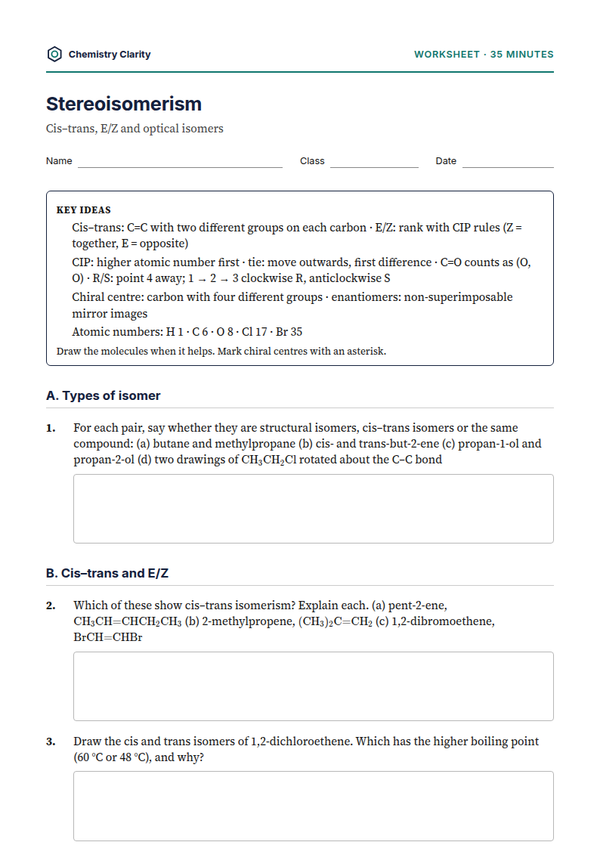
A. Types of isomer
1.
For each pair, say whether they are structural isomers, cis–trans isomers or the same compound: (a) butane and methylpropane (b) cis- and trans-but-2-ene (c) propan-1-ol and propan-2-ol (d) two drawings of rotated about the C–C bond
B. Cis–trans and E/Z
2.
Which of these show cis–trans isomerism? Explain each. (a) pent-2-ene, (b) 2-methylpropene, (c) 1,2-dibromoethene,
3.
Draw the cis and trans isomers of 1,2-dichloroethene. Which has the higher boiling point (60 °C or 48 °C), and why?
4.
Assign E or Z: (a) CHCl=CHBr with Cl and Br on the same side (b) with CH₃ and Cl on opposite sides
C. Optical isomerism
5.
Identify any chiral centres in: (a) 2-chlorobutane, (b) propan-2-ol, (c) lactic acid, (d) 1-chlorobutane
6.
Describe how the two enantiomers of lactic acid are (a) the same (b) different. What is a racemic mixture?
D. Applications
7.
Explain why a drug made as a single enantiomer can work better than the racemic mixture.
E. Challenge
8.
Butan-2-ol and butan-1-ol are both C₄H₁₀O. Explain why butan-2-ol has two stereoisomers but butan-1-ol has none, and name the type of isomerism that relates butan-1-ol to butan-2-ol.
F. CIP rules and R/S
9.
Use the CIP rules to rank each set of groups from highest to lowest priority, and explain the tie-breaks: (a) –OH, –CH₃, –H, –Cl (b) –COOH, –CH₂OH, –CHO, –CH₃ (c) –CH₂CH₃, –CH(CH₃)₂, –CH₂OH
10.
Lactic acid is . (a) Rank the four groups on its chiral carbon. (b) In one drawing, H points away from you and, going clockwise, you meet OH, then COOH, then CH₃. Is it R or S? (c) In another drawing, H is on a solid wedge and the path 1 → 2 → 3 looks clockwise. Is it R or S?