What is it?
A phase change (change of state) turns a substance from one state into another without changing what it is: ice, liquid water and steam are all .
| Change | From → to | Energy |
|---|---|---|
| Melting (fusion) | solid → liquid | absorbed (endothermic) |
| Freezing | liquid → solid | released (exothermic) |
| Vaporization (boiling, evaporation) | liquid → gas | absorbed |
| Condensation | gas → liquid | released |
| Sublimation | solid → gas | absorbed |
| Deposition | gas → solid | released |
Changes that pull particles apart (overcoming intermolecular forces) absorb energy; changes that bring them together release it.
Key idea
While a pure substance is melting or boiling, its temperature stays constant, even though heat is still being added. All the energy goes into overcoming the forces between particles, not into making them move faster. That’s why a heating curve has flat sections.
Why does it matter?
- Cooling and heating. Sweat cools you because evaporation absorbs heat; ice keeps drinks at 0 °C while it melts; refrigerators work by evaporating and condensing a fluid.
- Steam burns. Steam at 100 °C burns far worse than water at 100 °C, because it releases its large enthalpy of vaporization as it condenses on the skin.
- Cooking and climate. Water boils at a lower temperature at altitude; huge amounts of energy are moved around the planet as water evaporates and condenses.
How does it work?
1. The heating curve
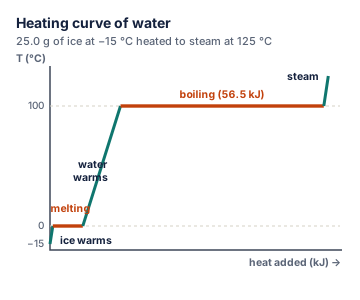
Heating ice at −15 °C steadily until it becomes steam at 125 °C gives five stages:
- ice warms (sloped):
- ice melts at 0 °C (flat):
- water warms (sloped):
- water boils at 100 °C (flat):
- steam warms (sloped):
The total heat is the sum of the five steps.
2. Enthalpies of fusion and vaporization
The enthalpy of fusion, , is the energy to melt one mole of solid at its melting point; the enthalpy of vaporization, , is the energy to vaporize one mole of liquid. For water, kJ/mol and kJ/mol. Vaporization needs far more energy because the molecules must be separated completely, while melting only loosens them.
3. Vapour pressure and boiling
Even below its boiling point, some molecules at the surface of a liquid have enough energy to escape: evaporation. In a closed container, the vapour builds up until evaporation and condensation balance. The pressure of the vapour then is the vapour pressure, which rises steeply with temperature.
A liquid boils when its vapour pressure equals the external pressure: bubbles of vapour can then form throughout the liquid. At 1 atm (760 mmHg) this is the normal boiling point: 100 °C for water. Where the air pressure is lower, such as on a mountain, water boils below 100 °C; in a pressure cooker it boils above 100 °C.
Think of it like this
Melting is like a crowd leaving a packed hall. While people are still squeezing out of the doors (the phase change), the crowd’s speed doesn’t increase: all the effort goes into getting through. Only once everyone is outside can they start to move faster (the temperature rises again).
More precisely
Evaporation happens at any temperature, from the surface only; boiling happens at one temperature (for a given pressure), throughout the liquid. The temperature stays constant during a phase change only while both phases are present and the pressure is constant. itself changes slightly with temperature (water: 44.0 kJ/mol at 25 °C, 40.7 kJ/mol at 100 °C). The relationship between vapour pressure and temperature is described by the Clausius–Clapeyron equation.
Visualise it
Worked example
Worked example: Melting ice
Question: How much heat is needed to melt 100. g of ice at 0 °C?
-
Moles:
-
Heat:
Worked example: A full heating curve
Question: How much heat turns 25.0 g of ice at −15.0 °C into steam at 125.0 °C? ( mol)
-
Warm ice:
-
Melt:
-
Warm water:
-
Boil:
-
Warm steam:
-
Total:
Boiling alone is about 73 % of the total.
Worked example: Why steam burns
Question: Compare the heat released to the skin (at 37 °C) by 5.00 g of steam at 100 °C and by 5.00 g of water at 100 °C.
-
Water cooling from 100 °C to 37 °C:
-
Steam first condenses: , then cools like the water (1.32 kJ): 12.6 kJ in total.
-
The steam delivers almost ten times as much heat.
Common mistake
Common mistake: Using q = mcΔT during a phase change
During melting or boiling, ΔT = 0, but heat is still absorbed. Use for the flat parts and only for the sloped parts, with the right for each state.
Common mistake: Mixing J and kJ
usually gives joules, while gives kilojoules. Convert to the same unit before adding.
Common mistake: Thinking boiling breaks bonds within molecules
When water boils, the bubbles contain molecules. Only intermolecular forces are overcome.
Notation note
- “Latent heat” is an older name for the enthalpy of a phase change.
- ΔH(fus) is positive for melting; for freezing the same value is negative.
Remember this
Remember this
- Melting, vaporization, sublimation: endothermic. Freezing, condensation, deposition: exothermic.
- Temperature is constant during a phase change: all the energy overcomes intermolecular forces.
- Sloped parts: . Flat parts: or .
- Water: kJ/mol; kJ/mol.
- A liquid boils when its vapour pressure equals the external pressure.
Test yourself
Check your understanding before moving on.
Flashcards
Phase Changes and Heating Curves: Flashcards
- QuestionName the six phase changes.Answer
Melting, freezing, vaporization, condensation, sublimation, deposition.
- QuestionWhich phase changes are endothermic?Answer
Melting, vaporization and sublimation (particles are pulled apart).
- QuestionWhy does the temperature stay constant while ice melts?Answer
All the heat goes into overcoming intermolecular forces, not into increasing the kinetic energy of the particles.
- QuestionWhich equation is used on the flat parts of a heating curve?Answer
(ΔH of fusion or vaporization).
- QuestionWhich equation is used on the sloped parts of a heating curve?Answer
, with the specific heat capacity of that state.
- QuestionGive ΔH(fus) and ΔH(vap) for water.Answer
6.01 kJ/mol and 40.7 kJ/mol.
- QuestionWhy is ΔH(vap) much larger than ΔH(fus)?Answer
Vaporizing separates the molecules completely; melting only loosens them.
- QuestionWhen does a liquid boil?Answer
When its vapour pressure equals the external pressure.
- QuestionWhy does water boil below 100 °C on a mountain?Answer
The air pressure is lower, so the vapour pressure reaches it at a lower temperature.
- QuestionHow much heat melts 100. g of ice at 0 °C?Answer
(100. g ÷ 18.02 g/mol) × 6.01 kJ/mol = 33.4 kJ
Tip: press Space to flip and ← → to move between cards.
Quiz
Phase Changes and Heating Curves: Quiz
7 questions
In condensation, gas particles come together and attractions form, releasing energy. Melting, sublimation and vaporization absorb energy.
Show answer
Answer: Condensation
In condensation, gas particles come together and attractions form, releasing energy. Melting, sublimation and vaporization absorb energy.
Sublimation is solid → gas (e.g. dry ice). Deposition is the reverse, gas → solid.
Show answer
Answer: Sublimation
Sublimation is solid → gas (e.g. dry ice). Deposition is the reverse, gas → solid.
Heat is still being added, but it goes into changing state, so the temperature (average kinetic energy) does not rise.
Show answer
Answer: A phase change: energy overcomes intermolecular forces
Heat is still being added, but it goes into changing state, so the temperature (average kinetic energy) does not rise.
n = 10.0 g ÷ 46.07 g/mol = 0.2171 mol; q = 0.2171 mol × 38.6 kJ/mol = 8.38 kJ.
Show answer
Answer: 8.38 kJ
n = 10.0 g ÷ 46.07 g/mol = 0.2171 mol; q = 0.2171 mol × 38.6 kJ/mol = 8.38 kJ.
Both are at 100 °C, but condensing steam first releases 40.7 kJ/mol before cooling, giving many times more heat than the water alone.
Show answer
Answer: Steam releases its enthalpy of vaporization when it condenses on the skin
Both are at 100 °C, but condensing steam first releases 40.7 kJ/mol before cooling, giving many times more heat than the water alone.
Boiling starts when vapour bubbles can form inside the liquid, which happens once the vapour pressure equals the pressure above the liquid. 100 °C is only water's boiling point at 1 atm.
Show answer
Answer: its vapour pressure equals the external pressure
Boiling starts when vapour bubbles can form inside the liquid, which happens once the vapour pressure equals the pressure above the liquid. 100 °C is only water's boiling point at 1 atm.
Warm ice 0.418 kJ + melt (10.0 g ÷ 18.02 g/mol × 6.01 kJ/mol) 3.34 kJ + warm water 2.09 kJ = 5.85 kJ. 2.51 kJ leaves out the melting step.
Show answer
Answer: 5.85 kJ
Warm ice 0.418 kJ + melt (10.0 g ÷ 18.02 g/mol × 6.01 kJ/mol) 3.34 kJ + warm water 2.09 kJ = 5.85 kJ. 2.51 kJ leaves out the melting step.
Notes and downloads
Worksheet
Phase Changes and Heating Curves Worksheet
8 questions on phase changes, reading heating curves, enthalpies of fusion and vaporization, multi-step heating calculations and boiling. Answer key included.
References
- Brown, T. L.; LeMay, H. E., Jr.; Bursten, B. E.; Murphy, C. J.; Woodward, P. M.; Stoltzfus, M. W. Chemistry: The Central Science, 15th ed.; Pearson, 2022.
Practise this topic with flashcards and a quiz at chemistryclarity.com/chemistry/phase-changes-and-heating-curves/
Spotted a mistake? Let us know and we'll fix it.