Worksheet
Phase Changes and Heating Curves Worksheet
8 questions on phase changes, reading heating curves, enthalpies of fusion and vaporization, multi-step heating calculations and boiling. Answer key included.
- Type
- Worksheet
- Level
- Intermediate
- Format
- PDF, ready to print
Preview the questions
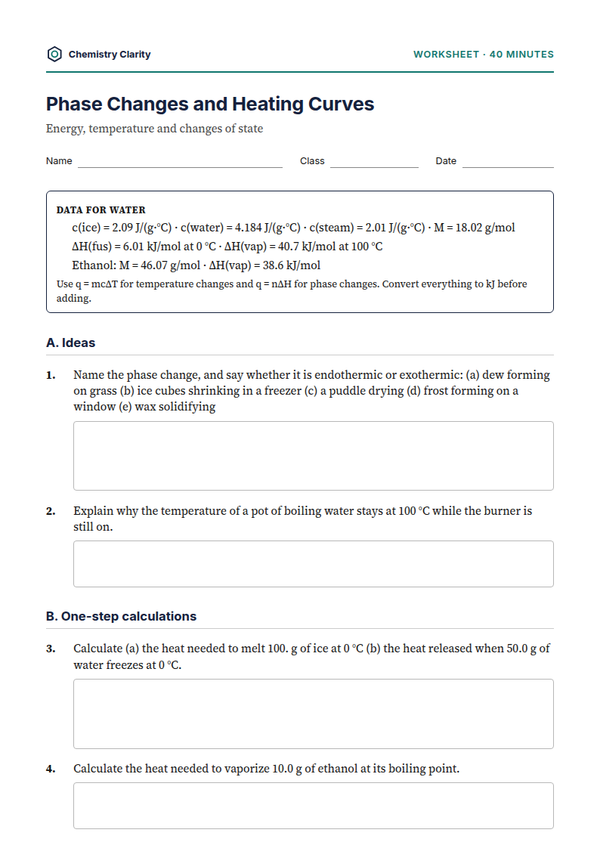
All the questions on this worksheet (about 40 minutes). Download the PDF to print it with space for working; the free answer key has full worked solutions.
A. Ideas
1.
Name the phase change, and say whether it is endothermic or exothermic: (a) dew forming on grass (b) ice cubes shrinking in a freezer (c) a puddle drying (d) frost forming on a window (e) wax solidifying
2.
Explain why the temperature of a pot of boiling water stays at 100 °C while the burner is still on.
B. One-step calculations
3.
Calculate (a) the heat needed to melt 100. g of ice at 0 °C (b) the heat released when 50.0 g of water freezes at 0 °C.
4.
Calculate the heat needed to vaporize 10.0 g of ethanol at its boiling point.
C. Multi-step calculations
5.
Calculate the heat needed to turn 10.0 g of ice at −20.0 °C into liquid water at 50.0 °C.
6.
A drink is cooled by adding 200. g of ice at 0 °C. Calculate the heat the ice absorbs as it melts and the meltwater warms to 20.0 °C.
D. Vapour pressure and boiling
7.
At the top of Mount Everest the air pressure is about one third of an atmosphere, and water boils at about 70 °C. Explain why, and why cooking pasta there takes longer.
E. Challenge
8.
Compare the heat released to skin at 37 °C by 10.0 g of steam at 100 °C and by 10.0 g of water at 100 °C. Use your answer to explain why steam burns are so severe.