What is it?
A nucleus contains positively charged protons packed together with neutrons. The protons repel each other strongly, yet most nuclei hold together because of the strong nuclear force: a very short-range attraction between all nucleons (protons and neutrons). Neutrons add this attraction without adding repulsion, so they act as a nuclear “glue”.
Whether a nucleus is stable depends mainly on its neutron-to-proton ratio, :
- For light elements (up to about ), stable nuclei have (for example , ).
- For heavier elements, more neutrons are needed to dilute the proton repulsion: rises to about 1.5 for lead (: 124/82 = 1.51).
- Every nucleus with above 83 (bismuth) is radioactive.
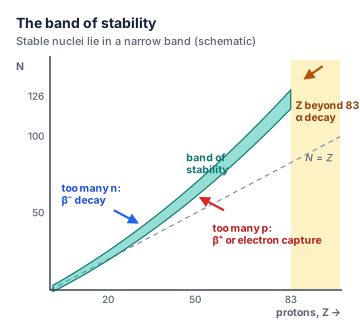
Plotting against for all stable nuclei gives a narrow band of stability.
Key idea
Radioactive nuclei decay in the direction that brings them towards the band of stability. Where a nuclide lies relative to the band predicts how it decays.
Why does it matter?
- Predicting decay. Knowing the N/Z ratio tells you whether to expect beta-minus, positron or alpha decay, which matters for medicine, energy and waste storage.
- Medical isotopes. Positron emitters such as fluorine-18 (used in PET scans) are made by adding protons, putting them below the band.
- The origin of the elements. Stability patterns explain why iron, nickel and lead are so common, and why heavy elements decay in long chains.
How does it work?
1. Predicting the type of decay
| Position relative to the band | Problem | Decay | Effect on N/Z |
|---|---|---|---|
| Above the band | too many neutrons | beta-minus (β⁻): a neutron becomes a proton, | decreases |
| Below the band | too many protons | positron emission (β⁺) or electron capture: a proton becomes a neutron | increases |
| Beyond | too large | alpha (α): loses 2 protons and 2 neutrons | moves towards smaller, stabler nuclei |
A quick check: compare the nuclide with the stable isotope of the same element. More neutrons than that: β⁻. Fewer: β⁺ or electron capture.
2. Extra stability: even numbers and magic numbers
Nuclei with even numbers of protons and neutrons are especially common: most stable nuclides are even–even. Nuclei with 2, 8, 20, 28, 50, 82 or 126 protons or neutrons (magic numbers) are unusually stable, like the full electron shells of noble gases. Lead-208 (82 protons, 126 neutrons) is “doubly magic”.
3. Decay series
A heavy nucleus such as uranium-238 cannot reach the band in one step. It undergoes a decay series of alpha and beta-minus decays until it reaches a stable nuclide (lead-206). To count the steps:
- Only alpha decay changes the mass number (by 4), so: number of α = (change in mass number) ÷ 4.
- Then use the change in atomic number: each α lowers by 2; each β⁻ raises it by 1.
Think of it like this
Think of the band of stability as a narrow mountain ridge. Nuclei off the ridge slide back towards it: those on the “too many neutrons” slope convert neutrons to protons (β⁻), those on the “too many protons” slope convert protons to neutrons (β⁺), and the very heaviest throw off chunks (α) to get down to a lower, stabler height.
More precisely
The strong force acts only over about m (the width of a few nucleons), while the electrostatic repulsion between protons acts across the whole nucleus. In large nuclei, each proton feels the repulsion of all the others but the attraction of only its neighbours, which is why heavy nuclei need extra neutrons and why nothing beyond bismuth is permanently stable. Bismuth-209 itself is very slightly radioactive, with a half-life about a billion times the age of the universe. Some nuclides decay by more than one route: potassium-40 undergoes both β⁻ decay and electron capture.
Visualise it
Worked example
Worked example: Carbon-14 and oxygen-15
Question: Predict the decay of (a) carbon-14 (b) oxygen-15. Stable carbon is and ; stable oxygen is .
-
(a) : N/Z = 8/6 = 1.33, more neutrons than stable carbon: β⁻ decay:
-
(b) : N/Z = 7/8 = 0.875, fewer neutrons than oxygen-16: positron emission:
Worked example: Iodine-131 and sodium-22
Question: Predict how iodine-131 and sodium-22 decay. (Stable isotopes: iodine-127, sodium-23.)
- I-131 has 4 more neutrons than stable I-127 (N/Z = 78/53 = 1.47 versus 74/53 = 1.40): too many neutrons, β⁻.
- Na-22 has 1 fewer neutron than stable Na-23 (N/Z = 11/11 = 1.00 versus 12/11 = 1.09): too few neutrons, β⁺ (or electron capture).
Worked example: Counting a decay series
Question: Uranium-238 decays through a series to lead-206. How many α and β⁻ decays occur?
- Mass number falls by 238 − 206 = 32, so there are 32 ÷ 4 = 8 α decays.
- Eight α decays lower by 16: 92 − 16 = 76. Lead has , so must rise by 6: 6 β⁻ decays.
- Check: ✓
Common mistake
Common mistake: Using N/Z = 1 for heavy elements
Stable heavy nuclei have more neutrons than protons (lead-206: N/Z = 1.51). An N/Z of 1 is “too few neutrons” only for light elements up to about calcium.
Common mistake: Getting the direction of beta decay backwards
β⁻ decay turns a neutron into a proton (N down, Z up), so it fixes too many neutrons. Positron emission does the reverse.
Common mistake: Counting beta decays first in a decay series
Beta decay does not change the mass number, so always count the alpha decays from the change in mass number first.
Notation note
- N = number of neutrons = A − Z; Z = atomic number.
- A positron is written (or β⁺); an electron from beta decay is (or β⁻).
Remember this
Remember this
- The strong nuclear force holds nucleons together; neutrons add attraction without repulsion.
- Stable light nuclei: N/Z ≈ 1. Stable heavy nuclei: N/Z up to about 1.5. All nuclei beyond Z = 83 are radioactive.
- Above the band (too many n): β⁻. Below (too many p): β⁺ or electron capture. Very heavy: α.
- Even numbers and magic numbers (2, 8, 20, 28, 50, 82, 126) give extra stability.
- Decay series: α count = ΔA ÷ 4; then β⁻ count from the change in Z.
Test yourself
Check your understanding before moving on.
Flashcards
Nuclear Stability: Flashcards
- QuestionWhat holds the nucleus together?Answer
The strong nuclear force: a very short-range attraction between all nucleons.
- QuestionWhy do heavier nuclei need more neutrons than protons?Answer
Neutrons add strong-force attraction without adding electrostatic repulsion between protons.
- QuestionWhat is the N/Z ratio of stable light nuclei, and of stable lead?Answer
About 1 for light nuclei (up to Z ≈ 20); about 1.5 for lead-206 (124/82).
- QuestionAbove which atomic number are all nuclei radioactive?Answer
Z = 83 (bismuth): every element beyond it is radioactive.
- QuestionHow does a nucleus with too many neutrons decay?Answer
Beta-minus decay: a neutron becomes a proton and an electron is emitted.
- QuestionHow does a nucleus with too many protons decay?Answer
Positron emission (β⁺) or electron capture: a proton becomes a neutron.
- QuestionHow do very heavy nuclei (Z above 83) usually decay?Answer
Alpha decay (losing 2 protons and 2 neutrons).
- QuestionName the magic numbers.Answer
2, 8, 20, 28, 50, 82, 126 (protons or neutrons).
- QuestionHow many α and β⁻ decays take U-238 to Pb-206?Answer
8 α (mass falls by 32) and 6 β⁻.
- QuestionPredict how carbon-14 decays.Answer
β⁻ (too many neutrons): ¹⁴C → ¹⁴N + e⁻.
Tip: press Space to flip and ← → to move between cards.
Quiz
Nuclear Stability: Quiz
7 questions
The strong force attracts all nucleons over very short distances, overcoming the repulsion between protons.
Show answer
Answer: The strong nuclear force
The strong force attracts all nucleons over very short distances, overcoming the repulsion between protons.
Too many neutrons: a neutron changes into a proton (β⁻), lowering N/Z towards the band of stability.
Show answer
Answer: Beta-minus decay
Too many neutrons: a neutron changes into a proton (β⁻), lowering N/Z towards the band of stability.
Too many protons for its neutrons: a proton becomes a neutron by emitting a positron. This is why F-18 is used in PET scans.
Show answer
Answer: Positron emission
Too many protons for its neutrons: a proton becomes a neutron by emitting a positron. This is why F-18 is used in PET scans.
Polonium (Z = 84) is beyond Z = 83, so it is too large and decays by alpha emission. C-14 and Co-60 are β⁻ emitters; Na-22 is a β⁺ emitter.
Show answer
Answer: Polonium-210
Polonium (Z = 84) is beyond Z = 83, so it is too large and decays by alpha emission. C-14 and Co-60 are β⁻ emitters; Na-22 is a β⁺ emitter.
N = 206 − 82 = 124; N/Z = 124 ÷ 82 = 1.51. Heavy stable nuclei need about 1.5 neutrons per proton.
Show answer
Answer: 1.51
N = 206 − 82 = 124; N/Z = 124 ÷ 82 = 1.51. Heavy stable nuclei need about 1.5 neutrons per proton.
Only alpha decay changes the mass number: (232 − 208) ÷ 4 = 6 alpha decays.
Show answer
Answer: 6
Only alpha decay changes the mass number: (232 − 208) ÷ 4 = 6 alpha decays.
6 alpha decays lower Z by 12, to 78. Lead has Z = 82, so Z must rise by 4: 4 β⁻ decays.
Show answer
Answer: 4
6 alpha decays lower Z by 12, to 78. Lead has Z = 82, so Z must rise by 4: 4 β⁻ decays.
Notes and downloads
Worksheet
Nuclear Stability Worksheet
8 questions on N/Z ratios, the band of stability, predicting and writing decay equations, magic numbers and decay series. Answer key included.
References
- Brown, T. L.; LeMay, H. E., Jr.; Bursten, B. E.; Murphy, C. J.; Woodward, P. M.; Stoltzfus, M. W. Chemistry: The Central Science, 15th ed.; Pearson, 2022.
Practise this topic with flashcards and a quiz at chemistryclarity.com/chemistry/nuclear-stability/
Spotted a mistake? Let us know and we'll fix it.