What is it?
Most nuclei are stable, but some have an unstable combination of protons and neutrons. An unstable nucleus decays: it changes into a different nucleus and gives out radiation. This is radioactivity, and it happens on its own, whatever the temperature, pressure or chemical form of the atom.
A nucleus is written in nuclide notation, with the mass number A (protons + neutrons) at the top left and the atomic number Z (protons) at the bottom left:
Uranium-238 has 92 protons and 238 − 92 = 146 neutrons.
The main types of radiation are:
| Radiation | Symbol | What it is | Effect on the nucleus |
|---|---|---|---|
| Alpha (α) | 2 protons + 2 neutrons | A − 4, Z − 2 | |
| Beta (β⁻) | a fast electron | A same, Z + 1 | |
| Positron (β⁺) | a positive electron | A same, Z − 1 | |
| Gamma (γ) | high-energy light | no change in A or Z |
Key idea
In every nuclear equation, the mass numbers add up to the same total on both sides, and so do the atomic numbers. Use these two sums to find any missing particle or nucleus.
Why does it matter?
- Medicine. Technetium-99m is used for medical imaging, fluorine-18 for PET scans, and iodine-131 and cobalt-60 to treat cancer.
- Dating. Carbon-14 dates objects up to about 50 000 years old; uranium and potassium isotopes date rocks billions of years old.
- Safety and energy. Radon gas from rocks is a health hazard in some homes, and nuclear power stations depend on radioactive fuels and produce radioactive waste.
How does it work?
1. Types of decay
- Alpha decay: a heavy nucleus emits a helium nucleus.
- Beta decay: a neutron turns into a proton and an electron, and the electron is emitted.
- Positron emission: a proton turns into a neutron and a positron.
- Gamma emission: a nucleus with excess energy releases it as a gamma ray, often just after alpha or beta decay. The element does not change.
2. Balancing a nuclear equation
- Write the parent nucleus on the left and the known products on the right.
- Mass numbers: top numbers on the left = top numbers on the right.
- Atomic numbers: bottom numbers on the left = bottom numbers on the right.
- Use the atomic number of the unknown to find its symbol from the periodic table.
3. Penetrating power
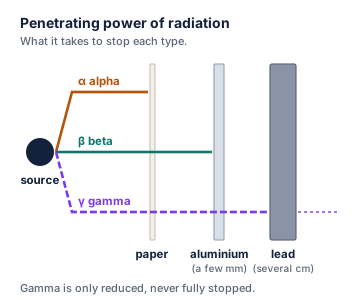
Alpha particles are heavy and doubly charged: they ionize strongly but are stopped by a sheet of paper or the outer layer of skin. Beta particles get through paper but are stopped by a few millimetres of aluminium. Gamma rays are the most penetrating and are only reduced by thick lead or concrete. Alpha emitters are therefore most dangerous inside the body (if swallowed or inhaled).
4. Half-life
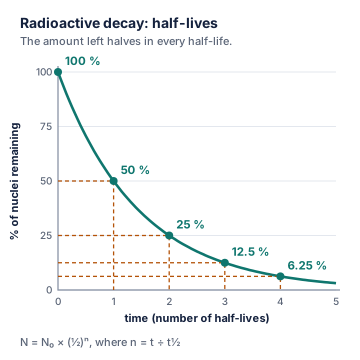
The half-life, , is the time it takes for half of the radioactive nuclei in a sample to decay. After each half-life, the amount (and the activity, the number of decays per second) halves again:
where is the starting amount, the amount left after time , and the number of half-lives. The time and the half-life must be in the same unit, so has no unit. and can be masses, numbers of nuclei or activities, as long as both use the same unit.
When is not a whole number, solve for with logarithms:
| Nuclide | Half-life |
|---|---|
| fluorine-18 | 110 min |
| technetium-99m | 6.01 h |
| radon-222 | 3.82 d |
| iodine-131 | 8.02 d |
| carbon-14 | 5730 yr |
| uranium-238 | 4.47 × 10⁹ yr |
5. Radiocarbon dating
Living things take in carbon-14 from the air, so the ratio of carbon-14 to carbon-12 in them stays constant. After death no new carbon-14 enters, and the carbon-14 decays with a half-life of 5730 years. Comparing the carbon-14 activity of a sample with that of living material gives its age.
Think of it like this
Half-life is like a bowl of popcorn kernels in which each kernel has the same chance of popping each minute. You can’t predict when one particular kernel pops, but you can say confidently that half of the kernels will have popped after a certain time, then half of the rest, and so on. In the same way, the decay of one nucleus is random, but a large sample follows the half-life exactly.
More precisely
Radioactive decay is a first-order process: the rate is proportional to the number of nuclei present, , with the decay constant . Activity is measured in becquerels (1 Bq = 1 decay per second). Another decay mode, electron capture, pulls an inner electron into the nucleus, turning a proton into a neutron (Z − 1, A unchanged). Whether a nucleus is stable depends mainly on its neutron-to-proton ratio: too many neutrons favours beta decay, too few favours positron emission or electron capture, and very heavy nuclei (Z above 83) undergo alpha decay.
Visualise it
Worked example
Worked example: Completing nuclear equations
Question: Complete: (a) (b)
- (a) Mass number: 238 = A + 4, so A = 234. Atomic number: 92 = Z + 2, so Z = 90, which is thorium: .
- (b) Mass number: 131 = A + 0, so A = 131. Atomic number: 53 = Z + (−1), so Z = 54, which is xenon: .
Worked example: A whole number of half-lives
Question: A hospital receives 80.0 mg of iodine-131 ( = 8.02 d). How much is left after 24.06 d?
- (the days cancel)
- 10.0 mg
Worked example: Radiocarbon dating
Question: A piece of ancient wood has 35.0 % of the carbon-14 activity of living wood. How old is it? ( = 5730 yr)
- (a ratio, so no unit)
- half-lives
- 8.68 × 10³ yr (about 8680 years)
- Check: 35.0 % lies between 50 % (1 half-life) and 25 % (2 half-lives), so the age must be between 5730 yr and 11 460 yr. ✓
Common mistake
Common mistake: Thinking everything is gone after two half-lives
After one half-life, half is left; after two, a quarter (not zero). The amount approaches zero but, in a large sample, takes many half-lives to become negligible: after 10 half-lives, about 0.1 % remains.
Common mistake: Changing the mass number in beta decay
Beta decay changes a neutron into a proton, so the mass number stays the same and the atomic number goes up by 1. becomes , not .
Common mistake: Mixing time units
In , both times must be in the same unit. For technetium-99m ( = 6.01 h) after 2.00 days, first convert: .
Notation note
- In nuclide notation the mass number is on top and the atomic number below: . In text, write carbon-14 or C-14.
- A beta particle can be written or ; an alpha particle or .
- The “m” in technetium-99m means “metastable”: an excited nucleus that releases gamma rays.
Remember this
Remember this
- Alpha: A − 4, Z − 2. Beta (β⁻): A same, Z + 1. Positron (β⁺): A same, Z − 1. Gamma: no change.
- Nuclear equations: mass numbers and atomic numbers both balance.
- Penetration: alpha stopped by paper, beta by aluminium, gamma reduced by thick lead.
- Half-life: with (same time units); for non-whole , .
Test yourself
Check your understanding before moving on.
Flashcards
Radioactive Decay and Half-Life: Flashcards
- QuestionIn nuclide notation, what do the top and bottom numbers mean?Answer
Top: mass number A (protons + neutrons). Bottom: atomic number Z (protons). E.g. uranium-238: A = 238, Z = 92.
- QuestionWhat is an alpha particle, and how does alpha decay change the nucleus?Answer
A helium-4 nucleus (2 protons + 2 neutrons). A decreases by 4, Z by 2.
- QuestionWhat happens in beta (β⁻) decay?Answer
A neutron becomes a proton and an electron; the electron is emitted. A stays the same, Z increases by 1.
- QuestionWhat happens in positron (β⁺) emission?Answer
A proton becomes a neutron and a positron is emitted. A stays the same, Z decreases by 1.
- QuestionWhat is gamma radiation?Answer
High-energy electromagnetic radiation from an excited nucleus. A and Z do not change.
- QuestionWhat must balance in a nuclear equation?Answer
The total mass number and the total atomic number on each side.
- QuestionWhat stops alpha, beta and gamma radiation?Answer
Alpha: paper or skin. Beta: a few mm of aluminium. Gamma: only reduced by thick lead or concrete.
- QuestionDefine half-life.Answer
The time for half of the radioactive nuclei in a sample (and its activity) to decay.
- QuestionWhat fraction of a sample remains after 3 half-lives?Answer
(½)³ = ⅛, i.e. 12.5 %.
- QuestionEquation for the amount left after time t?Answer
N = N₀ × (½)ⁿ, where n = t ÷ t½ (t and t½ in the same unit).
Tip: press Space to flip and ← → to move between cards.
Quiz
Radioactive Decay and Half-Life: Quiz
7 questions
Neutrons = mass number − atomic number = 14 − 6 = 8.
Show answer
Answer: 8
Neutrons = mass number − atomic number = 14 − 6 = 8.
Alpha decay removes 4 from A and 2 from Z: 226 − 4 = 222 and 88 − 2 = 86, which is radon.
Show answer
Answer: radon-222 (Z = 86)
Alpha decay removes 4 from A and 2 from Z: 226 − 4 = 222 and 88 − 2 = 86, which is radon.
A stays 234 and Z rises by 1, so X has A = 0 and Z = −1: an electron, ⁰₋₁e.
Show answer
Answer: a beta particle (electron)
A stays 234 and Z rises by 1, so X has A = 0 and Z = −1: an electron, ⁰₋₁e.
Alpha particles are heavy and doubly charged, so they lose their energy quickly. Beta needs aluminium; gamma is only reduced by thick lead.
Show answer
Answer: alpha
Alpha particles are heavy and doubly charged, so they lose their energy quickly. Beta needs aluminium; gamma is only reduced by thick lead.
n = 6.0 h ÷ 2.0 h = 3.0 half-lives, so 160 mg × (½)³ = 20 mg.
Show answer
Answer: 20 mg
n = 6.0 h ÷ 2.0 h = 3.0 half-lives, so 160 mg × (½)³ = 20 mg.
1200 Bq → 600 Bq → 300 Bq is 2 half-lives, so t½ = 16 days ÷ 2 = 8 days.
Show answer
Answer: 8 days
1200 Bq → 600 Bq → 300 Bq is 2 half-lives, so t½ = 16 days ÷ 2 = 8 days.
Positron emission keeps A the same and lowers Z by 1: Z = 8 is oxygen, so ¹⁸₉F → ¹⁸₈O + ⁰₊₁e.
Show answer
Answer: oxygen-18 (Z = 8)
Positron emission keeps A the same and lowers Z by 1: Z = 8 is oxygen, so ¹⁸₉F → ¹⁸₈O + ⁰₊₁e.
Notes and downloads
Worksheet
Radioactive Decay and Half-Life Worksheet
9 questions on nuclide notation, nuclear equations, types of radiation, half-life calculations and radiocarbon dating. Answer key included.
References
- Brown, T. L.; LeMay, H. E., Jr.; Bursten, B. E.; Murphy, C. J.; Woodward, P. M.; Stoltzfus, M. W. Chemistry: The Central Science, 15th ed.; Pearson, 2022.
Practise this topic with flashcards and a quiz at chemistryclarity.com/chemistry/radioactive-decay/
Spotted a mistake? Let us know and we'll fix it.