What is it?
Nuclear reactions can release millions of times more energy than chemical reactions. They come in two kinds:
- Fission: a heavy nucleus, such as uranium-235, splits into two medium-sized nuclei, releasing neutrons and energy.
- Fusion: two light nuclei, such as isotopes of hydrogen, join to form a heavier nucleus, releasing energy.
The energy comes from mass. A nucleus has slightly less mass than the protons and neutrons that make it up. This missing mass, the mass defect (), was converted into energy when the nucleus formed, according to Einstein’s equation:
where = 2.998 × 10⁸ m/s is the speed of light. The same energy, the binding energy, would be needed to pull the nucleus apart again.
Key idea
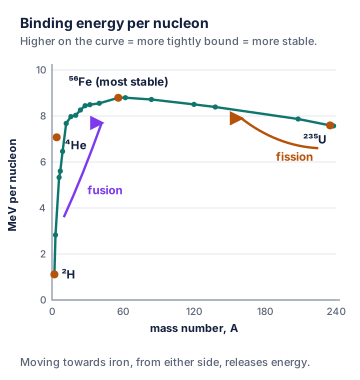
Nuclei with a higher binding energy per nucleon are more stable. Iron-56 is near the top of the curve. Splitting very heavy nuclei (fission) or joining very light ones (fusion) moves towards iron, so both release energy.
Why does it matter?
- Electricity. Nuclear power stations use controlled fission of uranium-235 and generate electricity without burning fuel or emitting carbon dioxide while they run.
- The stars. The Sun shines by fusing hydrogen into helium; most elements up to iron were made by fusion in stars.
- Future energy and risks. Fusion reactors are being developed as a cleaner energy source; fission produces long-lived radioactive waste, and both processes underlie nuclear weapons.
How does it work?
1. Mass defect and binding energy
- Add up the masses of the separate protons and neutrons.
- Subtract the measured mass of the nucleus: this is the mass defect, .
- Convert to kilograms (1 u = 1.66054 × 10⁻²⁷ kg) and use . The units give kg m² s⁻² = J.
- Divide by the number of nucleons (protons + neutrons) to compare nuclei.
Nuclear energies are often given in mega-electronvolts: 1 MeV = 1.602 × 10⁻¹³ J.
2. Fission and the chain reaction
When uranium-235 absorbs a slow neutron, it splits. One of many possible splits is:
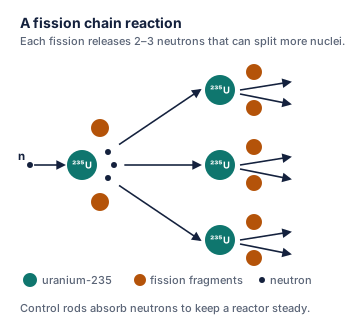
Each fission releases about 200 MeV and 2 or 3 neutrons. If at least one of these neutrons causes another fission, a chain reaction follows. The smallest mass of fuel that can keep the chain going is the critical mass.
A nuclear reactor controls the chain reaction:
- Fuel rods: uranium enriched in uranium-235.
- Moderator (water or graphite): slows the neutrons so they are captured by uranium-235 more easily.
- Control rods (boron or cadmium): absorb neutrons; lowering them slows the reaction.
- Coolant: carries the heat away to make steam, which drives turbines.
3. Fusion
Fusion needs temperatures of millions of degrees, so that the positively charged nuclei collide fast enough to overcome their repulsion. The most promising reaction for reactors fuses deuterium and tritium:
In the Sun, a series of steps has the overall effect (plus neutrinos and gamma rays).
| Fission | Fusion | |
|---|---|---|
| Nuclei | heavy split | light join |
| Fuel | uranium-235, plutonium-239 | hydrogen isotopes |
| Conditions | slow neutrons, critical mass | millions of degrees |
| Waste | radioactive fission products | mainly helium (little long-lived waste) |
| Status | power stations since the 1950s | experimental |
Think of it like this
Think of nucleons as people in groups, where the most comfortable group size is medium (iron). People in a huge, crowded group (uranium) are happier if it splits in two; people in tiny groups (hydrogen) are happier if they join up. Either change makes everyone more comfortable, and the “relief” is released as energy.
More precisely
Chemical reactions also turn a tiny amount of mass into energy, but it is far too small to measure: about one part in 10¹⁰ of the mass, compared with about one part in 10³ in fission. Binding energy uses because the strong nuclear force holding nucleons together is far stronger than the electrical forces in chemical bonds. In a nuclear power station, the fuel contains only a few percent of uranium-235, which cannot explode like a bomb, but the reactor must still be cooled even after shutdown, because its fission products keep releasing decay heat.
Visualise it
Worked example
Worked example: Binding energy of carbon-12
Question: A carbon-12 nucleus (6 protons, 6 neutrons) has a mass of 11.996709 u. Find its binding energy and its binding energy per nucleon. (proton 1.007276 u; neutron 1.008665 u)
-
Mass of the separate nucleons:
-
Mass defect:
-
In kilograms:
-
Energy:
-
In MeV: ; per nucleon: 7.68 MeV per nucleon
Worked example: Energy from deuterium–tritium fusion
Question: Find the energy released per mole of helium formed in . (²H 2.014102 u; ³H 3.016049 u; ⁴He 4.002603 u; n 1.008665 u)
-
Mass before:
-
Mass after:
-
per reaction, so 0.018883 g per mole kg/mol
-
Energy:
-
That is 1.697 × 10⁹ kJ/mol, about two million times the 890 kJ/mol released by burning methane.
Common mistake
Common mistake: Thinking mass is lost and energy appears from nowhere
Mass and energy are two forms of the same thing. The products of a nuclear reaction have slightly less mass, and the missing mass appears as the kinetic energy of the products and as radiation. Total mass-energy is conserved.
Common mistake: Forgetting to convert u to kg
gives joules only when is in kilograms and in m/s. Using in u or g/mol without converting gives an answer that is wrong by a large factor.
Common mistake: Mixing up fission and fusion
Fission divides (heavy nuclei split); fusion fuses (light nuclei join). Both release energy, but only fission is used in today’s power stations.
Notation note
- u is the unified atomic mass unit, 1/12 of the mass of a carbon-12 atom (also written amu or Da).
- A neutron is written ; deuterium (also D) and tritium (also T).
- A shortcut: 1 u of mass defect corresponds to 931.5 MeV.
Remember this
Remember this
- Mass defect = mass of separate nucleons − mass of nucleus; binding energy (Δm in kg, c in m/s, E in J).
- Binding energy per nucleon peaks near iron-56; fission of heavy and fusion of light nuclei both release energy.
- Fission: U-235 + slow neutron → two fragments + 2–3 neutrons + about 200 MeV; chain reaction controlled by moderator and control rods.
- Fusion: light nuclei join at millions of degrees; powers the Sun.
Test yourself
Check your understanding before moving on.
Flashcards
Nuclear Fission and Fusion: Flashcards
- QuestionWhat is the mass defect of a nucleus?Answer
Mass of the separate protons and neutrons minus the mass of the nucleus.
- QuestionWhat is binding energy?Answer
The energy needed to separate a nucleus into its protons and neutrons, E = Δm c² (Δm in kg, c in m/s, E in J).
- QuestionWhich nucleus is near the peak of the binding-energy-per-nucleon curve?Answer
Iron-56 (about 8.8 MeV per nucleon): among the most stable nuclei.
- QuestionWhy do both fission and fusion release energy?Answer
Both form nuclei with a higher binding energy per nucleon (closer to iron); the extra binding energy is released.
- QuestionWhat is nuclear fission?Answer
A heavy nucleus (e.g. uranium-235) splits into two medium nuclei, releasing 2–3 neutrons and about 200 MeV.
- QuestionWhat is a chain reaction, and what is the critical mass?Answer
Neutrons from one fission cause further fissions. The critical mass is the smallest mass of fuel that sustains the chain.
- QuestionRoles of the moderator and the control rods in a reactor?Answer
Moderator (water, graphite) slows neutrons. Control rods (boron, cadmium) absorb neutrons to control the rate.
- QuestionWhat is nuclear fusion?Answer
Light nuclei join to form a heavier one, e.g. ²H + ³H → ⁴He + n. It needs millions of degrees.
- QuestionWhy does fusion need such high temperatures?Answer
The positively charged nuclei repel each other; they must collide very fast to get close enough to fuse.
- QuestionHow do you convert u to kg, and MeV to J?Answer
1 u = 1.66054 × 10⁻²⁷ kg; 1 MeV = 1.602 × 10⁻¹³ J (and 1 u of mass ≈ 931.5 MeV).
Tip: press Space to flip and ← → to move between cards.
Quiz
Nuclear Fission and Fusion: Quiz
7 questions
The difference is the mass defect, released as binding energy (E = Δm c²) when the nucleus formed.
Show answer
Answer: smaller
The difference is the mass defect, released as binding energy (E = Δm c²) when the nucleus formed.
Mass numbers: 1 + 235 = 236 = 141 + 92 + 3. Atomic numbers: 92 = 56 + 36 + 0. So three neutrons.
Show answer
Answer: 3 ¹₀n
Mass numbers: 1 + 235 = 236 = 141 + 92 + 3. Atomic numbers: 92 = 56 + 36 + 0. So three neutrons.
Iron-56 lies near the peak of the curve (about 8.8 MeV per nucleon); uranium-235 is about 7.6 and helium-4 about 7.1.
Show answer
Answer: ⁵⁶Fe
Iron-56 lies near the peak of the curve (about 8.8 MeV per nucleon); uranium-235 is about 7.6 and helium-4 about 7.1.
Control rods (boron, cadmium) absorb neutrons. The moderator slows them; the coolant carries the heat.
Show answer
Answer: to absorb neutrons and control the rate of fission
Control rods (boron, cadmium) absorb neutrons. The moderator slows them; the coolant carries the heat.
Nuclei are positive and repel each other; only very fast collisions bring them close enough for the strong force to join them.
Show answer
Answer: to overcome the repulsion between positively charged nuclei
Nuclei are positive and repel each other; only very fast collisions bring them close enough for the strong force to join them.
E = mc² = (1.00 × 10⁻³ kg)(2.998 × 10⁸ m/s)² = 8.99 × 10¹³ kg m²/s² = 8.99 × 10¹³ J.
Show answer
Answer: 8.99 × 10¹³ J
E = mc² = (1.00 × 10⁻³ kg)(2.998 × 10⁸ m/s)² = 8.99 × 10¹³ kg m²/s² = 8.99 × 10¹³ J.
0.0300 u × 931.5 MeV/u = 27.9 MeV.
Show answer
Answer: 27.9 MeV
0.0300 u × 931.5 MeV/u = 27.9 MeV.
Notes and downloads
Worksheet
Nuclear Fission and Fusion Worksheet
9 questions on mass defect, binding energy, E = mc², nuclear equations, reactors, and energy from fission, fusion and the Sun. Answer key included.
References
- Brown, T. L.; LeMay, H. E., Jr.; Bursten, B. E.; Murphy, C. J.; Woodward, P. M.; Stoltzfus, M. W. Chemistry: The Central Science, 15th ed.; Pearson, 2022.
Practise this topic with flashcards and a quiz at chemistryclarity.com/chemistry/fission-and-fusion/
Spotted a mistake? Let us know and we'll fix it.