Worksheet
Nuclear Stability Worksheet
8 questions on N/Z ratios, the band of stability, predicting and writing decay equations, magic numbers and decay series. Answer key included.
- Type
- Worksheet
- Level
- Intermediate
- Format
- PDF, ready to print
Preview the questions
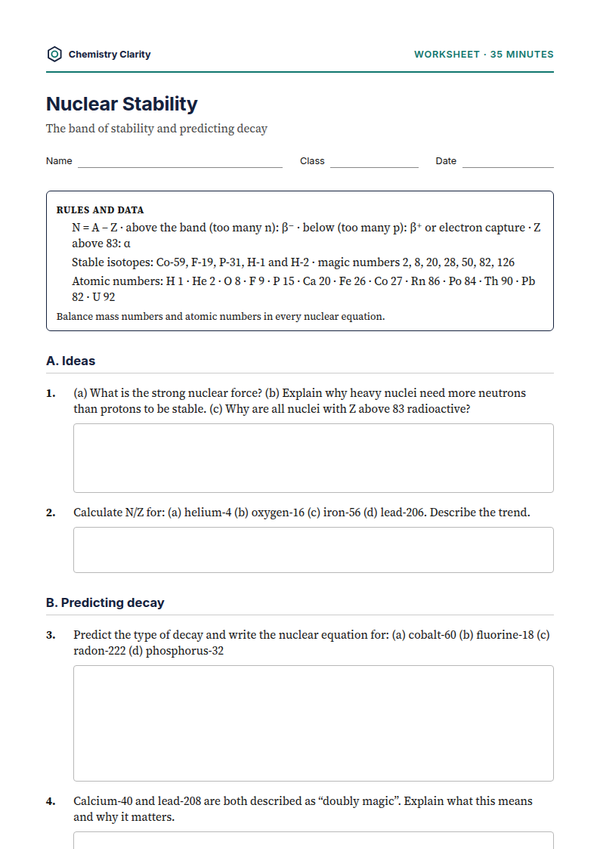
All the questions on this worksheet (about 35 minutes). Download the PDF to print it with space for working; the free answer key has full worked solutions.
A. Ideas
1.
(a) What is the strong nuclear force? (b) Explain why heavy nuclei need more neutrons than protons to be stable. (c) Why are all nuclei with Z above 83 radioactive?
2.
Calculate N/Z for: (a) helium-4 (b) oxygen-16 (c) iron-56 (d) lead-206. Describe the trend.
B. Predicting decay
3.
Predict the type of decay and write the nuclear equation for: (a) cobalt-60 (b) fluorine-18 (c) radon-222 (d) phosphorus-32
4.
Calcium-40 and lead-208 are both described as “doubly magic”. Explain what this means and why it matters.
C. Decay series
5.
Thorium-232 decays through a series to lead-208. How many α and β⁻ decays occur? Show your reasoning.
6.
Uranium-235 decays through a series to lead-207. How many α and β⁻ decays occur?
D. Applying the ideas
7.
Fluorine-18 is used in PET scans. Explain, using its N/Z ratio, why it emits positrons.
E. Challenge
8.
Tritium (hydrogen-3) is radioactive, but hydrogen-1 and hydrogen-2 are stable. Calculate the N/Z ratio of tritium, predict its decay, and write the equation.