What is it?
Standard cell potentials, , apply only when every dissolved species is at 1 mol/L (and gases at 1 bar). Real cells are rarely standard, and as a battery runs, the concentrations change. The Nernst equation gives the actual cell potential :
where is the number of electrons transferred, C/mol is the Faraday constant and is the reaction quotient. At 25 °C this becomes:
Key idea
As a cell runs, products build up and reactants are used, so Q increases and E falls. When reaches , the reaction is at equilibrium and : the battery is flat.
Why does it matter?
- Batteries. The Nernst equation explains why a battery’s voltage drops as it is used.
- Measuring concentrations. pH meters and ion-selective electrodes measure a voltage that depends on concentration through the Nernst equation.
- Biology. Nerve cells hold different ion concentrations inside and outside; the resulting voltage (membrane potential) is a concentration cell.
How does it work?
1. Using the Nernst equation
- Write the balanced overall equation and find and .
- Write (products over reactants; leave out solids).
- Substitute into .
2. Concentration cells
Two half-cells of the same metal in solutions of different concentration still give a voltage, even though . Electrons flow so as to make the concentrations equal: the dilute side is oxidized (anode) and the concentrated side is reduced (cathode).
3. E°, ΔG° and K
Three quantities describe how far a reaction “wants” to go, and each can be found from the others:
| Reaction at standard conditions | |||
|---|---|---|---|
| positive | negative | greater than 1 | spontaneous, products favoured |
| zero | zero | 1 | at equilibrium |
| negative | positive | less than 1 | non-spontaneous, reactants favoured |
Think of it like this
A cell is like water flowing between two tanks. is the height difference when both tanks start at a standard level. As water flows, the upper tank empties and the lower one fills, so the height difference (E) shrinks until the levels are equal and the flow stops (equilibrium, E = 0).
More precisely
The value 0.0592 V comes from at 298.15 K; at other temperatures use the full form. Because , a standard potential of only about 0.2 V for a 2-electron reaction already gives : small voltages correspond to very large equilibrium constants. Strictly, uses activities, so the Nernst equation is most accurate for dilute solutions.
Visualise it
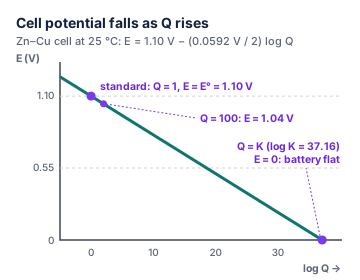
Worked example
Worked example: A non-standard Zn–Cu cell
Question: Calculate at 25 °C for when mol/L and mol/L.
-
; .
-
-
Nernst:
-
Less (a reactant) means a slightly lower voltage.
Worked example: A concentration cell
Question: Two copper electrodes dip into 0.0010 mol/L and 1.0 mol/L . Calculate the cell potential at 25 °C.
-
V (same half-reaction); . The dilute side is the anode: .
-
Nernst:
Worked example: From E° to K
Question: Calculate at 25 °C for the Zn–Cu reaction ( V, ).
The reaction goes essentially to completion.
Worked example: ΔG from E
Question: Calculate for the non-standard Zn–Cu cell above ( V).
(1 C × 1 V = 1 J.)
Common mistake
Common mistake: Using the wrong n
is the number of electrons transferred in the balanced overall equation: 2 for Zn + Cu²⁺, not 1.
Common mistake: Getting Q upside down
is products over reactants, like . For , . Solids (Zn, Cu) are left out.
Common mistake: Mixing ln and log
and are the same at 25 °C. Don’t use 0.0592 with ln.
Notation note
- : standard potential; : actual potential. = 96 485 C/mol.
- 1 V = 1 J/C, so comes out in J/mol.
Remember this
Remember this
- Nernst: ; at 25 °C, .
- As the cell runs, Q rises and E falls; at equilibrium Q = K and E = 0.
- Concentration cells: same electrodes, different concentrations, E° = 0 but E ≠ 0.
- ; V at 25 °C.
Test yourself
Check your understanding before moving on.
Flashcards
The Nernst Equation: Flashcards
- QuestionState the Nernst equation.Answer
- QuestionGive the Nernst equation at 25 °C with log.Answer
- QuestionWhy does a battery's voltage fall as it is used?Answer
Products build up and reactants are used, so Q increases and E decreases.
- QuestionWhat is E when the cell reaction reaches equilibrium?Answer
Zero: Q = K and the battery is flat.
- QuestionWhat is a concentration cell?Answer
A cell with the same electrode reaction on both sides but different concentrations; E° = 0 but E is not zero.
- QuestionIn a concentration cell, which side is the anode?Answer
The more dilute side (it is oxidized, raising its concentration).
- QuestionGive the relationship between ΔG° and E°.Answer
, with F = 96 485 C/mol.
- QuestionGive the relationship between E° and K at 25 °C.Answer
- QuestionA cell has E° = 1.10 V and n = 2. What is K at 25 °C?Answer
log K = 2 × 1.10 ÷ 0.0592 = 37.16, so K = 1.5 × 10³⁷.
- QuestionIf E° is positive, what are the signs of ΔG° and the size of K?Answer
ΔG° negative and K greater than 1: spontaneous, products favoured.
Tip: press Space to flip and ← → to move between cards.
Quiz
The Nernst Equation: Quiz
7 questions
Products accumulate, so Q rises; by the Nernst equation E = E° − (0.0592/n) log Q, E falls until it reaches zero at equilibrium.
Show answer
Answer: Q increases, E decreases
Products accumulate, so Q rises; by the Nernst equation E = E° − (0.0592/n) log Q, E falls until it reaches zero at equilibrium.
At equilibrium Q = K, there is no driving force and E = 0: the battery is flat.
Show answer
Answer: 0 V
At equilibrium Q = K, there is no driving force and E = 0: the battery is flat.
Q = 1.0 ÷ 0.010 = 100; E = 1.10 V − (0.0592 V ÷ 2) × log 100 = 1.10 V − 0.0592 V = 1.04 V.
Show answer
Answer: 1.04 V
Q = 1.0 ÷ 0.010 = 100; E = 1.10 V − (0.0592 V ÷ 2) × log 100 = 1.10 V − 0.0592 V = 1.04 V.
E° = 0; Q = 0.0010 ÷ 0.10 = 0.010; E = 0 − 0.0592 V × log(0.010) = +0.118 V.
Show answer
Answer: 0.118 V
E° = 0; Q = 0.0010 ÷ 0.10 = 0.010; E = 0 − 0.0592 V × log(0.010) = +0.118 V.
ΔG° = −nFE° = −2 × 96 485 C/mol × 0.46 V = −88 770 J/mol = −88.8 kJ/mol.
Show answer
Answer: −88.8 kJ/mol
ΔG° = −nFE° = −2 × 96 485 C/mol × 0.46 V = −88 770 J/mol = −88.8 kJ/mol.
log K = 2 × 0.46 ÷ 0.0592 = 15.54, so K = 10¹⁵·⁵⁴ = 3.5 × 10¹⁵. 3.5 × 10⁷ forgets n = 2.
Show answer
Answer: 3.5 × 10¹⁵
log K = 2 × 0.46 ÷ 0.0592 = 15.54, so K = 10¹⁵·⁵⁴ = 3.5 × 10¹⁵. 3.5 × 10⁷ forgets n = 2.
E° = (0.0592 V ÷ n) × log K = 0.0592 V × 5.0 = 0.296 V ≈ 0.30 V. K greater than 1 means E° is positive.
Show answer
Answer: 0.30 V
E° = (0.0592 V ÷ n) × log K = 0.0592 V × 5.0 = 0.296 V ≈ 0.30 V. K greater than 1 means E° is positive.
Notes and downloads
Worksheet
The Nernst Equation Worksheet
8 questions on the Nernst equation, concentration cells and converting between E°, ΔG° and K. Answer key included.
References
- Brown, T. L.; LeMay, H. E., Jr.; Bursten, B. E.; Murphy, C. J.; Woodward, P. M.; Stoltzfus, M. W. Chemistry: The Central Science, 15th ed.; Pearson, 2022.
Practise this topic with flashcards and a quiz at chemistryclarity.com/chemistry/nernst-equation/
Spotted a mistake? Let us know and we'll fix it.