What is it?
Electrolysis uses electricity to drive a redox reaction that would not happen on its own. It is the reverse of a galvanic cell: there, a spontaneous reaction makes electricity; here, electricity forces a non-spontaneous reaction.
An electrolytic cell has:
- a DC power supply, which pumps electrons;
- two electrodes, often inert (graphite or platinum);
- an electrolyte: an ionic compound that is molten or dissolved, so that its ions can move.
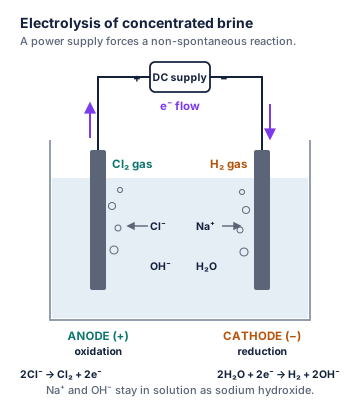
The anode is connected to the positive terminal: negative ions (anions) move to it and are oxidized. The cathode is connected to the negative terminal: positive ions (cations) move to it and are reduced.
Key idea
In every cell, oxidation at the anode, reduction at the cathode. In electrolysis the anode is positive and the cathode negative, the opposite signs to a galvanic cell, because the power supply decides the charges.
Why does it matter?
- Metals. All aluminium, and the most reactive metals (sodium, magnesium), are extracted by electrolysis because no chemical reducing agent is strong enough.
- Chemicals. Electrolysis of brine makes chlorine, hydrogen and sodium hydroxide, used in plastics (PVC), bleach, soap and water treatment.
- Purity and protection. Copper for electrical wiring is purified by electrolysis, and electroplating coats objects with chromium, nickel, silver or gold.
How does it work?
1. Molten electrolytes
A molten salt contains only its own ions, so the products are the elements:
- molten NaCl: cathode ; anode .
2. Aqueous electrolytes: water competes
In solution, water molecules can also be reduced or oxidized, so the more easily discharged species wins:
| Electrode | Product | Rule |
|---|---|---|
| Cathode (−) | the metal | if the metal is less reactive than hydrogen (Cu, Ag, Au) |
| Cathode (−) | hydrogen | if the metal is reactive (Na, K, Mg, Al): |
| Anode (+) | the halogen | for concentrated chloride, bromide or iodide |
| Anode (+) | oxygen | for sulfate, nitrate (and dilute chloride): |
3. Three important industrial processes
- Brine (concentrated NaCl solution): chlorine at the anode, hydrogen at the cathode, and sodium hydroxide left in solution.
- Aluminium: aluminium oxide is dissolved in molten cryolite at about 950 °C. Cathode: . Oxygen forms at the carbon anodes, which burn away to and must be replaced.
- Copper refining: an impure copper anode dissolves (), and pure copper deposits on the cathode; impurities such as silver and gold fall to the bottom as “anode sludge”.
4. Faraday’s law
The amount of product depends only on the charge passed:
Then use the half-equation to convert moles of electrons into moles of product: 1 mol needs 1 mol e⁻, 1 mol needs 2 mol e⁻, 1 mol needs 3 mol e⁻, and 1 mol releases 2 mol e⁻.
Think of it like this
A galvanic cell is a ball rolling downhill and turning a wheel on the way. Electrolysis is pushing the ball back up the hill with a motor: it only goes as long as you keep supplying energy, and the amount moved depends on how hard and how long you push (current × time).
More precisely
Which ion is discharged in solution depends on the electrode potentials, the concentrations and the electrode material. Concentrated chloride gives chlorine (not oxygen) even though oxygen has the less negative potential, because oxygen formation needs a large extra voltage (an overpotential) at most electrodes. The minimum voltage for electrolysis equals of the reverse, spontaneous reaction, but real cells need more, to overcome resistance and overpotentials.
Visualise it
Worked example
Worked example: Predicting the products
Question: Give the products at each electrode (inert electrodes) for: (a) molten (b) aqueous (c) dilute .
- (a) Molten: cathode lead (), anode bromine ().
- (b) Cathode copper (less reactive than hydrogen); anode oxygen (sulfate is not discharged). The blue colour fades as is used up, and the solution becomes acidic.
- (c) Cathode hydrogen, anode oxygen, in a 2 : 1 volume ratio: overall, water is split, .
Worked example: Aluminium from a cell
Question: What mass of aluminium is produced by a cell running at 1.00 × 10⁵ A for 24.0 h? (; Al = 26.98 g/mol)
- 805 kg
Worked example: Volume of chlorine from brine
Question: A current of 2.00 A passes through brine for 1.00 h. What volume of forms at 25.0 °C and 1.00 atm?
-
;
-
:
-
Ideal gas law:
Common mistake
Common mistake: Using galvanic-cell signs
In electrolysis the anode is positive; in a galvanic cell it is negative. What never changes is that oxidation happens at the anode.
Common mistake: Expecting a reactive metal from its solution
Electrolysis of aqueous NaCl does not give sodium: water is reduced instead, giving hydrogen. Sodium is made only from molten sodium chloride.
Common mistake: Forgetting the electron ratio
After finding moles of electrons, divide by the number of electrons in the half-equation: 3 for , 2 for and . Skipping this step makes the answer two or three times too large.
Notation note
- 1 A = 1 C/s; 1 faraday = 96 485 C, the charge on one mole of electrons.
- “Inert” electrodes (graphite, platinum) conduct electricity but do not react.
- “Discharged” means an ion gains or loses electrons at an electrode and becomes a neutral atom or molecule.
Remember this
Remember this
- Electrolysis: electricity forces a non-spontaneous redox reaction. Anode (+): oxidation; cathode (−): reduction.
- Molten salts give the elements. In water: cathode gives the metal (if below hydrogen) or H₂; anode gives the halogen (concentrated halide) or O₂.
- Brine → Cl₂, H₂, NaOH. Aluminium from molten Al₂O₃ in cryolite. Copper refined with an impure copper anode.
- , , then the half-equation ratio.
Test yourself
Check your understanding before moving on.
Flashcards
Electrolysis: Flashcards
- QuestionWhat is electrolysis?Answer
Using electricity to drive a non-spontaneous redox reaction.
- QuestionSigns and reactions at the electrodes in electrolysis?Answer
Anode (+): oxidation. Cathode (−): reduction.
- QuestionProducts of electrolysing molten NaCl?Answer
Sodium at the cathode, chlorine at the anode.
- QuestionWhen does a metal NOT form at the cathode in aqueous solution?Answer
When the metal is more reactive than hydrogen (e.g. Na, K, Mg, Al): water is reduced to H₂ instead.
- QuestionWhat forms at the anode in aqueous solution?Answer
The halogen from a concentrated halide; otherwise oxygen (e.g. with sulfate or nitrate).
- QuestionProducts of electrolysing concentrated brine?Answer
Chlorine (anode), hydrogen (cathode) and sodium hydroxide (left in solution).
- QuestionHow is aluminium extracted?Answer
Electrolysis of Al₂O₃ dissolved in molten cryolite (about 950 °C); Al³⁺ + 3e⁻ → Al; carbon anodes burn away.
- QuestionHow is copper purified?Answer
Impure copper anode dissolves; pure copper deposits on the cathode; impurities fall as anode sludge.
- QuestionFaraday's-law steps?Answer
Q = It; n(e⁻) = Q ÷ F (F = 96 485 C/mol); use the half-equation ratio; then mass or volume.
- QuestionMoles of electrons per mole of Ag, Cu, Al and Cl₂?Answer
Ag 1, Cu 2, Al 3, Cl₂ 2.
Tip: press Space to flip and ← → to move between cards.
Quiz
Electrolysis: Quiz
7 questions
Oxidation always happens at the anode; in electrolysis it is connected to the positive terminal.
Show answer
Answer: positive, where oxidation happens
Oxidation always happens at the anode; in electrolysis it is connected to the positive terminal.
Potassium is far more reactive than hydrogen, so water is reduced: 2H₂O + 2e⁻ → H₂ + 2OH⁻.
Show answer
Answer: hydrogen
Potassium is far more reactive than hydrogen, so water is reduced: 2H₂O + 2e⁻ → H₂ + 2OH⁻.
Sulfate is not discharged; water is oxidized: 2H₂O → O₂ + 4H⁺ + 4e⁻. Copper forms at the cathode.
Show answer
Answer: oxygen
Sulfate is not discharged; water is oxidized: 2H₂O → O₂ + 4H⁺ + 4e⁻. Copper forms at the cathode.
Na⁺ is very hard to reduce; in water, hydrogen forms at the cathode instead.
Show answer
Answer: in solution, water is reduced instead of Na⁺
Na⁺ is very hard to reduce; in water, hydrogen forms at the cathode instead.
Q = 1.00 C/s × 965 s = 965 C; n = 965 C ÷ 96 485 C/mol = 0.0100 mol.
Show answer
Answer: 0.0100 mol
Q = 1.00 C/s × 965 s = 965 C; n = 965 C ÷ 96 485 C/mol = 0.0100 mol.
0.0300 mol Ag needs 0.0300 mol e⁻; Cu²⁺ needs 2 e⁻ per atom, so 0.0300 ÷ 2 = 0.0150 mol Cu.
Show answer
Answer: 0.0150 mol
0.0300 mol Ag needs 0.0300 mol e⁻; Cu²⁺ needs 2 e⁻ per atom, so 0.0300 ÷ 2 = 0.0150 mol Cu.
The impure anode is oxidized and dissolves (Cu → Cu²⁺ + 2e⁻); pure copper is deposited on the cathode.
Show answer
Answer: the anode
The impure anode is oxidized and dissolves (Cu → Cu²⁺ + 2e⁻); pure copper is deposited on the cathode.
Notes and downloads
Worksheet
Electrolysis Worksheet
9 questions on electrode products, half-equations, industrial electrolysis, and Faraday's-law mass, time, gas-volume and energy calculations. Answer key included.
References
- Brown, T. L.; LeMay, H. E., Jr.; Bursten, B. E.; Murphy, C. J.; Woodward, P. M.; Stoltzfus, M. W. Chemistry: The Central Science, 15th ed.; Pearson, 2022.
Practise this topic with flashcards and a quiz at chemistryclarity.com/chemistry/electrolysis/
Spotted a mistake? Let us know and we'll fix it.