What is it?
Many reactions do not go to completion. They are reversible: the products can react to re-form the reactants. In a closed container, a reversible reaction reaches chemical equilibrium:
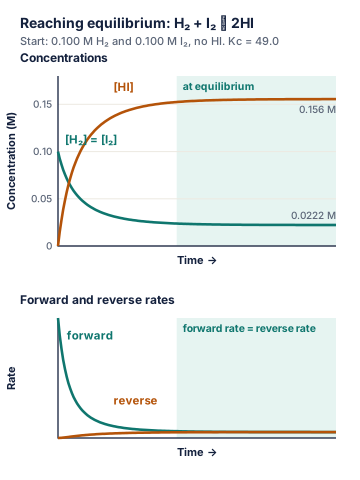
At equilibrium the forward and reverse reactions continue at equal rates, so the concentrations of reactants and products stay constant. This is a dynamic equilibrium: molecules keep reacting in both directions, but there is no overall change.
Key idea
At equilibrium, the concentrations are constant, not equal. The ratio between them is fixed by the equilibrium constant, .
Why does it matter?
- Yield. Equilibrium sets the maximum amount of product a reversible reaction can give, which matters in industry (ammonia, sulfuric acid, methanol).
- Acids, bases and solubility. for weak acids, buffers and solubility are all equilibrium constants.
- The body. Oxygen binding to haemoglobin and the carbonic acid buffer in blood are equilibria.
How does it work?
1. The equilibrium constant, Kc
For a general reaction , the equilibrium constant expression is:
- Products go on top, reactants on the bottom.
- Each concentration (in mol/L) is raised to the power of its coefficient in the balanced equation.
- Pure solids and pure liquids are left out (their “concentration” does not change). For , .
- is constant at a given temperature; it changes only when the temperature changes.
Units of Kc. Strictly, each concentration is divided by the standard concentration , so the units cancel and has no unit. The worked examples show this step.
2. What the size of K tells you
| Value of | At equilibrium the mixture contains… |
|---|---|
| very large (e.g. ) | mostly products: the reaction goes almost to completion |
| about 1 | significant amounts of both |
| very small (e.g. ) | mostly reactants: very little reaction |
3. Related equilibria
- Reverse the equation:
- Multiply the equation by : (for example, halving the coefficients gives )
4. The reaction quotient, Q
has the same form as , but uses the concentrations at any moment, not only at equilibrium. Comparing with predicts the direction of change:
| Comparison | What happens |
|---|---|
| too few products: the reaction goes forward (→) | |
| at equilibrium: no net change | |
| too many products: the reaction goes in reverse (←) |
5. ICE tables
To find equilibrium concentrations, use an ICE table: Initial, Change, Equilibrium. The changes follow the mole ratio of the equation, written in terms of an unknown, .
Think of it like this
Picture two shops connected by a door, with customers walking both ways. After a while, as many people walk from shop A to shop B each minute as walk back. The number of people in each shop stays the same, even though people never stop moving. That’s dynamic equilibrium, and the shops need not hold equal numbers.
More precisely
The thermodynamic equilibrium constant is defined with activities, which for dilute solutions are approximately and for gases . That is why equilibrium constants are dimensionless. For gases, uses partial pressures instead of concentrations; and are equal only when the number of moles of gas is the same on both sides.
Visualise it
Worked example
Worked example: Calculating Kc
Question: At a certain temperature, an equilibrium mixture of contains M and M. Calculate .
-
Write the expression:
-
Substitute, dividing each concentration by M:
-
The units cancel: .
Worked example: Predicting the direction with Q
Question: For , . A mixture contains 0.050 M , 0.050 M and 0.20 M HI. Is it at equilibrium? If not, which way will it shift?
- (the units of M² cancel)
- , so there is too little HI: the reaction goes forward, making more HI.
Worked example: An ICE table
Question: 0.100 M and 0.100 M are mixed with no HI (). Find the equilibrium concentrations.
-
ICE table, where is the decrease in , in M:
Initial 0.100 M 0.100 M 0 M Change −x −x +2x Equilibrium 0.100 M − x 0.100 M − x 2x -
Substitute: . Both sides are perfect squares, so take the square root:
-
, so
-
0.156 M; 0.0222 M
-
Check: (the small difference comes from rounding).
Common mistake
Common mistake: Thinking equilibrium means equal amounts
At equilibrium the concentrations are constant, not equal. In the example above there is seven times as much HI as .
Common mistake: Forgetting the coefficients as powers
For , , not . Coefficients become exponents.
Common mistake: Including solids, liquids or water
Pure solids and liquids (including water as the solvent) do not appear in . That’s why has no term.
Notation note
- The double half-arrow ⇌ shows a reversible reaction at equilibrium.
- Square brackets mean concentration in mol/L: = concentration of HI.
- “Position of equilibrium” describes whether reactants or products are favoured; it can change, but changes only with temperature.
Remember this
Remember this
- Dynamic equilibrium: forward rate = reverse rate; concentrations constant, not equal.
- = products over reactants, each to the power of its coefficient; leave out solids and liquids.
- : forward. : reverse. : at equilibrium.
- Use an ICE table; depends only on temperature.
Test yourself
Check your understanding before moving on.
Flashcards
Chemical Equilibrium: Flashcards
- QuestionWhat is dynamic equilibrium?Answer
The state in which the forward and reverse reactions continue at equal rates, so concentrations stay constant.
- QuestionAre reactant and product concentrations equal at equilibrium?Answer
No. They are constant, not equal.
- QuestionWrite for .Answer
- QuestionWhich substances are left out of ?Answer
Pure solids and pure liquids (including water as the solvent).
- QuestionWhat does a very large mean?Answer
At equilibrium the mixture is mostly products: the reaction goes almost to completion.
- QuestionIf , which way does the reaction go?Answer
Forward (→), making more products until .
- QuestionIf K for a reaction is 800, what is K for the reverse reaction?Answer
- QuestionWhat is the only factor that changes the value of ?Answer
Temperature.
- QuestionWhat do the letters in an ICE table stand for?Answer
Initial, Change, Equilibrium (concentrations, in M).
- QuestionWhy does have no unit?Answer
Each concentration is divided by the standard concentration , so the units cancel.
Tip: press Space to flip and ← → to move between cards.
Quiz
Chemical Equilibrium: Quiz
7 questions
Equilibrium is dynamic: both reactions continue at the same rate, so concentrations stay constant, but they are generally not equal.
Show answer
Answer: The forward and reverse rates are equal, and concentrations are constant
Equilibrium is dynamic: both reactions continue at the same rate, so concentrations stay constant, but they are generally not equal.
Products over reactants, each raised to the power of its coefficient.
Show answer
Answer:
Products over reactants, each raised to the power of its coefficient.
Pure solids are left out of the expression, so only the gas remains.
Show answer
Answer:
Pure solids are left out of the expression, so only the gas remains.
, with each concentration divided by 1 M: 0.000900 ÷ 0.0450 = 0.0200. The answer 0.667 forgets to square [NO₂].
Show answer
Answer: 0.0200
, with each concentration divided by 1 M: 0.000900 ÷ 0.0450 = 0.0200. The answer 0.667 forgets to square [NO₂].
means there are too few products, so the reaction goes forward until .
Show answer
Answer: The reaction goes forward, making more products
means there are too few products, so the reaction goes forward until .
Halving all the coefficients raises K to the power ½: √800 = 28.3. The answer 0.00125 is K for the reverse reaction.
Show answer
Answer: 28.3
Halving all the coefficients raises K to the power ½: √800 = 28.3. The answer 0.00125 is K for the reverse reaction.
Taking the square root of 49.0 = (2x)² / (0.100 M − x)² gives 7.00 = 2x / (0.100 M − x), so x = 0.0778 M and [HI] = 2x = 0.156 M. 0.0778 M is x itself.
Show answer
Answer: 0.156 M
Taking the square root of 49.0 = (2x)² / (0.100 M − x)² gives 7.00 = 2x / (0.100 M − x), so x = 0.0778 M and [HI] = 2x = 0.156 M. 0.0778 M is x itself.
Notes and downloads
Worksheet
Chemical Equilibrium Worksheet
9 questions on Kc expressions, calculating Kc, Q versus K and ICE tables. Answer key included.
References
- Brown, T. L.; LeMay, H. E., Jr.; Bursten, B. E.; Murphy, C. J.; Woodward, P. M.; Stoltzfus, M. W. Chemistry: The Central Science, 15th ed.; Pearson, 2022.
Practise this topic with flashcards and a quiz at chemistryclarity.com/chemistry/chemical-equilibrium/
Spotted a mistake? Let us know and we'll fix it.