Worksheet
The Nernst Equation Worksheet
8 questions on the Nernst equation, concentration cells and converting between E°, ΔG° and K. Answer key included.
- Type
- Worksheet
- Level
- Intermediate
- Format
- PDF, ready to print
Preview the questions
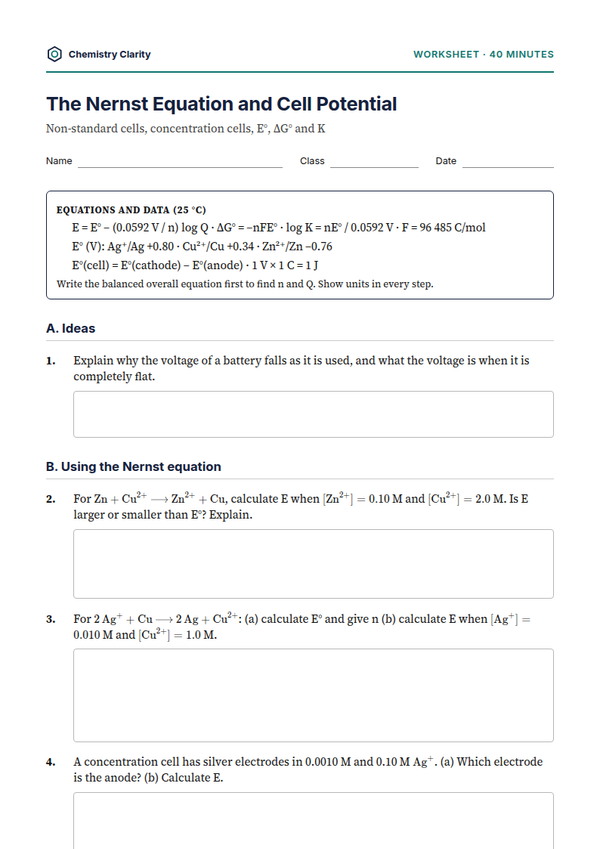
All the questions on this worksheet (about 40 minutes). Download the PDF to print it with space for working; the free answer key has full worked solutions.
A. Ideas
1.
Explain why the voltage of a battery falls as it is used, and what the voltage is when it is completely flat.
B. Using the Nernst equation
2.
For , calculate E when M and M. Is E larger or smaller than E°? Explain.
3.
For : (a) calculate E° and give n (b) calculate E when M and M.
4.
A concentration cell has silver electrodes in 0.0010 M and 0.10 M . (a) Which electrode is the anode? (b) Calculate E.
C. E°, ΔG° and K
5.
For the reaction in question 3, calculate (a) ΔG° (b) K at 25 °C.
6.
A one-electron reaction has K = 1.0 × 10⁵ at 25 °C. Calculate E°.
7.
Without calculating, what can you say about ΔG° and K for a cell with a negative E°?
D. Challenge
8.
A Zn–Cu cell starts with E = 1.10 V. Calculate the ratio at which its voltage has fallen to 1.00 V.