What is it?
A battery is one or more galvanic cells packaged so that a spontaneous redox reaction pushes electrons through a circuit. A fuel cell is a galvanic cell that is fed its reactants continuously. Corrosion is a galvanic cell nobody wanted: metal slowly oxidized by its surroundings.
| Device | Anode (oxidation, −) | Cathode (reduction, +) | Voltage per cell |
|---|---|---|---|
| Alkaline cell | zinc | manganese(IV) oxide | about 1.5 V |
| Lead–acid (car) battery | lead | lead(IV) oxide, in sulfuric acid | about 2.0 V (six cells: 12 V) |
| Lithium-ion | lithium in graphite | lithium metal oxide | about 3.7 V |
| Hydrogen fuel cell | hydrogen | oxygen | 1.23 V (standard) |
Key idea
Every battery, fuel cell and rusting nail is the same thing: an anode where something is oxidized, a cathode where something is reduced, an electrolyte that lets ions move, and a path for electrons. Change the chemicals and you change the voltage.
Why does it matter?
- Energy storage. Phones, laptops and electric cars run on lithium-ion batteries; grid storage helps renewable power.
- Clean energy. Hydrogen fuel cells produce only water as their exhaust.
- Cost of corrosion. Rust weakens bridges, pipelines and ships. Preventing it is a huge part of engineering.
How does it work?
1. Primary and rechargeable batteries
A primary battery (such as an alkaline cell) is used once: its reaction cannot easily be reversed. A secondary (rechargeable) battery is recharged by forcing current through it backwards, which drives the reaction in reverse: electrolysis. In a lithium-ion cell, ions shuttle between the graphite anode and the metal-oxide cathode, in one direction during discharge and in the other during charging.
2. The hydrogen fuel cell
. Unlike a battery, a fuel cell does not run down as long as hydrogen and oxygen are supplied.
3. How iron rusts
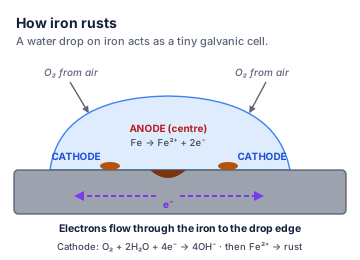
Rusting needs both oxygen and water. A drop of water on iron acts as a tiny galvanic cell:
- Anode (where the iron is pitted):
- Cathode (at the edge of the drop, where oxygen dissolves): (or, in neutral water, )
The is then oxidized further by air to hydrated iron(III) oxide, : rust. Salt speeds rusting because it makes the water a better electrolyte.
4. Preventing corrosion
- Barriers: paint, oil, grease or plastic coating keep out water and oxygen.
- Galvanizing: coating iron with zinc. Zinc ( V) is more easily oxidized than iron ( V), so even if the coating is scratched, zinc corrodes instead of the iron.
- Sacrificial anodes: blocks of magnesium or zinc are bolted to ship hulls and buried pipelines and slowly corrode in place of the steel.
- Alloys: stainless steel contains chromium, which forms a protective oxide layer.
Think of it like this
A sacrificial anode is a bodyguard for the iron. Because magnesium or zinc gives up electrons more readily, the corrosion “attacks” the bodyguard first, and the iron is left untouched until the bodyguard is used up and replaced.
More precisely
Coating iron with a less reactive metal, such as tin (tin cans) or copper, protects it only while the coating is unbroken; once scratched, the iron becomes the anode and corrodes faster. Aluminium does not rust away because it forms a thin, tough layer of that seals the surface (passivation). Lithium-ion batteries can fail dangerously if overcharged or damaged, because the electrolyte is flammable.
Visualise it
Worked example
Worked example: The energy of a fuel cell
Question: Calculate ΔG° for in a fuel cell ( V, ), and per mole of hydrogen.
That is for 2 mol of , so kJ per mole of hydrogen.
Worked example: The cell behind rusting
Question: Calculate for the rusting cell .
A large positive value: rusting is strongly spontaneous whenever oxygen and water are present.
Worked example: Which metal protects iron?
Question: Which of zinc, magnesium and copper could act as a sacrificial anode for iron?
Only a metal more easily oxidized than iron (more negative than −0.44 V) protects it: zinc (−0.76 V) and magnesium (−2.37 V). Copper (+0.34 V) would make the iron corrode faster.
Worked example: Battery capacity
Question: A phone battery is rated at 2000 mAh and about 3.7 V. Calculate (a) the charge it delivers (b) the moles of electrons (c) the mass of lithium that must move, if each carries one electron’s worth of charge (Li: 6.94 g/mol) (d) the energy stored.
- (a) (1 A s = 1 C)
- (b)
- (c)
- (d) , about 27 kJ.
Common mistake
Common mistake: Thinking iron rusts in dry air or in pure, air-free water
Rusting needs both oxygen and water. Iron stays bright in dry air and in boiled water sealed from air.
Common mistake: Coating iron with any metal
Only a more reactive metal (zinc, magnesium) gives sacrificial protection. A less reactive coating (tin, copper) speeds corrosion once it is scratched.
Common mistake: Confusing a fuel cell with a battery
A battery stores its reactants inside and runs down. A fuel cell is supplied with fuel continuously and keeps working while fuel flows.
Notation note
- In a battery the anode is the negative terminal and the cathode the positive terminal (the opposite of electrolysis).
- mAh (milliampere-hours) measures charge: 1 mAh = 3.6 C.
Remember this
Remember this
- Batteries and fuel cells are galvanic cells: oxidation at the anode (−), reduction at the cathode (+).
- Rechargeable batteries are recharged by electrolysis (reaction driven backwards).
- Hydrogen fuel cell: , V, only water as exhaust.
- Rusting needs oxygen and water; salt speeds it up. V.
- Protection: barriers, galvanizing and sacrificial anodes (metals with more negative E° than iron).
Test yourself
Check your understanding before moving on.
Flashcards
Batteries, Fuel Cells and Corrosion: Flashcards
- QuestionWhat is a battery, in electrochemical terms?Answer
One or more galvanic cells: a spontaneous redox reaction drives electrons through a circuit.
- QuestionWhat is the difference between a primary and a secondary battery?Answer
Primary: used once. Secondary: rechargeable, by driving the reaction backwards with an external current (electrolysis).
- QuestionIn a battery, which electrode is negative?Answer
The anode (oxidation); the cathode is positive.
- QuestionWhat moves between the electrodes in a lithium-ion battery?Answer
Li⁺ ions, between the graphite anode and the metal-oxide cathode.
- QuestionGive the overall reaction and E° of a hydrogen fuel cell.Answer
2H₂ + O₂ → 2H₂O; E° = 1.23 V.
- QuestionWhat two substances are needed for iron to rust?Answer
Oxygen and water.
- QuestionGive the anode half-equation for rusting.Answer
- QuestionWhy does salt speed up rusting?Answer
It makes the water a better electrolyte, so ions move more easily.
- QuestionWhy does zinc protect iron even when the coating is scratched?Answer
Zinc (E° −0.76 V) is more easily oxidized than iron (−0.44 V), so it corrodes instead (sacrificial protection).
- QuestionHow many coulombs is 2000 mAh?Answer
2.000 A × 3600 s = 7200 C
Tip: press Space to flip and ← → to move between cards.
Quiz
Batteries, Fuel Cells and Corrosion: Quiz
7 questions
Charging is electrolysis: electrical energy forces the non-spontaneous reverse reaction, restoring the reactants.
Show answer
Answer: An external current drives the cell reaction in reverse
Charging is electrolysis: electrical energy forces the non-spontaneous reverse reaction, restoring the reactants.
Overall reaction: 2H₂ + O₂ → 2H₂O.
Show answer
Answer: Water
Overall reaction: 2H₂ + O₂ → 2H₂O.
Rusting needs oxygen and water; dissolved salt makes the water a better electrolyte and speeds the reaction.
Show answer
Answer: Salt water open to air
Rusting needs oxygen and water; dissolved salt makes the water a better electrolyte and speeds the reaction.
Magnesium (E° −2.37 V) is oxidized more easily than iron (−0.44 V), so it corrodes instead. Copper, silver and tin are less reactive than iron.
Show answer
Answer: Magnesium
Magnesium (E° −2.37 V) is oxidized more easily than iron (−0.44 V), so it corrodes instead. Copper, silver and tin are less reactive than iron.
E°cell = E°cathode − E°anode = 1.23 V − (−0.44 V) = 1.67 V. 0.79 V comes from adding the values.
Show answer
Answer: 1.67 V
E°cell = E°cathode − E°anode = 1.23 V − (−0.44 V) = 1.67 V. 0.79 V comes from adding the values.
ΔG° = −4 × 96 485 C/mol × 1.23 V = −475 kJ for 2 mol H₂, which is −237 kJ per mole of H₂.
Show answer
Answer: −237 kJ
ΔG° = −4 × 96 485 C/mol × 1.23 V = −475 kJ for 2 mol H₂, which is −237 kJ per mole of H₂.
Where both metals touch the electrolyte, the more reactive iron is oxidized and the tin acts as the cathode, speeding corrosion of the iron.
Show answer
Answer: Iron becomes the anode, because iron is more reactive than tin
Where both metals touch the electrolyte, the more reactive iron is oxidized and the tin acts as the cathode, speeding corrosion of the iron.
Notes and downloads
Worksheet
Batteries, Fuel Cells and Corrosion Worksheet
8 questions on batteries, fuel cells, the electrochemistry of rusting, corrosion protection and battery-capacity calculations. Answer key included.
References
- Brown, T. L.; LeMay, H. E., Jr.; Bursten, B. E.; Murphy, C. J.; Woodward, P. M.; Stoltzfus, M. W. Chemistry: The Central Science, 15th ed.; Pearson, 2022.
Practise this topic with flashcards and a quiz at chemistryclarity.com/chemistry/batteries-fuel-cells-and-corrosion/
Spotted a mistake? Let us know and we'll fix it.