What is it?
A galvanic (or voltaic) cell uses a spontaneous redox reaction to produce electricity. The oxidation and the reduction happen in separate half-cells, so the electrons must travel through an external wire, where they can do useful work.
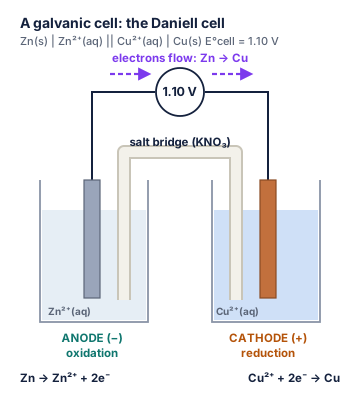
In the Daniell cell, a zinc electrode in solution is connected to a copper electrode in solution:
- Anode (zinc): oxidation, . It is the negative electrode.
- Cathode (copper): reduction, . It is the positive electrode.
- A salt bridge lets ions move between the solutions to keep them electrically neutral.
Key idea
Electrons flow through the wire from the anode (oxidation) to the cathode (reduction). The cell voltage is ; a positive means the reaction is spontaneous.
Why does it matter?
- Batteries. Every battery, from AA cells to lithium-ion packs, is a galvanic cell (or several in series).
- Corrosion. Rusting is an unwanted galvanic process; zinc coatings protect steel because zinc is oxidized first.
- Industry. Electrolysis (the reverse process, driven by electricity) produces aluminium, chlorine and copper, and electroplates metals.
How does it work?
1. Standard reduction potentials
Each half-cell has a standard reduction potential, , measured against the standard hydrogen electrode (defined as 0.00 V) at 25 °C, 1 M and 1 bar. A more positive means a stronger oxidizing agent (more easily reduced).
| Half-reaction (reduction) | (V) |
|---|---|
| +2.87 | |
| +1.51 | |
| +1.36 | |
| +0.80 | |
| +0.77 | |
| +0.34 | |
| 0.00 | |
| −0.25 | |
| −0.76 | |
| −1.66 | |
| −2.37 |
2. Cell voltage
Use both values as reduction potentials from the table, and do not multiply by the coefficients: a potential does not depend on how much substance reacts.
3. Cell notation
The anode is written on the left and the cathode on the right; a single line | separates phases and a double line || shows the salt bridge:
4. Free energy and spontaneity
The cell voltage is linked to the Gibbs free energy change:
where is the moles of electrons transferred and C/mol (the Faraday constant, the charge on one mole of electrons). Positive gives negative : a spontaneous reaction.
5. Electrolysis
In electrolysis, an external power supply forces a non-spontaneous redox reaction. The amount of product follows from the charge passed (Faraday’s law):
where is the current in amperes (A = C/s) and is the time in seconds.
Think of it like this
A galvanic cell is like water flowing downhill through a water wheel: the reaction “wants” to happen, and the cell makes it do work on the way. Electrolysis is like pumping water back uphill: it needs an external energy source.
More precisely
Standard potentials apply at 1 M concentrations and 25 °C. At other concentrations, the Nernst equation, , gives the actual cell voltage; it falls as the cell runs and Q increases, reaching zero when the reaction is at equilibrium (a “flat” battery).
Visualise it
Worked example
Worked example: Cell voltage and ΔG°
Question: A cell is made from Ag⁺/Ag and Cu²⁺/Cu half-cells. Find , write the overall reaction, and calculate .
-
The more positive (Ag⁺/Ag, +0.80 V) is reduced at the cathode; copper (+0.34 V) is oxidized at the anode.
-
-
Overall: , so mol of electrons.
-
Substitute (1 C × 1 V = 1 J):
-
is positive and negative: the reaction is spontaneous.
Worked example: Electroplating copper
Question: A current of 2.00 A passes through copper(II) sulfate solution for 30.0 min. What mass of copper is deposited? (; Cu = 63.55 g/mol)
- 1.19 g
Common mistake
Common mistake: Multiplying E° by the coefficients
In , use V for silver, not 2 × 0.80 V. Potentials are intensive: they don’t depend on amount.
Common mistake: Flipping signs twice
Use with both values copied straight from the reduction table. Don’t also change the sign of the anode value, or you will subtract twice.
Common mistake: Mixing up anode and cathode
In any cell, oxidation happens at the anode and reduction at the cathode (“an ox, red cat”). In a galvanic cell the anode is negative; in electrolysis it is positive.
Notation note
- 1 V = 1 J/C, so C × V = J; 1 A = 1 C/s.
- = 96 485 C/mol is sometimes rounded to 96 500 C/mol.
- “SHE” = standard hydrogen electrode, the zero of the potential scale.
Remember this
Remember this
- Galvanic cell: spontaneous redox makes electricity; anode = oxidation (−), cathode = reduction (+).
- ; positive means spontaneous. Don’t multiply E° by coefficients.
- with C/mol.
- Electrolysis: , , then use the half-equation’s mole ratio.
Test yourself
Check your understanding before moving on.
Flashcards
Galvanic Cells and Electrode Potentials: Flashcards
- QuestionWhat is a galvanic cell?Answer
A cell that uses a spontaneous redox reaction to produce electricity.
- QuestionWhat happens at the anode and the cathode?Answer
Anode: oxidation. Cathode: reduction. ("An ox, red cat")
- QuestionWhich way do electrons flow in the external wire?Answer
From the anode to the cathode.
- QuestionWhat does the salt bridge do?Answer
Lets ions move between the half-cells to keep each solution electrically neutral.
- QuestionFormula for E°cell?Answer
(both as reduction potentials)
- QuestionE°cell for the Daniell cell (Cu²⁺/Cu +0.34 V, Zn²⁺/Zn −0.76 V)?Answer
+0.34 V − (−0.76 V) = +1.10 V
- QuestionWrite the cell notation for the Daniell cell.Answer
Zn(s) | Zn²⁺(aq) || Cu²⁺(aq) | Cu(s)
- QuestionHow are ΔG° and E°cell related?Answer
, with F = 96 485 C/mol; positive E° means negative ΔG° (spontaneous).
- QuestionShould E° be multiplied by the coefficients in the equation?Answer
No. Potentials do not depend on the amount of substance.
- QuestionIn electrolysis, how do you find the moles of electrons?Answer
(charge in C), then .
Tip: press Space to flip and ← → to move between cards.
Quiz
Galvanic Cells and Electrode Potentials: Quiz
7 questions
Oxidation always occurs at the anode and reduction at the cathode.
Show answer
Answer: At the anode
Oxidation always occurs at the anode and reduction at the cathode.
Silver is reduced (cathode): E°cell = +0.80 V − (−0.76 V) = +1.56 V. Doubling the silver value to 1.60 V would be wrong; the answer 2.36 V does that.
Show answer
Answer: +1.56 V
Silver is reduced (cathode): E°cell = +0.80 V − (−0.76 V) = +1.56 V. Doubling the silver value to 1.60 V would be wrong; the answer 2.36 V does that.
The most positive reduction potential means the species is most easily reduced, so it is the strongest oxidizing agent.
Show answer
Answer: Ag⁺
The most positive reduction potential means the species is most easily reduced, so it is the strongest oxidizing agent.
For Cu + Zn²⁺ → Cu²⁺ + Zn, Zn²⁺ would be the cathode: E°cell = −0.76 V − (+0.34 V) = −1.10 V. Negative means not spontaneous.
Show answer
Answer: No, E°cell = −1.10 V
For Cu + Zn²⁺ → Cu²⁺ + Zn, Zn²⁺ would be the cathode: E°cell = −0.76 V − (+0.34 V) = −1.10 V. Negative means not spontaneous.
ΔG° = −(2 mol)(96 485 C/mol)(1.10 V) = −2.12 × 10⁵ J = −212 kJ (C × V = J). The answer −106 kJ uses n = 1.
Show answer
Answer: −212 kJ
ΔG° = −(2 mol)(96 485 C/mol)(1.10 V) = −2.12 × 10⁵ J = −212 kJ (C × V = J). The answer −106 kJ uses n = 1.
Electrons travel through the wire; ions move through the salt bridge. Without it, charge would build up and the current would stop.
Show answer
Answer: To let ions flow and keep the solutions neutral
Electrons travel through the wire; ions move through the salt bridge. Without it, charge would build up and the current would stop.
Q = It = 2.00 C/s × (30.0 min × 60 s/min) = 2.00 C/s × 1800 s = 3600 C. The answer 60.0 C forgets to convert minutes to seconds.
Show answer
Answer: 3600 C
Q = It = 2.00 C/s × (30.0 min × 60 s/min) = 2.00 C/s × 1800 s = 3600 C. The answer 60.0 C forgets to convert minutes to seconds.
Notes and downloads
Worksheet
Galvanic Cells and Electrode Potentials Worksheet
9 questions on galvanic cells, standard reduction potentials, E°cell, cell notation, ΔG° and electrolysis calculations. Answer key included.
References
- Brown, T. L.; LeMay, H. E., Jr.; Bursten, B. E.; Murphy, C. J.; Woodward, P. M.; Stoltzfus, M. W. Chemistry: The Central Science, 15th ed.; Pearson, 2022.
Practise this topic with flashcards and a quiz at chemistryclarity.com/chemistry/galvanic-cells/
Spotted a mistake? Let us know and we'll fix it.