What is it?
Three kinds of strong bond hold matter together: ionic (between ions), covalent (shared pairs of electrons) and metallic.
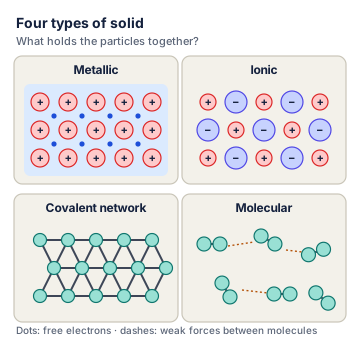
Metallic bonding is the attraction between positive metal ions arranged in a regular lattice and a “sea” of delocalized electrons that are free to move through the whole structure. Each metal atom gives its outer electrons to the sea; the electrons are shared by all the ions at once, rather than belonging to one bond.
The type of bonding, and the way the particles are arranged, decide the kind of solid a substance forms:
| Type of solid | Particles | Held by | Examples |
|---|---|---|---|
| Ionic | Positive and negative ions | Ionic bonds throughout a lattice | NaCl, MgO, CaCO₃ |
| Molecular | Small molecules | Weak intermolecular forces between molecules (strong covalent bonds inside them) | Ice, iodine, sugar, CO₂ (dry ice) |
| Covalent network | Atoms | Covalent bonds throughout a giant structure | Diamond, graphite, silicon dioxide (quartz) |
| Metallic | Metal ions in a sea of electrons | Metallic bonding | Copper, iron, aluminium, alloys |
Key idea
To predict properties, ask what has to be overcome to melt the solid. Molecular solids only need weak forces between molecules to be overcome, so they melt at low temperatures. Ionic, network and metallic solids need strong bonds to be broken or loosened, so they melt at high temperatures.
Why does it matter?
- Choosing materials. Wires are copper (conducts), drill tips are diamond (hard), cookware is metal (conducts heat) and insulators are often ionic or network ceramics.
- Explaining everyday observations. Why salt dissolves but sand does not, why a metal spoon bends but a crystal of salt shatters, why pencils write.
- Alloys. Steel, brass and bronze are designed by changing the metallic lattice.
How does it work?
1. Properties of metals from the electron sea
- Electrical conductivity: the delocalized electrons move when a voltage is applied, in the solid and the liquid.
- Thermal conductivity: mobile electrons carry energy quickly through the metal.
- Malleable and ductile: layers of ions can slide over each other without breaking the bonding, because the electron sea moves with them. (In an ionic crystal, sliding brings like charges together, and the crystal shatters.)
- Shiny: the free electrons absorb and re-emit light.
- High melting points (mostly): the attraction between ions and electrons is strong. More delocalized electrons per atom and smaller ions give stronger bonding (sodium melts at 98 °C, but iron at 1538 °C).
2. Alloys
An alloy is a mixture of a metal with other elements. Atoms of a different size disrupt the regular layers, so they slide less easily: alloys are usually harder and stronger than the pure metal. Examples: steel (iron with a little carbon), brass (copper and zinc), bronze (copper and tin).
3. Comparing the four types of solid
| Property | Ionic | Molecular | Covalent network | Metallic |
|---|---|---|---|---|
| Melting point | High (NaCl 801 °C) | Low (I₂ 114 °C) | Very high (SiO₂ about 1700 °C; diamond above 3500 °C) | Low to very high (Na 98 °C, W 3422 °C) |
| Conducts as solid? | No | No | No (except graphite) | Yes |
| Conducts when molten or dissolved? | Yes: ions are free to move | No | No | Yes (molten) |
| Hardness | Hard but brittle | Soft | Very hard (diamond) | Malleable |
| Soluble in water? | Often | Polar ones may be | No | No |
4. Diamond and graphite
Both are pure carbon, but the atoms are bonded differently:
- Diamond: each carbon is bonded to four others in a rigid 3D network. Extremely hard; does not conduct.
- Graphite: each carbon is bonded to three others in flat layers of hexagons. The fourth electron of each atom is delocalized along the layer, so graphite conducts electricity. The layers are held together only weakly, so they slide: graphite is soft and slippery, which is why it works in pencils and as a lubricant.
Think of it like this
A metal is like a crowd of people (the ions) standing in rows in a pool of water (the electrons). Push the crowd and the rows slide along, still surrounded by water: the metal bends instead of breaking. Push an ionic crystal and positive meets positive: it splits apart.
More precisely
The “electron sea” is a simple picture of what band theory describes more exactly: in a metal, atomic orbitals merge into bands of closely spaced energy levels, and a partly filled band lets electrons move freely. In insulators the filled and empty bands are separated by a large gap; in semiconductors such as silicon the gap is small, so a few electrons can cross it, and more do as the temperature rises. Graphene, a single layer of graphite, is one of the strongest and most conductive materials known.
Visualise it
Worked example
Worked example: Classifying solids from their properties
Question: Classify each solid. A: melts at 1085 °C, conducts as a solid. B: melts at 801 °C, conducts only when molten. C: melts at 114 °C, does not conduct. D: melts at about 1700 °C, does not conduct even when molten.
- A conducts as a solid: metallic (it is copper).
- B conducts only when molten, high melting point: ionic (sodium chloride).
- C low melting point, non-conductor: molecular (iodine).
- D very high melting point, never conducts: covalent network (silicon dioxide).
Worked example: Explaining a property
Question: Explain why solid sodium chloride does not conduct electricity, but molten sodium chloride does.
In the solid, the ions are held in fixed positions in the lattice and cannot move. When the solid melts (or dissolves), the ions become free to move and carry charge. Ionic compounds have no delocalized electrons, so the moving charges are the ions themselves.
Worked example: Composition of an alloy
Question: A brass key has a mass of 25.0 g and is 70.0 % copper by mass. What masses of copper and zinc does it contain?
-
Copper:
-
Zinc (the rest):
Common mistake
Common mistake: Thinking melting a molecular solid breaks covalent bonds
When ice melts, the O–H bonds inside the water molecules stay intact. Only the weak forces between molecules are overcome. That’s why molecular solids melt at low temperatures.
Common mistake: Saying ionic solids conduct because of electrons
Ionic compounds conduct (when molten or dissolved) because ions move, not electrons. Metals and graphite conduct because electrons move.
Common mistake: Expecting all network solids to be insulators
Graphite is a network solid that conducts, because each carbon has one delocalized electron. Diamond does not, because all four outer electrons are used in bonds.
Notation note
- “Giant structure”, “giant covalent” and “macromolecular” are other names for covalent network solids.
- The formula of a network or ionic solid (SiO₂, NaCl) gives the ratio of atoms or ions, not a molecule.
Remember this
Remember this
- Metallic bonding: positive ions attracted to a sea of delocalized electrons.
- Metals conduct (mobile electrons), are malleable (layers slide) and shiny.
- Alloys are harder than pure metals because different-sized atoms stop the layers sliding.
- Four solids: ionic (ions), molecular (molecules, weak forces), covalent network (atoms, giant structure), metallic.
- Molecular solids melt low; ionic, network and most metallic solids melt high.
- Graphite conducts (delocalized electrons in layers); diamond does not.
Test yourself
Check your understanding before moving on.
Flashcards
Metallic Bonding and Types of Solids: Flashcards
- QuestionWhat is metallic bonding?Answer
The attraction between positive metal ions in a lattice and a sea of delocalized electrons.
- QuestionWhy do metals conduct electricity?Answer
Their delocalized electrons are free to move through the structure.
- QuestionWhy are metals malleable but ionic crystals brittle?Answer
Metal layers slide without breaking the bonding; in an ionic crystal, sliding brings like charges together and it shatters.
- QuestionWhy are alloys harder than pure metals?Answer
Atoms of a different size disrupt the layers, so they slide less easily.
- QuestionName the four types of solid.Answer
Ionic, molecular, covalent network, metallic.
- QuestionWhy do molecular solids have low melting points?Answer
Only weak forces between molecules need to be overcome; the covalent bonds inside the molecules stay intact.
- QuestionWhen does an ionic compound conduct electricity?Answer
When molten or dissolved, because the ions are then free to move.
- QuestionGive two examples of covalent network solids.Answer
Diamond, graphite, silicon dioxide (quartz), silicon.
- QuestionWhy does graphite conduct electricity but diamond does not?Answer
In graphite each C bonds to 3 others, leaving one delocalized electron per atom; in diamond all 4 outer electrons are in bonds.
- QuestionA solid melts at 801 °C and conducts only when molten. What type is it?Answer
Ionic (e.g. sodium chloride).
Tip: press Space to flip and ← → to move between cards.
Quiz
Metallic Bonding and Types of Solids: Quiz
7 questions
In metallic bonding the outer electrons are delocalized and free to move, so they carry the current. The positive ions stay in the lattice.
Show answer
Answer: Delocalized electrons
In metallic bonding the outer electrons are delocalized and free to move, so they carry the current. The positive ions stay in the lattice.
Melting a molecular solid only overcomes the weak forces between molecules, so molecular solids usually melt at low temperatures.
Show answer
Answer: Molecular
Melting a molecular solid only overcomes the weak forces between molecules, so molecular solids usually melt at low temperatures.
In the solid the ions are fixed in the lattice; when molten they can move and carry charge. NaCl has no delocalized electrons.
Show answer
Answer: Its ions are free to move
In the solid the ions are fixed in the lattice; when molten they can move and carry charge. NaCl has no delocalized electrons.
A very high melting point means strong bonds throughout; no conduction even when molten rules out ionic and metallic solids. Silicon dioxide fits.
Show answer
Answer: Covalent network
A very high melting point means strong bonds throughout; no conduction even when molten rules out ionic and metallic solids. Silicon dioxide fits.
Within each layer the covalent bonds are very strong, but the forces between layers are weak, so the layers slide over each other.
Show answer
Answer: Its layers are held together only weakly and can slide
Within each layer the covalent bonds are very strong, but the forces between layers are weak, so the layers slide over each other.
Atoms of a different size distort the regular layers of iron ions, making it harder for layers to slide: the alloy is harder and stronger.
Show answer
Answer: Carbon atoms disrupt the layers so they slide less easily
Atoms of a different size distort the regular layers of iron ions, making it harder for layers to slide: the alloy is harder and stronger.
Ice is a molecular solid. Melting overcomes the intermolecular forces, mainly hydrogen bonds; the O–H bonds inside each molecule are not broken.
Show answer
Answer: Forces between water molecules (including hydrogen bonds)
Ice is a molecular solid. Melting overcomes the intermolecular forces, mainly hydrogen bonds; the O–H bonds inside each molecule are not broken.
Notes and downloads
Worksheet
Metallic Bonding and Types of Solids Worksheet
8 questions on metallic bonding, alloys, classifying solids from their properties, and diamond and graphite. Answer key included.
References
- Brown, T. L.; LeMay, H. E., Jr.; Bursten, B. E.; Murphy, C. J.; Woodward, P. M.; Stoltzfus, M. W. Chemistry: The Central Science, 15th ed.; Pearson, 2022.
Practise this topic with flashcards and a quiz at chemistryclarity.com/chemistry/metallic-bonding-and-solids/
Spotted a mistake? Let us know and we'll fix it.