Worksheet
Metallic Bonding and Types of Solids Worksheet
8 questions on metallic bonding, alloys, classifying solids from their properties, and diamond and graphite. Answer key included.
- Type
- Worksheet
- Level
- Beginner
- Format
- PDF, ready to print
Preview the questions
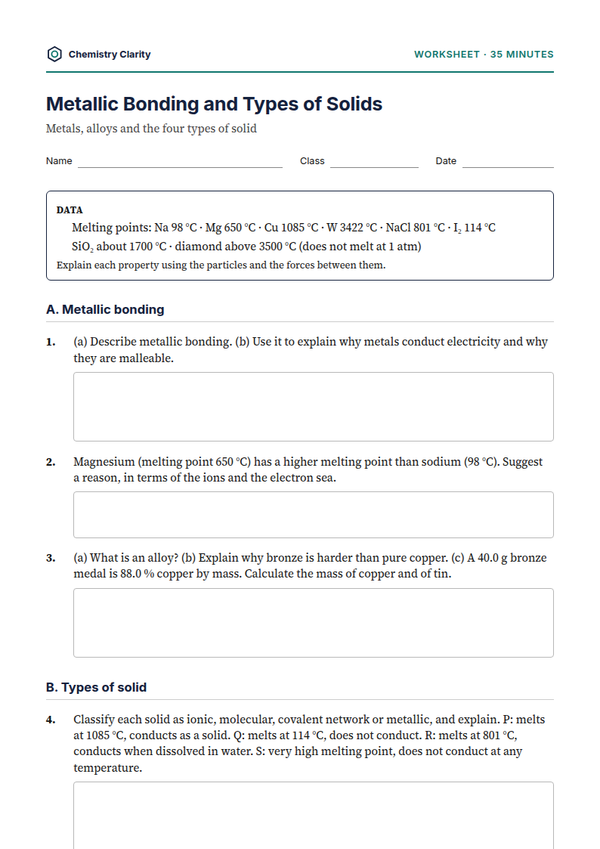
All the questions on this worksheet (about 35 minutes). Download the PDF to print it with space for working; the free answer key has full worked solutions.
A. Metallic bonding
1.
(a) Describe metallic bonding. (b) Use it to explain why metals conduct electricity and why they are malleable.
2.
Magnesium (melting point 650 °C) has a higher melting point than sodium (98 °C). Suggest a reason, in terms of the ions and the electron sea.
3.
(a) What is an alloy? (b) Explain why bronze is harder than pure copper. (c) A 40.0 g bronze medal is 88.0 % copper by mass. Calculate the mass of copper and of tin.
B. Types of solid
4.
Classify each solid as ionic, molecular, covalent network or metallic, and explain. P: melts at 1085 °C, conducts as a solid. Q: melts at 114 °C, does not conduct. R: melts at 801 °C, conducts when dissolved in water. S: very high melting point, does not conduct at any temperature.
5.
Explain why: (a) solid potassium chloride does not conduct, but its solution does (b) iodine has a low melting point even though the I–I bond is covalent.
C. Diamond and graphite
6.
Diamond and graphite are both pure carbon. Explain, in terms of structure and bonding, why (a) diamond is very hard (b) graphite conducts electricity (c) graphite is used in pencils.
D. Comparing structures
7.
Explain why a metal spoon bends when you hit it, but a crystal of salt shatters.
E. Challenge
8.
Silicon dioxide (SiO₂) melts at about 1700 °C, but carbon dioxide (CO₂) is a gas at room temperature. Both have the formula XO₂. Explain the huge difference.