What is it?
A chemistry lab is a safe place when everyone follows the same rules. Two skills go together:
- Safety: recognizing hazards, wearing the right protection and working in a way that prevents accidents.
- Equipment: knowing what each piece of apparatus is for and how precisely it measures, so that results are reliable.
Hazards are communicated worldwide with the GHS (Globally Harmonized System) pictograms: red-bordered diamonds printed on bottles and on safety data sheets (SDS).
| Pictogram | Meaning | Example |
|---|---|---|
| Flame | Flammable | Ethanol, propanone (acetone) |
| Flame over circle | Oxidizer: makes fires burn more fiercely | Concentrated hydrogen peroxide, potassium nitrate |
| Exploding bomb | Explosive or self-reacting | Some peroxides |
| Gas cylinder | Gas under pressure | Oxygen and nitrogen cylinders |
| Corrosion | Destroys skin, eyes or metal | Concentrated acids, sodium hydroxide |
| Skull and crossbones | Toxic: can kill in small amounts | Mercury compounds |
| Exclamation mark | Harmful or irritant | Dilute ammonia solution |
| Health hazard | Long-term harm (e.g. cancer, damage to organs) | Benzene |
| Environment | Toxic to aquatic life | Copper(II) sulfate |
The signal word shows severity: Danger for the more serious hazards, Warning for the less serious ones.
Key idea
Before any practical, ask three questions: What are the hazards? (read the label and the SDS), How could I be harmed? and What will I do to reduce the risk? This is a risk assessment, and every professional chemist does one.
Why does it matter?
- Your safety and others’. Most lab accidents come from a few avoidable causes: no eye protection, spills, heating carelessly and mixing up bottles.
- Reliable results. Using a beaker to measure 25.00 mL, or reading a burette from above, gives results that no calculation can rescue.
- Every later practical depends on it, from making solutions (molarity) to titrations.
How does it work?
1. Protective equipment and safe habits
- Wear safety goggles at all times while chemicals are in use; add a lab coat and, when needed, gloves. Tie back long hair; wear closed shoes.
- No eating or drinking in the lab, and never taste or directly sniff a chemical: waft the vapour gently towards your nose if told to smell it.
- Use a fume cupboard for toxic or smelly gases and volatile solvents.
- When heating a test tube, point it away from everyone. Keep flammable liquids away from flames; use a water bath or hot plate instead.
- To dilute a concentrated acid, add acid to water, slowly, never water to acid: the mixing releases heat, and adding water to acid can make it boil and spit.
- Never pipette by mouth; use a pipette filler.
- Report every spill, breakage and injury at once. Know where the eyewash, safety shower and fire blanket are. Dispose of waste as instructed, not down the sink by default.
2. Equipment and its precision
| Apparatus | Use | Typical tolerance (class A) |
|---|---|---|
| Beaker | Holding, mixing, heating | Marks only approximate (about ±5 %) |
| Conical flask | Swirling, titrations | Marks only approximate |
| Measuring cylinder, 100 mL | Measuring volumes roughly | ±0.5 mL |
| Burette, 50 mL | Adding a variable, measured volume (titration) | ±0.05 mL |
| Volumetric pipette, 25 mL | Delivering one fixed volume | ±0.03 mL |
| Volumetric flask, 250 mL | Making a solution of exact volume | ±0.15 mL |
| Top-pan balance | Weighing | ±0.01 g |
| Analytical balance | Accurate weighing | ±0.0001 g |
The percent uncertainty compares equipment fairly:
3. Reading a scale
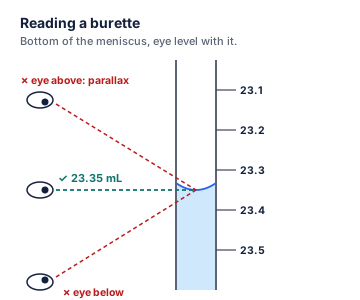
- Liquids in narrow glassware form a curved surface, the meniscus. For water and most solutions, read the bottom of the meniscus.
- Your eye must be level with the meniscus. Reading from above or below gives a parallax error.
- Record one more digit than the smallest graduation by estimating between the lines: a burette marked every 0.1 mL is read to two decimal places, for example 23.35 mL.
- A burette reads downwards from 0.00 mL at the top. The volume delivered (the titre) is the final reading minus the initial reading.
Think of it like this
Using the right glassware is like choosing the right kitchen tool: you can measure a teaspoon of salt with a mug, but you wouldn’t expect the cake to come out the same twice. A beaker is the mug; a volumetric pipette is the measuring spoon.
More precisely
Glassware is made to two standards: class A (tighter tolerances, for accurate analysis) and class B (about twice the tolerance). The tolerance is printed on the glass. Pipettes and flasks are calibrated at a stated temperature, usually 20 °C, and are marked “Ex” (calibrated to deliver) or “In” (calibrated to contain). The tolerance is a limit on the systematic error of the item; replicate measurements show the random error of your technique.
Visualise it
Worked example
Worked example: Choosing equipment by percent uncertainty
Question: You need 25.0 mL of a solution. Compare the percent uncertainty using a 100 mL measuring cylinder (±0.5 mL) and a 25 mL volumetric pipette (±0.03 mL).
-
Measuring cylinder:
-
Volumetric pipette:
-
The pipette is far more precise. Use it whenever an exact volume matters, for example in a titration.
Worked example: Finding a titre
Question: A burette reads 0.50 mL at the start of a titration and 23.35 mL at the end. What volume was delivered?
Both readings are recorded to two decimal places, so the titre is also given to two decimal places.
Worked example: Planning a safe method
Question: A student plans to warm ethanol over a Bunsen burner and to dilute concentrated sulfuric acid by pouring water into it. Identify the hazards and improve the plan.
- Ethanol carries the flame pictogram: its vapour catches fire easily. Warm it in a water bath (hot water from a kettle, or a beaker of water on a hot plate), with no flames nearby.
- Concentrated sulfuric acid carries the corrosion pictogram, and mixing it with water releases a lot of heat. Add the acid slowly to the water, stirring, wearing goggles and gloves.
Common mistake
Common mistake: Measuring with a beaker
The marks on a beaker are only a rough guide. “50 mL” in a beaker could be several millilitres out. Use a measuring cylinder for rough volumes and a pipette or burette for accurate ones.
Common mistake: Reading the top of the meniscus, or from an angle
For water-based solutions, read the bottom of the curve, with your eye level with it. Looking from above or below shifts the reading (parallax).
Common mistake: Adding water to concentrated acid
The heat released can make the water boil instantly and spray acid. Always add acid to water, slowly.
Notation note
- Record a burette reading to two decimal places even when the last digit is zero: 24.00 mL, not 24 mL.
- “±0.05 mL” is the tolerance of the item; a result is reported as mean ± standard deviation of replicates.
Remember this
Remember this
- Read the label and the SDS; know the GHS pictograms; Danger is more severe than Warning.
- Goggles on; no eating or drinking; fume cupboard for harmful vapours; add acid to water.
- Beakers and flasks are for holding; cylinders for rough volumes; pipettes, burettes and volumetric flasks for accurate ones.
- Percent uncertainty = uncertainty ÷ measured value × 100 %.
- Read the bottom of the meniscus at eye level; a burette is read to two decimal places; titre = final − initial.
Test yourself
Check your understanding before moving on.
Flashcards
Laboratory Equipment and Safety: Flashcards
- QuestionWhat does the flame pictogram mean? And the flame over a circle?Answer
Flame: flammable. Flame over circle: oxidizer (makes fires burn more fiercely).
- QuestionWhat does the corrosion pictogram mean?Answer
The substance destroys skin, eyes or metals (e.g. concentrated acids, sodium hydroxide).
- QuestionWhich signal word shows the more severe hazard: Danger or Warning?Answer
Danger.
- QuestionWhere do you find full hazard and handling information for a chemical?Answer
On its safety data sheet (SDS), as well as the label.
- QuestionHow should a concentrated acid be diluted?Answer
Add the acid slowly to the water, never water to acid: mixing releases heat and can make it spit.
- QuestionWhich glassware delivers one exact, fixed volume?Answer
A volumetric pipette (e.g. 25.00 mL, ±0.03 mL).
- QuestionWhy should you not measure volumes with a beaker?Answer
Its marks are only approximate (about ±5 %).
- QuestionGive the formula for percent uncertainty.Answer
Percent uncertainty = (uncertainty ÷ measured value) × 100 %
- QuestionWhich part of the meniscus do you read for water, and from where?Answer
The bottom of the meniscus, with your eye level with it (to avoid parallax error).
- QuestionA burette reads 0.50 mL at the start and 23.35 mL at the end. What is the titre?Answer
23.35 mL − 0.50 mL = 22.85 mL
Tip: press Space to flip and ← → to move between cards.
Quiz
Laboratory Equipment and Safety: Quiz
7 questions
The flame pictogram means the substance or its vapour catches fire easily. Keep it away from flames; heat it with a water bath or hot plate.
Show answer
Answer: Flammable
The flame pictogram means the substance or its vapour catches fire easily. Keep it away from flames; heat it with a water bath or hot plate.
Mixing releases a lot of heat. Adding acid to a larger volume of water spreads the heat; adding water to acid can boil the water and spray acid.
Show answer
Answer: Add the acid slowly to the water, stirring
Mixing releases a lot of heat. Adding acid to a larger volume of water spreads the heat; adding water to acid can boil the water and spray acid.
A burette delivers a variable volume that is read accurately (to two decimal places) and can be added a drop at a time.
Show answer
Answer: Burette
A burette delivers a variable volume that is read accurately (to two decimal places) and can be added a drop at a time.
(0.5 mL ÷ 25.0 mL) × 100 % = 2 %. A 25 mL pipette (±0.03 mL) gives only 0.12 %.
Show answer
Answer: 2 %
(0.5 mL ÷ 25.0 mL) × 100 % = 2 %. A 25 mL pipette (±0.03 mL) gives only 0.12 %.
Titre = final − initial = 24.70 mL − 1.20 mL = 23.50 mL, recorded to two decimal places like the readings.
Show answer
Answer: 23.50 mL
Titre = final − initial = 24.70 mL − 1.20 mL = 23.50 mL, recorded to two decimal places like the readings.
Viewed from above or below, the meniscus lines up with the wrong mark on the scale. This is parallax error.
Show answer
Answer: To avoid parallax error
Viewed from above or below, the meniscus lines up with the wrong mark on the scale. This is parallax error.
A class A 250 mL volumetric flask is accurate to about ±0.15 mL (0.06 %). Beakers and conical flasks have only approximate marks, and five cylinder fills add five uncertainties.
Show answer
Answer: A 250 mL volumetric flask
A class A 250 mL volumetric flask is accurate to about ±0.15 mL (0.06 %). Beakers and conical flasks have only approximate marks, and five cylinder fills add five uncertainties.
Notes and downloads
Worksheet
Laboratory Equipment and Safety Worksheet
8 questions on hazard pictograms, spotting unsafe practice, choosing glassware, percent uncertainty and burette readings. Answer key included.
References
- United Nations. Globally Harmonized System of Classification and Labelling of Chemicals (GHS), 10th revised ed.; United Nations: New York and Geneva, 2023. Link
- Brown, T. L.; LeMay, H. E., Jr.; Bursten, B. E.; Murphy, C. J.; Woodward, P. M.; Stoltzfus, M. W. Chemistry: The Central Science, 15th ed.; Pearson, 2022.
Practise this topic with flashcards and a quiz at chemistryclarity.com/chemistry/laboratory-equipment-and-safety/
Spotted a mistake? Let us know and we'll fix it.