What is it?
For reactions of gases, it is often easier to measure partial pressures than concentrations. The equilibrium constant written with partial pressures is . For
It has exactly the same form as , with each partial pressure (in atm) in place of a concentration.
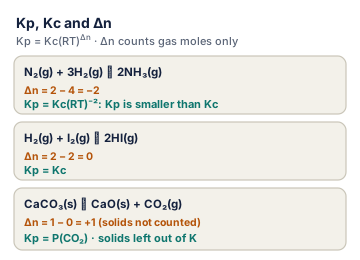
A heterogeneous equilibrium involves more than one phase. Pure solids and pure liquids are left out of , because their “concentration” does not change as they are used up. For the decomposition of limestone:
Key idea
and describe the same equilibrium in different units. Because for each gas, they are linked by
where = moles of gaseous products − moles of gaseous reactants. When , .
Why does it matter?
- Industry. Ammonia, sulfuric acid and methanol are made by gas-phase equilibria; engineers use to choose pressures and temperatures.
- The atmosphere. Reactions such as (a brown gas in smog) are gas equilibria.
- Solids and gases together. Limestone kilns, rusting and the equilibrium vapour pressure of water are all heterogeneous equilibria.
How does it work?
1. Writing Kp
Products over reactants, each partial pressure raised to its coefficient; leave out solids and liquids.
2. Converting between Kc and Kp
- Find from the gas coefficients only.
- Use L·atm/(mol·K) and in kelvin.
- .
3. ICE tables with pressures
Pressures behave like concentrations: set up Initial, Change and Equilibrium rows in atm, substitute into and solve.
Think of it like this
Kc and Kp are like the same price written in two currencies. The exchange rate is . If the reaction has the same number of gas molecules on both sides, there is nothing to convert: the price is identical in both.
More precisely
Strictly, equilibrium constants use dimensionless activities: each partial pressure is divided by the standard pressure (1 bar, or 1 atm in older tables), which is why has no units. Values of therefore depend slightly on whether pressures are in bar or atm. The in is for gas reactions.
Visualise it
Worked example
Worked example: Kp from partial pressures
Question: At 25 °C, an equilibrium mixture contains at 0.70 atm and at 0.32 atm. Calculate for .
Worked example: From Kc to Kp
Question: For , at 400 °C. Find .
-
; K.
-
:
-
Then, using the number 55.24 (K values are written without units):
Worked example: A heterogeneous equilibrium
Question: Write and for .
Carbon is a pure solid, so it is left out:
Worked example: An ICE table with pressures
Question: has at a certain temperature. Pure at 1.00 atm is allowed to reach equilibrium. Find the equilibrium partial pressures.
-
ICE (atm): : ; : ; : .
-
Substitute:
-
Quadratic formula, positive root, with , , :
-
atm and atm. Check: ✓.
Common mistake
Common mistake: Including solids or liquids
In , only. Writing is wrong: solids have no partial pressure.
Common mistake: Counting all moles in Δn
Δn counts gas moles only. For , , not .
Common mistake: Using the wrong R or temperature
With pressures in atm, use L·atm/(mol·K), not 8.314, and always convert °C to K.
Notation note
- means the partial pressure of A at equilibrium (in atm here).
- Kc uses mol/L; Kp uses partial pressures. Both are quoted without units.
Remember this
Remember this
- : same form as , with partial pressures.
- ; Δn = gas moles (products − reactants); R = 0.08206; T in K.
- Leave pure solids and liquids out of K.
- ICE tables work with pressures just as with concentrations.
Test yourself
Check your understanding before moving on.
Flashcards
Gas-Phase and Heterogeneous Equilibria: Flashcards
- QuestionWhat is Kp?Answer
The equilibrium constant written with partial pressures of gases (in atm) instead of concentrations.
- QuestionWrite Kp for N₂ + 3H₂ ⇌ 2NH₃.Answer
- QuestionGive the equation linking Kp and Kc.Answer
, with R = 0.08206 L·atm/(mol·K) and T in K.
- QuestionWhat is Δn in Kp = Kc(RT)^Δn?Answer
Moles of gaseous products − moles of gaseous reactants.
- QuestionWhen is Kp equal to Kc?Answer
When Δn = 0 (same number of gas moles on both sides), e.g. H₂ + I₂ ⇌ 2HI.
- QuestionWhat is a heterogeneous equilibrium?Answer
An equilibrium involving substances in more than one phase.
- QuestionWhich substances are left out of K expressions?Answer
Pure solids and pure liquids.
- QuestionWrite Kp for CaCO₃(s) ⇌ CaO(s) + CO₂(g).Answer
Kp = P(CO₂)
- QuestionP(N₂O₄) = 0.70 atm, P(NO₂) = 0.32 atm at equilibrium. Find Kp for N₂O₄ ⇌ 2NO₂.Answer
Kp = (0.32)² ÷ 0.70 = 0.15
- QuestionFor C(s) + H₂O(g) ⇌ CO(g) + H₂(g), what is Δn?Answer
+1 (2 gas moles − 1 gas mole; the solid is not counted).
Tip: press Space to flip and ← → to move between cards.
Quiz
Gas-Phase and Heterogeneous Equilibria: Quiz
7 questions
The solids are left out, so only the gas remains: Kp = P(CO₂).
Show answer
Answer: P(CO₂)
The solids are left out, so only the gas remains: Kp = P(CO₂).
Δn = 2 − 2 = 0, so (RT)⁰ = 1 and Kp = Kc. The others have Δn = −2, −1 and +1.
Show answer
Answer: H₂ + I₂ ⇌ 2HI
Δn = 2 − 2 = 0, so (RT)⁰ = 1 and Kp = Kc. The others have Δn = −2, −1 and +1.
Δn = gas moles of products − reactants = 2 − 3 = −1.
Show answer
Answer: −1
Δn = gas moles of products − reactants = 2 − 3 = −1.
Kp = (1.2)² ÷ [(0.20)² × 0.10] = 1.44 ÷ 0.0040 = 360. 60 forgets to square the pressures.
Show answer
Answer: 360
Kp = (1.2)² ÷ [(0.20)² × 0.10] = 1.44 ÷ 0.0040 = 360. 60 forgets to square the pressures.
Δn = −1; RT = 0.08206 × 1000 = 82.06; Kp = 280 × (82.06)⁻¹ = 3.41. 2.3 × 10⁴ uses Δn = +1.
Show answer
Answer: 3.41
Δn = −1; RT = 0.08206 × 1000 = 82.06; Kp = 280 × (82.06)⁻¹ = 3.41. 2.3 × 10⁴ uses Δn = +1.
Converting mol/L to atm needs R in L·atm/(mol·K).
Show answer
Answer: 0.08206 L·atm/(mol·K)
Converting mol/L to atm needs R in L·atm/(mol·K).
Q = (0.50)² ÷ (0.10 × 0.10) = 25, less than K = 50, so more HI forms.
Show answer
Answer: Forward, because Q is less than K
Q = (0.50)² ÷ (0.10 × 0.10) = 25, less than K = 50, so more HI forms.
Notes and downloads
Worksheet
Gas-Phase and Heterogeneous Equilibria Worksheet
8 questions on writing Kp, heterogeneous equilibria, converting between Kc and Kp, Q versus K and ICE tables with pressures. Answer key included.
References
- Brown, T. L.; LeMay, H. E., Jr.; Bursten, B. E.; Murphy, C. J.; Woodward, P. M.; Stoltzfus, M. W. Chemistry: The Central Science, 15th ed.; Pearson, 2022.
Practise this topic with flashcards and a quiz at chemistryclarity.com/chemistry/gas-phase-equilibria/
Spotted a mistake? Let us know and we'll fix it.