What is it?
Le Chatelier’s principle: if a system at equilibrium is disturbed by a change in concentration, pressure or temperature, the position of equilibrium shifts in the direction that partly counteracts the change.
“Shifts to the right” means more products form; “shifts to the left” means more reactants form. The system never fully undoes the change; it only reduces its effect.
Key idea
Changes in concentration and pressure shift the equilibrium without changing K: they make , and the reaction runs until again. A change in temperature changes K itself. A catalyst changes neither.
Why does it matter?
- Industry. Chemists choose temperatures and pressures that push equilibria toward the product, as in the Haber process for ammonia.
- Everyday chemistry. A fizzy drink goes flat when opened because lowering the pressure shifts toward the gas.
- Living systems. The body’s buffers respond to added acid or base following the same principle.
How does it work?
1. Changing a concentration
- Add a reactant (or remove a product): becomes smaller than , so the equilibrium shifts right to use some of it up.
- Add a product (or remove a reactant): , so it shifts left.
2. Changing the pressure (gases)
Increasing the pressure by reducing the volume shifts the equilibrium toward the side with fewer moles of gas, which lowers the pressure:
The left side has 1 mol + 3 mol = 4 mol of gas; the right side has 2 mol.
Higher pressure shifts this equilibrium right, toward ammonia. If both sides have the same number of moles of gas (as in ), pressure has no effect on the position. Adding an inert gas at constant volume does not change any concentration, so it has no effect either.
3. Changing the temperature
Treat heat as a reactant or product:
- Exothermic forward reaction (ΔH negative): heat is a “product”. Raising the temperature shifts the equilibrium left and decreases K.
- Endothermic forward reaction (ΔH positive): heat is a “reactant”. Raising the temperature shifts it right and increases K.
For , ΔH = +57 kJ: on heating, more brown forms, so the colourless-to-brown mixture gets darker.
4. Adding a catalyst
A catalyst speeds up the forward and reverse reactions equally. Equilibrium is reached sooner, but its position and are unchanged.
| Change | Effect on position | Effect on K |
|---|---|---|
| Add reactant / remove product | shifts right | none |
| Add product / remove reactant | shifts left | none |
| Increase pressure (smaller volume) | toward fewer moles of gas | none |
| Increase temperature | in the endothermic direction | changes |
| Add a catalyst | none (equilibrium reached faster) | none |
Think of it like this
Think of a crowded room with two doors and people moving between it and the corridor at equal rates. Push more people into the room and, for a while, more people leave than enter, until the flows balance again. The room ends up a bit more crowded than before, but less crowded than right after the push: the change is partly counteracted.
More precisely
Le Chatelier’s principle predicts the direction of a shift; comparing with explains why, and an ICE table gives the new concentrations. How strongly depends on temperature is described by the van ‘t Hoff equation, which links it to ΔH°.
Visualise it
Worked example
Worked example: Predicting shifts in the Haber process
Question: For , ΔH = −92 kJ, predict the effect on the amount of ammonia of (a) adding (b) increasing the pressure (c) increasing the temperature (d) adding an iron catalyst.
- Adding (a reactant): shifts right, so more .
- Higher pressure: 4 mol gas on the left, 2 mol on the right, so it shifts toward fewer moles: right, more .
- The forward reaction is exothermic, so heating shifts left: less (and decreases).
- A catalyst does not shift the equilibrium: no change in the amount, but equilibrium is reached faster.
Worked example: Checking a shift with Q
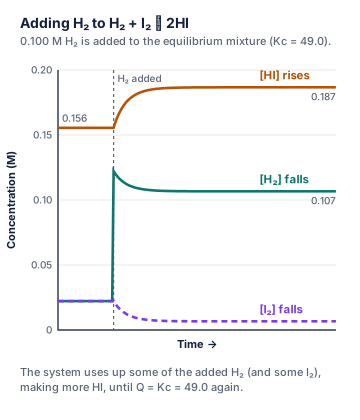
Question: An equilibrium mixture of () contains 0.0222 M , 0.0222 M and 0.156 M HI. 0.100 M is added. Which way does the equilibrium shift?
- Just after the addition,
- (the units of M² cancel)
- , so the reaction goes forward: and are used up and more HI forms, as Le Chatelier’s principle predicts.
Common mistake
Common mistake: Thinking concentration changes alter K
Adding a reactant shifts the position, but stays the same. Only temperature changes .
Common mistake: Thinking a catalyst increases the yield
A catalyst makes equilibrium arrive faster but does not change how much product is present at equilibrium.
Common mistake: Counting all moles, not moles of gas
For pressure changes, count only gases. In there is 0 mol of gas on the left and 1 mol on the right.
Notation note
- “Shifts to the right / forward” = more products; “to the left / backward” = more reactants.
- ΔH refers to the forward reaction as written; the reverse reaction has the opposite sign.
Remember this
Remember this
- A disturbed equilibrium shifts to partly counteract the change.
- Add reactant or remove product: right. Higher pressure: fewer moles of gas.
- Heating favours the endothermic direction and is the only change that alters .
- A catalyst gives equilibrium faster but does not move it.
Test yourself
Check your understanding before moving on.
Flashcards
Le Chatelier's Principle: Flashcards
- QuestionState Le Chatelier's principle.Answer
If an equilibrium is disturbed, its position shifts in the direction that partly counteracts the change.
- QuestionA reactant is added to an equilibrium mixture. Which way does it shift?Answer
To the right (toward products): Q becomes smaller than K.
- QuestionA product is removed. Which way does the equilibrium shift?Answer
To the right, to replace some of the product.
- QuestionHow does increasing the pressure (smaller volume) affect a gas equilibrium?Answer
It shifts toward the side with fewer moles of gas.
- QuestionWhich way does shift at higher pressure?Answer
Right: 4 mol of gas become 2 mol.
- QuestionHow does raising the temperature affect an exothermic equilibrium?Answer
It shifts left (the endothermic direction) and K decreases.
- QuestionWhich change alters the value of K?Answer
Only a change in temperature.
- QuestionWhat does a catalyst do to an equilibrium?Answer
Nothing to its position or K; equilibrium is just reached faster.
- Question(ΔH = +57 kJ; NO₂ is brown). What happens to the colour on heating?Answer
It gets darker: the endothermic forward reaction is favoured, forming more NO₂.
- QuestionDoes pressure affect ?Answer
No: there are 2 mol of gas on each side.
Tip: press Space to flip and ← → to move between cards.
Quiz
Le Chatelier's Principle: Quiz
7 questions
Removing a product makes Q smaller than K, so the reaction goes forward to replace some of it. K is unchanged.
Show answer
Answer: The equilibrium shifts right, making more NH₃
Removing a product makes Q smaller than K, so the reaction goes forward to replace some of it. K is unchanged.
Higher pressure favours fewer moles of gas: 2 mol → 1 mol. HI: no change (2 = 2). The other two have more gas on the right, so they shift left.
Show answer
Answer:
Higher pressure favours fewer moles of gas: 2 mol → 1 mol. HI: no change (2 = 2). The other two have more gas on the right, so they shift left.
Heat is a "product" of an exothermic reaction. Adding heat shifts the equilibrium left, and K itself becomes smaller.
Show answer
Answer: Shifts left and decreases K
Heat is a "product" of an exothermic reaction. Adding heat shifts the equilibrium left, and K itself becomes smaller.
A catalyst speeds up the forward and reverse reactions equally, so the position of equilibrium and K are unchanged.
Show answer
Answer: Equilibrium is reached faster, with the same composition
A catalyst speeds up the forward and reverse reactions equally, so the position of equilibrium and K are unchanged.
Concentration and pressure changes shift the position but leave K unchanged. Only temperature changes K.
Show answer
Answer: Changing the temperature
Concentration and pressure changes shift the position but leave K unchanged. Only temperature changes K.
The forward reaction is endothermic. Cooling favours the exothermic reverse reaction, forming more colourless N₂O₄, so the brown colour fades.
Show answer
Answer: It becomes paler
The forward reaction is endothermic. Cooling favours the exothermic reverse reaction, forming more colourless N₂O₄, so the brown colour fades.
Q = (0.156 M)² / ((0.122 M)(0.0222 M)) = 8.99. Q < K, so the reaction goes forward, using up H₂ and I₂.
Show answer
Answer: 8.99
Q = (0.156 M)² / ((0.122 M)(0.0222 M)) = 8.99. Q < K, so the reaction goes forward, using up H₂ and I₂.
Notes and downloads
Worksheet
Le Chatelier's Principle Worksheet
9 questions on how concentration, pressure, temperature and catalysts affect equilibria, including Q calculations. Answer key included.
References
- Brown, T. L.; LeMay, H. E., Jr.; Bursten, B. E.; Murphy, C. J.; Woodward, P. M.; Stoltzfus, M. W. Chemistry: The Central Science, 15th ed.; Pearson, 2022.
Practise this topic with flashcards and a quiz at chemistryclarity.com/chemistry/le-chateliers-principle/
Spotted a mistake? Let us know and we'll fix it.