What is it?
“Insoluble” salts are really very slightly soluble. When solid silver chloride is placed in water, a tiny amount dissolves until the solution is saturated. Then a dynamic equilibrium is set up between the solid and its ions:
The equilibrium constant is the solubility product, :
The solid does not appear in the expression (its concentration is constant). Each ion concentration is raised to the power of its coefficient: for , .
Key idea
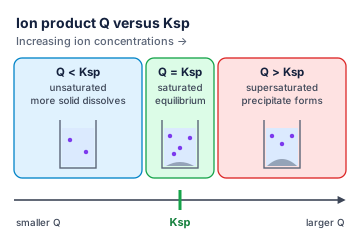
is the ceiling for the product of the ion concentrations. If the ion product is below , more solid can dissolve. If is above , the solution is supersaturated and a precipitate forms until .
Why does it matter?
- Health. Barium sulfate is swallowed for X-ray imaging of the gut: barium ions are toxic, but is so insoluble () that almost none dissolves. Kidney stones form when calcium oxalate exceeds its .
- Teeth. Fluoride converts tooth enamel into a less soluble mineral, so it dissolves less in acid.
- Analysis and clean-up. Chemists precipitate one ion while leaving others in solution, and remove heavy metals from waste water.
How does it work?
1. Molar solubility
The molar solubility, , is the number of moles that dissolve per litre of saturated solution. Write the ion concentrations in terms of :
| Salt | Ions | in terms of |
|---|---|---|
| AgCl, BaSO₄ (1 : 1) | and | |
| CaF₂, PbI₂, Mg(OH)₂ (1 : 2) | and | |
| Ag₂CrO₄ (2 : 1) | and |
Only compare values directly for salts with the same ion ratio; otherwise, compare their molar solubilities.
2. The common-ion effect
If the solution already contains one of the ions, the equilibrium shifts to the left (Le Chatelier’s principle), and less solid dissolves. Silver chloride is far less soluble in salt water than in pure water.
3. Will a precipitate form?
- Find each ion concentration after mixing (allow for the total volume).
- Calculate the ion product in the same form as .
- Compare: : precipitate forms. : no precipitate. : saturated.
Think of it like this
is like the capacity of a crowded room. While there is space (Q below Ksp), more people can come in. Once it is full (Q = Ksp), anyone else who arrives must leave again. If you already filled the room with one group (a common ion), there is less space for anyone else.
More precisely
depends on temperature. Simple calculations ignore effects such as ion pairing and reactions of the ions with water: for example, the solubility of salts of weak acids (carbonates, phosphates, fluorides) increases in acid, because removes the anion. Strictly, equilibrium constants use activities rather than concentrations, which matters in concentrated solutions.
Visualise it
Worked example
Worked example: Molar solubility of AgCl
Question: Calculate the molar solubility of AgCl () in mol/L and in g/L.
-
, so .
-
Molar solubility:
-
In g/L: , about 2 mg per litre.
Worked example: A 1 : 2 salt
Question: Calculate the molar solubility of ().
-
and , so .
-
Solve:
Worked example: Ksp from solubility
Question: The solubility of is 0.62 g/L. Calculate .
-
Molar solubility:
-
, :
Worked example: The common-ion effect
Question: Calculate the molar solubility of AgCl in 0.10 mol/L NaCl.
-
mol/L (from the NaCl); .
-
, so
-
That is about 7500 times less than in pure water ( mol/L).
Worked example: Will a precipitate form?
Question: Equal volumes of 0.0010 mol/L and 0.0010 mol/L NaCl are mixed. Does AgCl precipitate?
-
Mixing equal volumes halves each concentration: mol/L.
-
Ion product:
-
is greater than : a precipitate forms.
Common mistake
Common mistake: Forgetting to double (and square) the second ion
For , , and it is squared in : , not or .
Common mistake: Comparing Ksp values of different types of salt
A smaller does not always mean a less soluble salt. Ag₂CrO₄ () is actually more soluble than AgCl (): versus mol/L. Compare molar solubilities.
Common mistake: Ignoring dilution when solutions are mixed
Mixing two solutions increases the volume, so every concentration falls. Recalculate the concentrations before working out .
Notation note
- Solids are left out of expressions; ion concentrations are in mol/L at equilibrium.
- values are usually quoted without units.
Remember this
Remember this
- = product of the ion concentrations in a saturated solution, each raised to its coefficient.
- 1 : 1 salts: . 1 : 2 or 2 : 1 salts: .
- A common ion lowers the solubility.
- : precipitate. : no precipitate. Remember to allow for dilution on mixing.
Test yourself
Check your understanding before moving on.
Flashcards
Solubility Equilibria: Flashcards
- QuestionWhat is Ksp?Answer
The solubility product: the equilibrium constant for a slightly soluble salt dissolving, the product of its ion concentrations in a saturated solution.
- QuestionWrite the Ksp expression for CaF₂.Answer
- QuestionWhy is the solid left out of the Ksp expression?Answer
The concentration of a pure solid is constant.
- QuestionHow is Ksp related to the molar solubility s for a 1 : 1 salt such as AgCl?Answer
- QuestionHow is Ksp related to s for a 1 : 2 salt such as CaF₂?Answer
- QuestionWhat is the common-ion effect?Answer
A salt is less soluble in a solution that already contains one of its ions, because the equilibrium shifts to the left.
- QuestionWhen does a precipitate form?Answer
When the ion product Q is greater than Ksp.
- QuestionCalculate the molar solubility of AgCl (Ksp = 1.8 × 10⁻¹⁰).Answer
mol/L
- QuestionWhy can't you always compare Ksp values directly to rank solubility?Answer
Salts with different ion ratios have different Ksp formulas (s² vs 4s³); compare molar solubilities instead.
- QuestionWhat must you do to concentrations when two solutions are mixed before calculating Q?Answer
Recalculate them for the new total volume (dilution).
Tip: press Space to flip and ← → to move between cards.
Quiz
Solubility Equilibria: Quiz
7 questions
Mg(OH)₂(s) ⇌ Mg²⁺ + 2OH⁻. Each ion is raised to its coefficient, and the solid is left out.
Show answer
Answer: Ksp = [Mg²⁺][OH⁻]²
Mg(OH)₂(s) ⇌ Mg²⁺ + 2OH⁻. Each ion is raised to its coefficient, and the solid is left out.
For a 1 : 1 salt, Ksp = s², so s = √(1.1 × 10⁻¹⁰) = 1.0 × 10⁻⁵ mol/L.
Show answer
Answer: 1.0 × 10⁻⁵ mol/L
For a 1 : 1 salt, Ksp = s², so s = √(1.1 × 10⁻¹⁰) = 1.0 × 10⁻⁵ mol/L.
Ksp = s(2s)² = 4s³, so s = ∛(3.9 × 10⁻¹¹ ÷ 4) = 2.1 × 10⁻⁴ mol/L. 6.2 × 10⁻⁶ wrongly uses s².
Show answer
Answer: 2.1 × 10⁻⁴ mol/L
Ksp = s(2s)² = 4s³, so s = ∛(3.9 × 10⁻¹¹ ÷ 4) = 2.1 × 10⁻⁴ mol/L. 6.2 × 10⁻⁶ wrongly uses s².
Cl⁻ is a common ion; the equilibrium AgCl(s) ⇌ Ag⁺ + Cl⁻ shifts left, so less AgCl dissolves. Ksp itself does not change.
Show answer
Answer: It decreases it
Cl⁻ is a common ion; the equilibrium AgCl(s) ⇌ Ag⁺ + Cl⁻ shifts left, so less AgCl dissolves. Ksp itself does not change.
Q = (5.0 × 10⁻⁴)² = 2.5 × 10⁻⁷, which is greater than 1.8 × 10⁻¹⁰, so AgCl precipitates.
Show answer
Answer: A precipitate forms: Q is greater than Ksp
Q = (5.0 × 10⁻⁴)² = 2.5 × 10⁻⁷, which is greater than 1.8 × 10⁻¹⁰, so AgCl precipitates.
AgCl: s = √Ksp = 1.3 × 10⁻⁵ mol/L. Ag₂CrO₄: s = ∛(Ksp ÷ 4) = 6.5 × 10⁻⁵ mol/L. Different ion ratios mean Ksp values cannot be compared directly.
Show answer
Answer: Ag₂CrO₄, because its molar solubility is larger
AgCl: s = √Ksp = 1.3 × 10⁻⁵ mol/L. Ag₂CrO₄: s = ∛(Ksp ÷ 4) = 6.5 × 10⁻⁵ mol/L. Different ion ratios mean Ksp values cannot be compared directly.
[Cl⁻] ≈ 0.10 mol/L, so s = Ksp ÷ 0.10 = 1.8 × 10⁻⁹ mol/L, thousands of times less than in pure water.
Show answer
Answer: 1.8 × 10⁻⁹ mol/L
[Cl⁻] ≈ 0.10 mol/L, so s = Ksp ÷ 0.10 = 1.8 × 10⁻⁹ mol/L, thousands of times less than in pure water.
Notes and downloads
Worksheet
Solubility Equilibria Worksheet
8 questions on Ksp expressions, molar solubility, Ksp from solubility, the common-ion effect and predicting precipitates. Answer key included.
References
- Brown, T. L.; LeMay, H. E., Jr.; Bursten, B. E.; Murphy, C. J.; Woodward, P. M.; Stoltzfus, M. W. Chemistry: The Central Science, 15th ed.; Pearson, 2022.
Practise this topic with flashcards and a quiz at chemistryclarity.com/chemistry/solubility-equilibria/
Spotted a mistake? Let us know and we'll fix it.