What is it?
In a mixture of gases that don’t react, each gas behaves as if it were alone in the container. The pressure each gas would exert on its own is its partial pressure. Dalton’s law says the total pressure is the sum of the partial pressures:
Because pressure depends only on the number of moles (at fixed and ), each gas’s share of the pressure equals its share of the moles, its mole fraction :
Key idea
For gases, volume is a measure of moles. At the same temperature and pressure, equal volumes of gases contain equal numbers of moles (Avogadro’s law). So turns any gas volume into moles, and moles are the link to the balanced equation.
Why does it matter?
- Breathing and diving. Air is about 21 % oxygen, so the partial pressure of oxygen at sea level is about 0.21 atm. At high altitude it is lower, which is why climbers carry oxygen; divers breathing compressed air risk taking in too much nitrogen.
- Collecting gases in the lab. Gases collected over water are mixed with water vapour, which has to be subtracted.
- Airbags, baking and industry. Calculating the volume of gas a reaction produces is gas stoichiometry.
How does it work?
1. Partial pressures
Find each partial pressure with , or from the mole fraction. Add them to get the total.
2. Collecting a gas over water
A gas bubbled into an upturned bottle of water becomes saturated with water vapour. The pressure inside equals atmospheric pressure, so:
The vapour pressure of water depends only on temperature (23.8 mmHg at 25 °C).
3. Molar volume
One mole of any ideal gas occupies 22.4 L at 0 °C and 1 atm, and 24.5 L at 25 °C and 1 atm. (Check which “standard” conditions your course uses; IUPAC STP, 0 °C and 1 bar, gives 22.7 L/mol.)
4. Gas stoichiometry
- Convert what you know to moles (from mass, or from a gas volume with ).
- Use the mole ratio from the balanced equation.
- Convert to what you want (mass, or a gas volume with ).
Think of it like this
Partial pressures are like voices in a choir. Each singer adds to the total sound, and a section with more singers is louder. The total volume of sound is the sum of every section, and each section’s share depends only on how many singers it has.
More precisely
Dalton’s law holds exactly for ideal gases and very closely for real gases at ordinary pressures. Because the partial pressure is proportional to moles, mole fraction is also the volume fraction of an ideal-gas mixture: air is about 78 % N₂, 21 % O₂ and 1 % Ar by volume and by moles. Vapour pressure tables give the partial pressure of water above liquid water at each temperature; at 100 °C it reaches 760 mmHg, which is why water boils there at 1 atm.
Visualise it
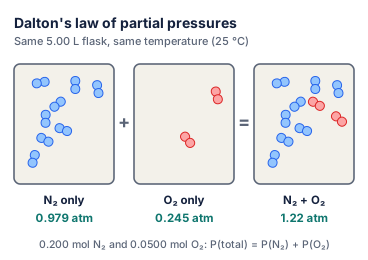
Worked example
Worked example: Partial pressures
Question: A 5.00 L flask at 25 °C contains 0.200 mol of N₂ and 0.0500 mol of O₂. Find each partial pressure and the total pressure.
-
K. It saves work to find first:
-
Nitrogen:
-
Oxygen has a quarter of the moles, so atm.
-
Total:
Worked example: A gas collected over water
Question: Hydrogen is collected over water at 25 °C. The volume is 0.250 L and the total pressure is 755 mmHg. How many moles of H₂ were collected?
-
Pressure of the dry hydrogen:
-
Moles, using L atm/mol at 25 °C (from the first example):
Worked example: Volume of gas from a reaction
Question: What volume of CO₂, at 25 °C and 1.00 atm, is released when 10.0 g of CaCO₃ decomposes?
-
Moles of CaCO₃: , so 0.09991 mol CO₂ (1 : 1).
-
Volume, with L atm/mol at 25 °C:
Worked example: Using molar volume
Question: 5.00 g of potassium chlorate is heated: . What volume of O₂ forms at 0 °C and 1 atm?
Common mistake
Common mistake: Forgetting the water vapour
A gas collected over water is not pure. Subtract the vapour pressure of water before using , or the moles of gas will be too high.
Common mistake: Using 22.4 L/mol at room temperature
22.4 L/mol applies only at 0 °C and 1 atm. At 25 °C and 1 atm, a mole of gas occupies 24.5 L. When conditions are not standard, use .
Common mistake: Mixing pressure units
With L·atm/(mol·K), pressure must be in atm. Convert mmHg (÷ 760) or kPa (÷ 101.325) first.
Notation note
- (or ) is the mole fraction; mole fractions of all components add up to 1.
- 1 mmHg = 1 torr.
Remember this
Remember this
- Dalton: ; .
- Over water: .
- Molar volume: 22.4 L/mol at 0 °C, 1 atm; 24.5 L/mol at 25 °C, 1 atm.
- Gas stoichiometry: gas volume ↔ moles with ; moles ↔ moles with the equation.
Test yourself
Check your understanding before moving on.
Flashcards
Gas Mixtures and Gas Stoichiometry: Flashcards
- QuestionState Dalton's law of partial pressures.Answer
The total pressure of a gas mixture is the sum of the partial pressures: P(total) = P(A) + P(B) + ...
- QuestionHow is a partial pressure related to the mole fraction?Answer
P(A) = x(A) × P(total), where x(A) = n(A) ÷ n(total).
- QuestionAir is 21 % O₂. What is the partial pressure of O₂ at 1.00 atm?Answer
About 0.21 atm.
- QuestionHow do you find the pressure of a dry gas collected over water?Answer
P(gas) = P(total) − vapour pressure of water at that temperature.
- QuestionWhat is the molar volume of a gas at 0 °C and 1 atm? At 25 °C and 1 atm?Answer
22.4 L/mol and 24.5 L/mol.
- QuestionState Avogadro's law.Answer
Equal volumes of gases at the same temperature and pressure contain equal numbers of moles.
- QuestionOutline the steps of a gas stoichiometry calculation.Answer
Convert to moles (n = PV/RT or from mass) → mole ratio from the equation → convert to the answer (V = nRT/P or mass).
- QuestionFor gases at the same T and P, what volume of O₂ reacts with 2.00 L of C₃H₈? (C₃H₈ + 5O₂ → 3CO₂ + 4H₂O)Answer
10.0 L: volume ratios equal mole ratios.
- QuestionWhat do the mole fractions in a mixture add up to?Answer
1
- QuestionWhich value of R goes with pressures in atm and volumes in L?Answer
0.08206 L·atm/(mol·K)
Tip: press Space to flip and ← → to move between cards.
Quiz
Gas Mixtures and Gas Stoichiometry: Quiz
7 questions
Dalton's law: P(total) = 0.60 atm + 0.25 atm + 0.15 atm = 1.00 atm.
Show answer
Answer: 1.00 atm
Dalton's law: P(total) = 0.60 atm + 0.25 atm + 0.15 atm = 1.00 atm.
P(He) = x(He) × P(total) = 0.40 × 2.0 atm = 0.80 atm.
Show answer
Answer: 0.80 atm
P(He) = x(He) × P(total) = 0.40 × 2.0 atm = 0.80 atm.
P(O₂) = P(total) − P(H₂O) = 760 mmHg − 23.8 mmHg = 736.2 mmHg.
Show answer
Answer: 736.2 mmHg
P(O₂) = P(total) − P(H₂O) = 760 mmHg − 23.8 mmHg = 736.2 mmHg.
0.500 mol × 22.4 L/mol = 11.2 L. 12.2 L would be the volume at 25 °C (24.5 L/mol).
Show answer
Answer: 11.2 L
0.500 mol × 22.4 L/mol = 11.2 L. 12.2 L would be the volume at 25 °C (24.5 L/mol).
For gases at the same T and P, volumes are in the mole ratio: 1 N₂ : 2 NH₃, so 10.0 L × 2 = 20.0 L.
Show answer
Answer: 20.0 L
For gases at the same T and P, volumes are in the mole ratio: 1 N₂ : 2 NH₃, so 10.0 L × 2 = 20.0 L.
n(Zn) = 1.31 g ÷ 65.38 g/mol = 0.0200 mol = n(H₂). V = nRT/P = 0.0200 mol × 0.08206 L·atm/(mol·K) × 298.15 K ÷ 1.00 atm = 0.490 L. 0.449 L uses 22.4 L/mol at the wrong temperature.
Show answer
Answer: 0.490 L
n(Zn) = 1.31 g ÷ 65.38 g/mol = 0.0200 mol = n(H₂). V = nRT/P = 0.0200 mol × 0.08206 L·atm/(mol·K) × 298.15 K ÷ 1.00 atm = 0.490 L. 0.449 L uses 22.4 L/mol at the wrong temperature.
By Dalton's law the measured pressure is the sum of the gas pressure and the water vapour pressure, so the vapour pressure is subtracted.
Show answer
Answer: The collected gas is mixed with water vapour, which contributes to the total pressure
By Dalton's law the measured pressure is the sum of the gas pressure and the water vapour pressure, so the vapour pressure is subtracted.
Notes and downloads
Worksheet
Gas Mixtures and Gas Stoichiometry Worksheet
8 questions on partial pressures, mole fractions, gases collected over water, molar volume and gas stoichiometry. Answer key included.
References
- Brown, T. L.; LeMay, H. E., Jr.; Bursten, B. E.; Murphy, C. J.; Woodward, P. M.; Stoltzfus, M. W. Chemistry: The Central Science, 15th ed.; Pearson, 2022.
Practise this topic with flashcards and a quiz at chemistryclarity.com/chemistry/gas-mixtures-and-gas-stoichiometry/
Spotted a mistake? Let us know and we'll fix it.