Worksheet
Gas Mixtures and Gas Stoichiometry Worksheet
8 questions on partial pressures, mole fractions, gases collected over water, molar volume and gas stoichiometry. Answer key included.
- Type
- Worksheet
- Level
- Intermediate
- Format
- PDF, ready to print
Preview the questions
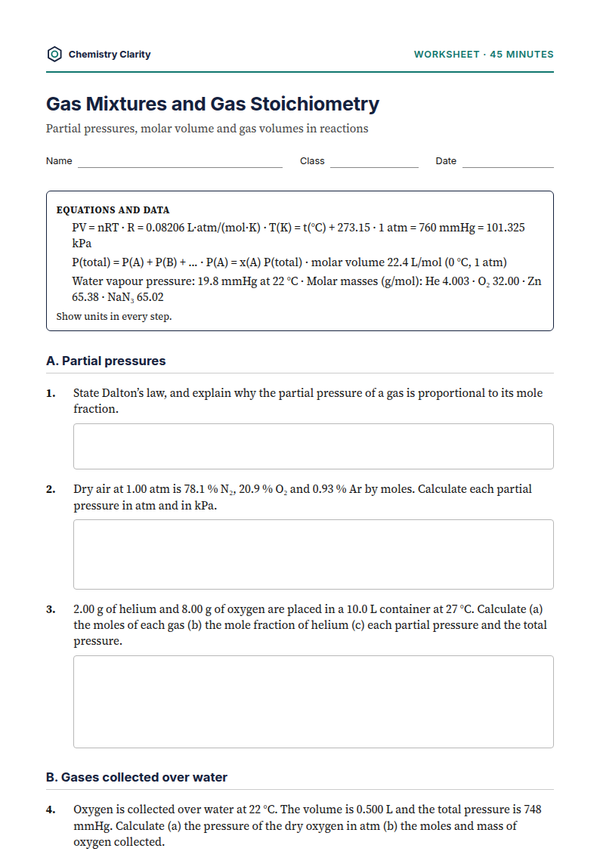
All the questions on this worksheet (about 45 minutes). Download the PDF to print it with space for working; the free answer key has full worked solutions.
A. Partial pressures
1.
State Dalton’s law, and explain why the partial pressure of a gas is proportional to its mole fraction.
2.
Dry air at 1.00 atm is 78.1 % N₂, 20.9 % O₂ and 0.93 % Ar by moles. Calculate each partial pressure in atm and in kPa.
3.
2.00 g of helium and 8.00 g of oxygen are placed in a 10.0 L container at 27 °C. Calculate (a) the moles of each gas (b) the mole fraction of helium (c) each partial pressure and the total pressure.
B. Gases collected over water
4.
Oxygen is collected over water at 22 °C. The volume is 0.500 L and the total pressure is 748 mmHg. Calculate (a) the pressure of the dry oxygen in atm (b) the moles and mass of oxygen collected.
C. Gas stoichiometry
5.
1.31 g of zinc reacts with excess hydrochloric acid: . Calculate the volume of hydrogen formed at 25 °C and 1.00 atm.
6.
All gases are at the same temperature and pressure. (a) What volume of oxygen is needed to burn 2.00 L of propane? (b) What volume of CO₂ forms?
7.
What volume does 0.250 mol of nitrogen occupy at 0 °C and 1 atm? Why can’t you use the same molar volume at 25 °C?
D. Challenge
8.
A car airbag inflates with nitrogen from the decomposition of sodium azide: . What mass of sodium azide is needed to fill a 60.0 L airbag at 25 °C and 1.10 atm?