What is it?
For particles to react, they must collide with enough energy to break existing bonds and start forming new ones. The minimum energy needed is the activation energy, (usually in kJ/mol).
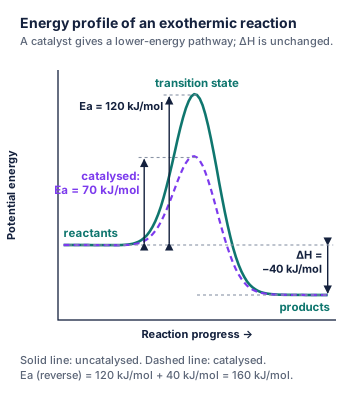
An energy profile shows the energy of the reacting particles as the reaction proceeds. The highest point is the transition state (or activated complex), an unstable arrangement partway between reactants and products. is the height of this “energy hill” above the reactants.
Key idea
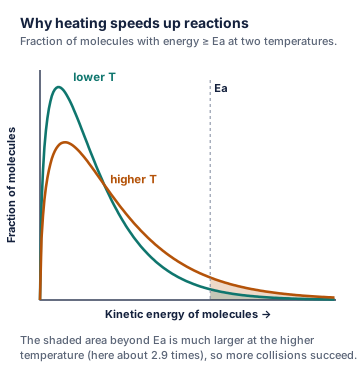
The higher the activation energy, the slower the reaction. Raising the temperature gives more molecules enough energy to get over the hill; a catalyst provides a different route with a lower hill.
Why does it matter?
- Food and medicine. Fridges slow spoilage, and medicines are stored cool, because lower temperatures slow reactions.
- Industry. Catalysts let chemical plants run faster at lower temperatures, saving energy (iron in the Haber process; platinum in catalytic converters).
- Life. Enzymes are biological catalysts that make the reactions of life fast enough at body temperature.
How does it work?
1. Collision theory
A collision leads to reaction only if the particles:
- collide with energy at least equal to , and
- have a suitable orientation.
Most collisions fail. Anything that increases the number of successful collisions per second increases the rate.
2. Why temperature has such a large effect
The Maxwell–Boltzmann distribution shows how kinetic energy is spread among molecules. At a higher temperature the curve flattens and shifts to the right, and the area beyond (the fraction of molecules that can react) grows much more than the average energy does. A rise of only 10 K can roughly double the rate of many reactions.
3. The Arrhenius equation
where is the frequency factor (collision frequency and orientation), and is in kelvin. Comparing two temperatures:
Always convert to J/mol to match the units of .
4. Catalysts
A catalyst speeds up a reaction by providing an alternative pathway with a lower activation energy. It takes part in the reaction but is regenerated, so it is not used up.
- It speeds up the forward and reverse reactions equally, so it does not change ΔH, the equilibrium position or K.
- Homogeneous catalysts are in the same phase as the reactants; heterogeneous catalysts (often solids such as iron or platinum) work at a surface.
Think of it like this
Getting from one valley to the next over a high mountain pass is slow; few hikers have the energy. A tunnel (the catalyst) offers a lower route, so many more get through each hour, but both valleys stay at the same heights: the start and finish (reactants and products, and ΔH) don’t change.
More precisely
Taking logarithms gives , so a plot of against (an Arrhenius plot) is a straight line with slope . That’s how activation energies are measured from experimental rate constants.
Visualise it
Worked example
Worked example: How much faster when 10 K warmer?
Question: A reaction has kJ/mol. By what factor does increase from 298 K to 308 K?
-
Convert:
-
Substitute:
J/mol cancel, and K × K⁻¹ cancel, so the logarithm is a pure number.
-
1.93: the rate almost doubles.
Worked example: Finding the activation energy
Question: A rate constant is at 300. K and at 320. K. Find .
-
Rearrange:
-
(the units of s⁻¹ cancel)
-
-
Numerator: (keep extra digits until the end)
-
Divide:
K and K⁻¹ cancel, leaving J/mol.
Common mistake
Common mistake: Mixing kJ and J
J/(mol·K) is in joules. Using in kJ/mol without converting makes the exponent 1000 times too small.
Common mistake: Using °C in the Arrhenius equation
Temperatures must be in kelvin. has no physical meaning; use 298 K.
Common mistake: Thinking a catalyst changes ΔH or the yield
A catalyst lowers for both directions. It does not change ΔH, the equilibrium position or K; it only gets the system to equilibrium faster.
Notation note
- may be written per mole (kJ/mol) or per molecule (J); chemistry courses use kJ/mol.
- “Activated complex” and “transition state” are used for the top of the energy profile.
Remember this
Remember this
- Reaction needs collisions with energy ≥ and the right orientation.
- Higher temperature: many more molecules exceed (Maxwell–Boltzmann), so the rate rises steeply.
- ; use J/mol and kelvin; .
- Catalysts lower , are regenerated, and don’t change ΔH or K.
Test yourself
Check your understanding before moving on.
Flashcards
Activation Energy and Catalysts: Flashcards
- QuestionWhat is activation energy, Ea?Answer
The minimum energy colliding particles need in order to react.
- QuestionWhat two conditions must a collision meet to cause a reaction?Answer
Energy at least equal to Ea, and a suitable orientation.
- QuestionWhat is the transition state?Answer
The highest-energy arrangement on the energy profile, partway between reactants and products.
- QuestionWhy does a small rise in temperature greatly increase the rate?Answer
The fraction of molecules with energy ≥ Ea (the area beyond Ea on the Maxwell–Boltzmann curve) increases sharply.
- QuestionWrite the Arrhenius equation.Answer
, with J/(mol·K) and T in kelvin
- QuestionTwo-temperature form of the Arrhenius equation?Answer
- QuestionHow does a catalyst increase the rate?Answer
It provides an alternative pathway with a lower activation energy, and is regenerated at the end.
- QuestionDoes a catalyst change ΔH or K?Answer
No. It lowers Ea for both directions equally, so ΔH, the equilibrium position and K are unchanged.
- QuestionEa (forward) = 120 kJ/mol and ΔH = −40 kJ/mol. What is Ea (reverse)?Answer
120 kJ/mol + 40 kJ/mol = 160 kJ/mol
- QuestionHomogeneous vs heterogeneous catalyst?Answer
Homogeneous: same phase as the reactants. Heterogeneous: different phase, usually a solid surface (e.g. iron, platinum).
Tip: press Space to flip and ← → to move between cards.
Quiz
Activation Energy and Catalysts: Quiz
7 questions
A catalyst lowers Ea. It does not change the energies of reactants or products, ΔH, or the equilibrium position.
Show answer
Answer: Provides a pathway with a lower activation energy
A catalyst lowers Ea. It does not change the energies of reactants or products, ΔH, or the equilibrium position.
Ea stays the same, but at a higher temperature many more molecules have enough energy (the area beyond Ea grows), and they also collide more often.
Show answer
Answer: A larger fraction of collisions have energy ≥ Ea
Ea stays the same, but at a higher temperature many more molecules have enough energy (the area beyond Ea grows), and they also collide more often.
The reverse reaction starts from the lower-energy products, so its hill is higher: 80 kJ/mol + 30 kJ/mol = 110 kJ/mol.
Show answer
Answer: 110 kJ/mol
The reverse reaction starts from the lower-energy products, so its hill is higher: 80 kJ/mol + 30 kJ/mol = 110 kJ/mol.
Ea must be in J/mol to match the joules in R, and T must be in kelvin, so that Ea/RT has no unit.
Show answer
Answer: J/mol and K
Ea must be in J/mol to match the joules in R, and T must be in kelvin, so that Ea/RT has no unit.
ln(k₂/k₁) = (5.00 × 10⁴ J/mol ÷ 8.314 J/(mol·K)) × (1/298 K − 1/308 K) = 0.655, so k₂/k₁ = e^0.655 = 1.93.
Show answer
Answer: 1.93
ln(k₂/k₁) = (5.00 × 10⁴ J/mol ÷ 8.314 J/(mol·K)) × (1/298 K − 1/308 K) = 0.655, so k₂/k₁ = e^0.655 = 1.93.
Because both directions speed up equally, equilibrium is reached faster but its position and K do not change. The catalyst is regenerated.
Show answer
Answer: They speed up the forward and reverse reactions equally
Because both directions speed up equally, equilibrium is reached faster but its position and K do not change. The catalyst is regenerated.
The top of the hill is the transition state (activated complex); its height above the reactants is Ea.
Show answer
Answer: The transition state
The top of the hill is the transition state (activated complex); its height above the reactants is Ea.
Notes and downloads
Worksheet
Activation Energy and Catalysts Worksheet
9 questions on activation energy, energy profiles, the Maxwell–Boltzmann distribution, the Arrhenius equation and catalysts. Answer key included.
References
- Brown, T. L.; LeMay, H. E., Jr.; Bursten, B. E.; Murphy, C. J.; Woodward, P. M.; Stoltzfus, M. W. Chemistry: The Central Science, 15th ed.; Pearson, 2022.
Practise this topic with flashcards and a quiz at chemistryclarity.com/chemistry/activation-energy/
Spotted a mistake? Let us know and we'll fix it.