Worksheet
Enthalpy and Calorimetry Worksheet
9 questions on exothermic and endothermic reactions, q = mcΔT, calorimetry and heat transfer. Answer key included.
- Type
- Worksheet
- Level
- Intermediate
- Format
- PDF, ready to print
Preview the questions
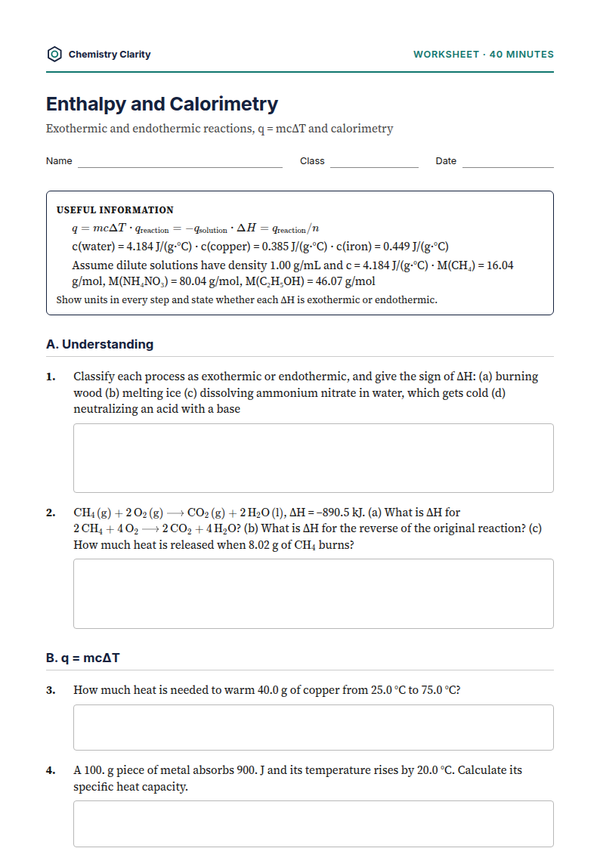
All the questions on this worksheet (about 40 minutes). Download the PDF to print it with space for working; the free answer key has full worked solutions.
A. Understanding
1.
Classify each process as exothermic or endothermic, and give the sign of ΔH: (a) burning wood (b) melting ice (c) dissolving ammonium nitrate in water, which gets cold (d) neutralizing an acid with a base
2.
, ΔH = −890.5 kJ. (a) What is ΔH for ? (b) What is ΔH for the reverse of the original reaction? (c) How much heat is released when 8.02 g of burns?
B. q = mcΔT
3.
How much heat is needed to warm 40.0 g of copper from 25.0 °C to 75.0 °C?
4.
A 100. g piece of metal absorbs 900. J and its temperature rises by 20.0 °C. Calculate its specific heat capacity.
5.
5.00 kJ of heat is added to 150. g of water at 22.0 °C. What is the final temperature?
C. Calorimetry
6.
8.00 g of ammonium nitrate is dissolved in 100.0 g of water in a calorimeter. The temperature falls from 22.0 °C to 16.0 °C. Calculate ΔH for dissolving ammonium nitrate, in kJ/mol. (Mass of solution = 108.0 g.)
7.
25.0 mL of 2.00 M HCl and 25.0 mL of 2.00 M NaOH, both at 20.0 °C, are mixed. The temperature rises to 33.5 °C. Calculate ΔH per mole of water formed.
D. Challenge
8.
Burning 0.500 g of ethanol ( kJ/mol) under a can containing 200. g of water raises the water temperature by only 12.4 °C. (a) What temperature rise would occur if all the heat went into the water? (b) What percentage of the heat was transferred to the water?
9.
A 50.0 g iron block at 100.0 °C is dropped into 100. g of water at 20.0 °C in an insulated cup. Find the final temperature. (Heat lost by the iron = heat gained by the water.)