Worksheet
Density Worksheet
8 questions on calculating density, displacement, floating and sinking, using density as a conversion factor and replicate measurements. Answer key included.
- Type
- Worksheet
- Level
- Beginner
- Format
- PDF, ready to print
Preview the questions
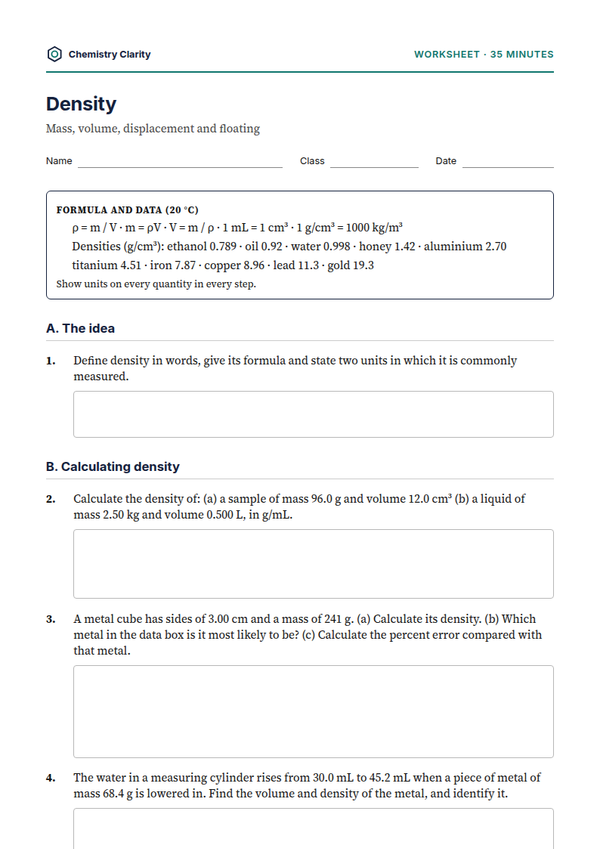
All the questions on this worksheet (about 35 minutes). Download the PDF to print it with space for working; the free answer key has full worked solutions.
A. The idea
1.
Define density in words, give its formula and state two units in which it is commonly measured.
B. Calculating density
2.
Calculate the density of: (a) a sample of mass 96.0 g and volume 12.0 cm³ (b) a liquid of mass 2.50 kg and volume 0.500 L, in g/mL.
3.
A metal cube has sides of 3.00 cm and a mass of 241 g. (a) Calculate its density. (b) Which metal in the data box is it most likely to be? (c) Calculate the percent error compared with that metal.
4.
The water in a measuring cylinder rises from 30.0 mL to 45.2 mL when a piece of metal of mass 68.4 g is lowered in. Find the volume and density of the metal, and identify it.
C. Using density
5.
Oil, water and honey are poured into a tall jar and left to settle. (a) Sketch the order of the layers. (b) A plastic bead with a density of 1.10 g/cm³ is dropped in. Where does it come to rest? Explain.
6.
Calculate: (a) the mass of 200. mL of ethanol (b) the volume of 1.00 kg of lead, in cm³.
D. Replicate measurements
7.
A student measures the density of a metal five times: 2.68, 2.71, 2.69, 2.72 and 2.70 g/cm³. (a) Calculate the mean and the sample standard deviation. (b) Report the result. (c) Comment on its accuracy and precision if the metal is aluminium.
E. Challenge
8.
A “gold” crown has a mass of 1.50 kg. When submerged, it displaces 93.0 mL of water. (a) Calculate its density in g/cm³ and in kg/m³. (b) Is the crown pure gold? Explain.