What is it?
Matter is anything that has mass and takes up space. Chemists sort matter in two ways: by its state (solid, liquid or gas) and by its composition (what it is made of).
By composition, every sample of matter is either a pure substance or a mixture:
- A pure substance has a fixed composition and the same properties throughout. It is either an element or a compound.
- A mixture contains two or more substances that are not chemically joined. Its composition can vary.
| Type | Made of | Can be separated by | Examples |
|---|---|---|---|
| Element | one kind of atom | cannot be broken down chemically | iron, Fe; oxygen, O₂; helium, He |
| Compound | two or more elements chemically combined in a fixed ratio | chemical reactions only | water, H₂O; sodium chloride, NaCl |
| Mixture | two or more substances, not chemically combined | physical methods | salt water, air, sand and iron filings |
Key idea
Elements and compounds are pure substances. A compound has a fixed composition (water is always 11.19% hydrogen by mass); a mixture does not (salt water can be weak or strong).
Why does it matter?
- It decides how to separate things. You can filter sand out of water, but you cannot filter hydrogen out of water: that needs a chemical reaction.
- It explains properties. A compound’s properties are completely different from those of its elements. Sodium is a reactive metal and chlorine a toxic gas, but sodium chloride is table salt.
- It is the language of chemistry. Words like element, compound, solution and chemical change appear in every later topic.
How does it work?
1. Elements and compounds
An element contains only one kind of atom. Some elements exist as single atoms (He, Ne), others as molecules (, , ). They are listed in the periodic table.
A compound contains two or more elements chemically bonded in a fixed ratio, shown by its formula. Carbon dioxide is always one C atom to two O atoms: .
2. Mixtures
- Homogeneous mixtures (also called solutions) are uniform throughout: you cannot see separate parts. Examples: salt water, air, brass (an alloy of copper and zinc).
- Heterogeneous mixtures are not uniform: you can see or detect different parts. Examples: sand in water, oil and water, granite.
3. Physical and chemical properties and changes
| Physical | Chemical | |
|---|---|---|
| Property | observed without changing the substance: colour, density, melting point, boiling point | describes how it reacts: flammability, reaction with acid, tendency to rust |
| Change | no new substance forms: melting, boiling, dissolving, cutting | new substance(s) form: burning, rusting, cooking an egg |
Signs that a chemical change may have happened: a gas is given off, a colour change, a precipitate (solid) forms, or heat or light is released. These are clues, not proof: boiling water also releases gas bubbles, but it is a physical change.
Is dissolving always a physical change? Usually it is: when sugar or salt dissolves, evaporating the water gets the original solid back. But some substances react with water as they “dissolve”. Calcium oxide (quicklime) is an example:
The mixture becomes hot, and evaporating the water gives calcium hydroxide, not calcium oxide: a new substance has formed, so this is a chemical change. Similarly, hydrogen chloride gas reacts with water as it dissolves, forming ions: . The test is always the same: can the original substance be recovered unchanged?
4. Separating mixtures
| Method | Separates | Example |
|---|---|---|
| Filtration | an insoluble solid from a liquid | sand from water |
| Evaporation / crystallisation | a dissolved solid from its solvent | salt from salt water |
| Distillation | a liquid from a solution, or liquids with different boiling points | pure water from sea water |
| Chromatography | dissolved substances that move at different speeds through a medium | the dyes in ink |
| Magnetism | magnetic from non-magnetic solids | iron filings from sand |
Think of it like this
A compound is like a cake: once flour, eggs and sugar are baked together, you can’t pick the egg back out, and the cake has new properties. A mixture is like a fruit salad: the pieces are just mixed, keep their own properties, and can be picked apart again.
More precisely
The law of definite proportions states that a given compound always contains its elements in the same proportions by mass, whatever its source. That is why percent composition can be calculated from the formula alone. Some solids (for example certain metal oxides) deviate slightly from ideal ratios; these “non-stoichiometric” compounds are an advanced exception.
Visualise it
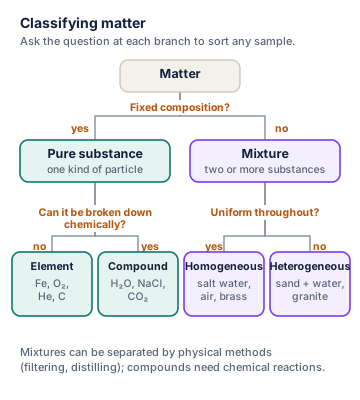
Worked example
Worked example: Classifying samples
Question: Classify each as an element, a compound, a homogeneous mixture or a heterogeneous mixture: (a) copper wire (b) sugar dissolved in water (c) carbon dioxide (d) a salad.
- Copper contains only Cu atoms: element.
- Sugar water is uniform and its composition can vary: homogeneous mixture (a solution).
- is two elements bonded in a fixed 1 : 2 ratio: compound.
- A salad has visibly different parts: heterogeneous mixture.
Worked example: Physical or chemical change?
Question: Which of these are chemical changes: ice melting, a match burning, iron rusting, sugar dissolving?
- Ice melting: still , so physical.
- A match burning: new substances (carbon dioxide, water, ash) and heat and light, so chemical.
- Iron rusting: iron reacts with oxygen and water to form iron oxide, so chemical.
- Sugar dissolving: the sugar molecules are unchanged and can be recovered by evaporating the water, so physical.
Common mistake
Common mistake: Calling every pure-looking liquid a pure substance
Clear liquids are often mixtures. Tap water, vinegar and air look uniform but are homogeneous mixtures. “Pure” in chemistry means one substance only.
Common mistake: Thinking molecules are always compounds
and are molecules, but they are elements, because each contains only one kind of atom. A compound needs at least two different elements.
Common mistake: Treating a change of state as chemical
Melting, freezing, boiling and condensing are physical changes: the substance stays the same.
Notation note
- “Solution” means a homogeneous mixture, not only a liquid one: air (a gas) and brass (a solid) are solutions too.
- State symbols in equations: (s) solid, (l) liquid, (g) gas, (aq) dissolved in water.
Remember this
Remember this
- Pure substances: elements (one kind of atom) and compounds (elements bonded in a fixed ratio).
- Mixtures: homogeneous (uniform, solutions) or heterogeneous (not uniform); composition can vary.
- Physical change: no new substance. Chemical change: new substance(s) form.
- Mixtures separate by physical methods; compounds only by chemical reactions.
Test yourself
Check your understanding before moving on.
Flashcards
Classification of Matter: Flashcards
- QuestionWhat is matter?Answer
Anything that has mass and takes up space.
- QuestionWhat is an element?Answer
A pure substance made of only one kind of atom. It cannot be broken down by chemical reactions.
- QuestionWhat is a compound?Answer
A pure substance of two or more elements chemically bonded in a fixed ratio, e.g. .
- QuestionWhat is a mixture?Answer
Two or more substances physically mixed, not chemically bonded. Its composition can vary.
- QuestionHomogeneous or heterogeneous: salt water?Answer
Homogeneous (a solution): it is uniform throughout.
- QuestionIs an element or a compound?Answer
An element: its molecules contain only one kind of atom.
- QuestionPhysical or chemical change: iron rusting?Answer
Chemical: a new substance (iron oxide) forms.
- QuestionPhysical or chemical change: ice melting?Answer
Physical: it is still water ().
- QuestionWhich method separates sand from water?Answer
Filtration.
- QuestionWhich method gets pure water from sea water?Answer
Distillation: boil the water and condense the vapour.
- QuestionGive an example of "dissolving" that is a chemical change.Answer
Calcium oxide in water: . Evaporation gives calcium hydroxide, not calcium oxide.
Tip: press Space to flip and ← → to move between cards.
Quiz
Classification of Matter: Quiz
7 questions
CO₂ contains two different elements bonded in a fixed ratio. O₂ is an element; air and brass are mixtures.
Show answer
Answer: Carbon dioxide,
CO₂ contains two different elements bonded in a fixed ratio. O₂ is an element; air and brass are mixtures.
Oil and water form separate layers, so the mixture is not uniform. Salt water and air are uniform (homogeneous); distilled water is a pure compound.
Show answer
Answer: Oil and water
Oil and water form separate layers, so the mixture is not uniform. Salt water and air are uniform (homogeneous); distilled water is a pure compound.
Burning forms new substances (carbon dioxide, water, ash). The other changes do not change what the substance is.
Show answer
Answer: Wood burning
Burning forms new substances (carbon dioxide, water, ash). The other changes do not change what the substance is.
The salt is dissolved, so it passes through a filter. Evaporating the water leaves the salt behind.
Show answer
Answer: Evaporation
The salt is dissolved, so it passes through a filter. Evaporating the water leaves the salt behind.
This is the law of definite proportions. Compounds have new properties and can be broken down only by chemical reactions.
Show answer
Answer: Their elements are combined in a fixed ratio by mass
This is the law of definite proportions. Compounds have new properties and can be broken down only by chemical reactions.
Flammability describes how a substance reacts (burns). The others can be observed without changing the substance.
Show answer
Answer: Flammability
Flammability describes how a substance reacts (burns). The others can be observed without changing the substance.
Pure substances have a sharp, fixed boiling point at a given pressure. Boiling over a range is typical of a mixture.
Show answer
Answer: It is a mixture
Pure substances have a sharp, fixed boiling point at a given pressure. Boiling over a range is typical of a mixture.
Notes and downloads
Worksheet
Classification of Matter Worksheet
9 questions on elements, compounds and mixtures, physical and chemical changes, and separating mixtures. Answer key included.
References
- Brown, T. L.; LeMay, H. E., Jr.; Bursten, B. E.; Murphy, C. J.; Woodward, P. M.; Stoltzfus, M. W. Chemistry: The Central Science, 15th ed.; Pearson, 2022.
Practise this topic with flashcards and a quiz at chemistryclarity.com/chemistry/classification-of-matter/
Spotted a mistake? Let us know and we'll fix it.