What is it?
Benzene, , is a ring of six carbon atoms, each bonded to one hydrogen. It is the parent of the aromatic compounds (arenes), a huge family that includes aspirin, paracetamol, many dyes and polystyrene.
In 1865 August Kekulé proposed a ring of alternating single and double bonds. But benzene does not behave like a molecule with three C=C bonds:
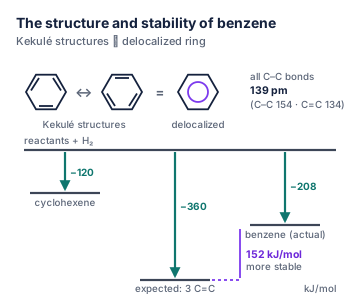
- all six C–C bonds are the same length, 139 pm, between a single bond (154 pm) and a double bond (134 pm);
- it is much more stable than expected;
- it does not decolourize bromine water, and it reacts by substitution, not addition.
The modern picture: each carbon is sp² hybridized, and the six leftover p orbitals overlap side-on all around the ring. The six π electrons are delocalized above and below the ring, shared by all six carbons. This is drawn as a hexagon with a circle inside.
Key idea
Delocalizing the six π electrons over the whole ring makes benzene unusually stable (by about 152 kJ/mol). Reactions that keep the ring intact (substitution) are therefore favoured over reactions that would destroy it (addition).
Why does it matter?
- Medicines and materials. Aspirin, paracetamol, ibuprofen, many antibiotics, dyes, explosives (TNT) and plastics (polystyrene, PET) all contain benzene rings.
- Biology. Several amino acids (phenylalanine, tyrosine, tryptophan) contain aromatic rings, as do the bases of DNA.
- Health. Benzene itself is toxic and causes cancer, so it has been replaced as a solvent by methylbenzene (toluene) in most uses.
How does it work?
1. Evidence from enthalpies of hydrogenation
Adding hydrogen to one C=C in cyclohexene releases 120 kJ/mol. If benzene had three separate C=C bonds, hydrogenating it to cyclohexane should release about kJ/mol. The measured value is only 208 kJ/mol, so benzene is about 152 kJ/mol more stable than the Kekulé structure: the delocalization (resonance) energy.
2. Naming aromatic compounds
| Formula | Name | Common name |
|---|---|---|
| methylbenzene | toluene | |
| phenol | phenol | |
| phenylamine | aniline | |
| benzoic acid | benzoic acid | |
| nitrobenzene | nitrobenzene | |
| chlorobenzene | chlorobenzene |
With two groups, number the ring carbons: 1,2- (adjacent), 1,3- or 1,4- (opposite), for example 1,4-dimethylbenzene.
3. Electrophilic substitution
The electron-rich ring attracts electrophiles (electron-pair acceptors, E⁺). An electrophile replaces a hydrogen atom, and the ring stays aromatic:
| Reaction | Reagents and conditions | Product |
|---|---|---|
| Nitration | concentrated + concentrated , about 50 °C | nitrobenzene |
| Halogenation | with an (or Fe) catalyst | bromobenzene + HBr |
| Friedel–Crafts alkylation | haloalkane with an catalyst | alkylbenzene |
| Friedel–Crafts acylation | acyl chloride with an catalyst | aromatic ketone |
Unlike alkenes, benzene needs a catalyst to react with bromine, because its stable delocalized ring is reluctant to give up its electrons.
Think of it like this
The six π electrons in benzene are like six people sharing a round table instead of sitting in three fixed pairs. Shared around the whole table, everyone is more comfortable (more stable). Swapping one diner for a newcomer (substitution) keeps the table intact; breaking the table apart (addition) costs too much.
More precisely
A ring is aromatic when it is planar, cyclic and fully conjugated, with π electrons (Hückel’s rule; benzene has 6, with ). In nitration, the electrophile is the nitronium ion, , formed when sulfuric acid protonates nitric acid. Groups already on the ring change both the rate and the position of further substitution: and make the ring more reactive and direct new groups to the 2- and 4-positions, while makes it less reactive and directs to the 3-position.
Visualise it
Worked example
Worked example: The delocalization energy
Question: Use ΔH(hydrogenation) of cyclohexene, −120 kJ/mol, and of benzene, −208 kJ/mol, to estimate how much more stable benzene is than the Kekulé structure.
-
Expected for three C=C bonds:
-
Difference:
-
Benzene releases 152 kJ/mol less energy, so it is about 152 kJ/mol more stable.
Worked example: Alkene or arene?
Question: Bromine water is shaken separately with cyclohexene and with benzene. What is seen, and why?
Cyclohexene decolourizes bromine water quickly: bromine adds across the C=C. Benzene gives no change at room temperature without a catalyst: addition would destroy the stable delocalized ring.
Worked example: Yield of nitrobenzene
Question: 7.80 g of benzene is nitrated: . Calculate the theoretical yield of nitrobenzene, and the mass obtained at an 80.0 % yield.
-
Moles of benzene:
-
1 : 1, so the theoretical yield is:
-
At 80.0 %:
Common mistake
Common mistake: Drawing benzene as cyclohexene with three double bonds
The Kekulé structure is a useful drawing, but benzene does not have three short and three long bonds. All six bonds are identical; the circle notation shows the delocalized π electrons.
Common mistake: Expecting addition reactions
Benzene reacts mainly by substitution. Addition (for example, hydrogenation to cyclohexane) is possible but needs harsh conditions.
Common mistake: Forgetting the catalyst
Bromine reacts with benzene only with a halogen carrier catalyst such as ; nitration needs concentrated sulfuric acid to make the electrophile.
Notation note
- is the phenyl group (Ph). Phenol is ; phenylamine is .
- “Aromatic” in chemistry means a stable conjugated ring, not a pleasant smell (though many aromatic compounds do smell).
Remember this
Remember this
- Benzene: planar ring of 6 sp² carbons, 6 delocalized π electrons; all C–C bonds 139 pm.
- Evidence: equal bond lengths; ΔH(hydrogenation) −208 kJ/mol instead of −360 kJ/mol: about 152 kJ/mol extra stability.
- Benzene reacts by electrophilic substitution, keeping the ring intact; it does not decolourize bromine water.
- Nitration: conc. HNO₃ + conc. H₂SO₄, about 50 °C. Bromination: Br₂ + FeBr₃. Friedel–Crafts: AlCl₃ catalyst.
Test yourself
Check your understanding before moving on.
Flashcards
Benzene and Aromatic Compounds: Flashcards
- QuestionDescribe the bonding in benzene.Answer
A planar ring of six sp² carbons; six p electrons are delocalized above and below the ring.
- QuestionWhat is the C–C bond length in benzene, compared with single and double bonds?Answer
139 pm, between C–C (154 pm) and C=C (134 pm); all six bonds are equal.
- QuestionHow does the enthalpy of hydrogenation show that benzene is extra stable?Answer
Expected 3 × −120 = −360 kJ/mol; actual −208 kJ/mol, so benzene is about 152 kJ/mol more stable.
- QuestionWhy does benzene undergo substitution rather than addition?Answer
Substitution keeps the stable delocalized ring intact; addition would destroy it.
- QuestionDoes benzene decolourize bromine water?Answer
No (unlike alkenes).
- QuestionGive the reagents and conditions for nitrating benzene.Answer
Concentrated HNO₃ and concentrated H₂SO₄, about 50 °C.
- QuestionWhat catalyst is needed to brominate benzene?Answer
FeBr₃ (or iron filings), a halogen carrier.
- QuestionWhat is the electrophile in nitration?Answer
The nitronium ion, NO₂⁺.
- QuestionName C₆H₅CH₃, C₆H₅OH and C₆H₅NH₂.Answer
Methylbenzene (toluene), phenol, phenylamine (aniline).
- QuestionWhat is the catalyst in Friedel–Crafts reactions?Answer
Aluminium chloride, AlCl₃.
Tip: press Space to flip and ← → to move between cards.
Quiz
Benzene and Aromatic Compounds: Quiz
7 questions
All C–C bonds are 139 pm, between C–C (154 pm) and C=C (134 pm), because the π electrons are delocalized.
Show answer
Answer: All six are the same length, between a single and a double bond
All C–C bonds are 139 pm, between C–C (154 pm) and C=C (134 pm), because the π electrons are delocalized.
An electrophile replaces a hydrogen, keeping the stable aromatic ring intact.
Show answer
Answer: Electrophilic substitution
An electrophile replaces a hydrogen, keeping the stable aromatic ring intact.
Bromine adds across the C=C of cyclohexene. Benzene does not react without a catalyst, because addition would destroy its delocalized ring.
Show answer
Answer: Only cyclohexene decolourizes it
Bromine adds across the C=C of cyclohexene. Benzene does not react without a catalyst, because addition would destroy its delocalized ring.
Expected for 3 C=C: 3 × (−120) = −360 kJ/mol. Actual −208 kJ/mol. Difference: 360 − 208 = 152 kJ/mol.
Show answer
Answer: 152 kJ/mol
Expected for 3 C=C: 3 × (−120) = −360 kJ/mol. Actual −208 kJ/mol. Difference: 360 − 208 = 152 kJ/mol.
Sulfuric acid helps form the nitronium ion, NO₂⁺, the electrophile that attacks the ring (about 50 °C).
Show answer
Answer: Concentrated HNO₃ and concentrated H₂SO₄
Sulfuric acid helps form the nitronium ion, NO₂⁺, the electrophile that attacks the ring (about 50 °C).
C₆H₅– is the phenyl group, so C₆H₅NH₂ is phenylamine (common name aniline).
Show answer
Answer: Phenylamine
C₆H₅– is the phenyl group, so C₆H₅NH₂ is phenylamine (common name aniline).
7.80 g ÷ 78.11 g/mol = 0.09986 mol; × 123.11 g/mol = 12.3 g (1 : 1). 9.83 g is the mass at 80 % yield.
Show answer
Answer: 12.3 g
7.80 g ÷ 78.11 g/mol = 0.09986 mol; × 123.11 g/mol = 12.3 g (1 : 1). 9.83 g is the mass at 80 % yield.
Notes and downloads
Worksheet
Benzene and Aromatic Compounds Worksheet
8 questions on the structure of benzene, the evidence for delocalization, naming aromatic compounds, electrophilic substitution and yield calculations. Answer key included.
References
- Brown, T. L.; LeMay, H. E., Jr.; Bursten, B. E.; Murphy, C. J.; Woodward, P. M.; Stoltzfus, M. W. Chemistry: The Central Science, 15th ed.; Pearson, 2022.
Practise this topic with flashcards and a quiz at chemistryclarity.com/chemistry/benzene-and-aromatic-compounds/
Spotted a mistake? Let us know and we'll fix it.