Worksheet
Benzene and Aromatic Compounds Worksheet
8 questions on the structure of benzene, the evidence for delocalization, naming aromatic compounds, electrophilic substitution and yield calculations. Answer key included.
- Type
- Worksheet
- Level
- Intermediate
- Format
- PDF, ready to print
Preview the questions
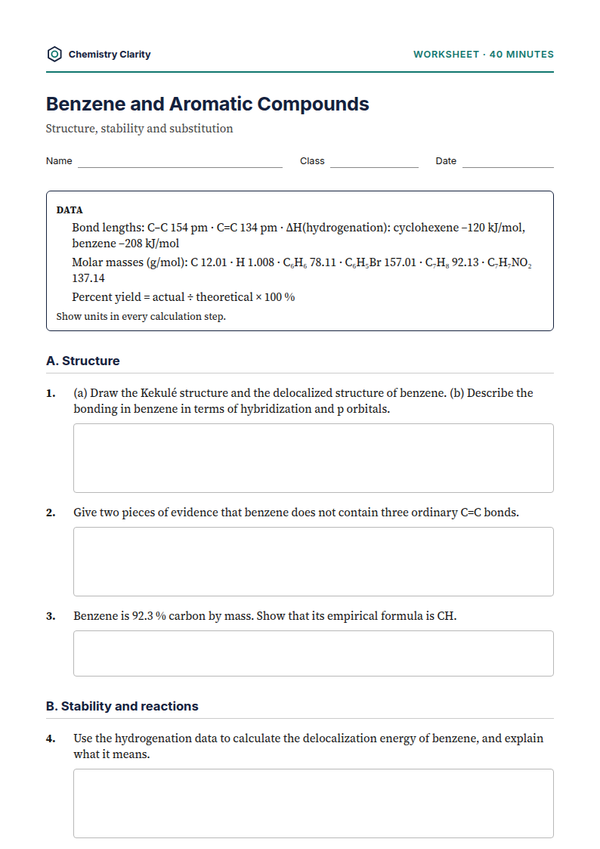
All the questions on this worksheet (about 40 minutes). Download the PDF to print it with space for working; the free answer key has full worked solutions.
A. Structure
1.
(a) Draw the Kekulé structure and the delocalized structure of benzene. (b) Describe the bonding in benzene in terms of hybridization and p orbitals.
2.
Give two pieces of evidence that benzene does not contain three ordinary C=C bonds.
3.
Benzene is 92.3 % carbon by mass. Show that its empirical formula is CH.
B. Stability and reactions
4.
Use the hydrogenation data to calculate the delocalization energy of benzene, and explain what it means.
5.
Give the reagents, conditions and product for (a) the nitration of benzene (b) the bromination of benzene. Name the type of reaction.
6.
Name: (a) (b) (c) (d)
C. Calculations
7.
15.6 g of benzene is converted completely into bromobenzene. Calculate the theoretical mass of bromobenzene.
D. Challenge
8.
9.21 g of methylbenzene () is nitrated to give a single product, . 10.5 g of product is obtained. Calculate the theoretical yield and the percent yield.