What is it?
A polymer is a very large molecule made by joining many small molecules, called monomers, into a long chain. Plastics, rubber, nylon, DNA, proteins, starch and cellulose are all polymers.
- The repeat unit is the part of the chain that repeats over and over. It is drawn in brackets with an n, and the bonds at each end extend through the brackets.
- The degree of polymerization, n, is the number of repeat units in a chain, often thousands.
There are two ways to build a polymer:
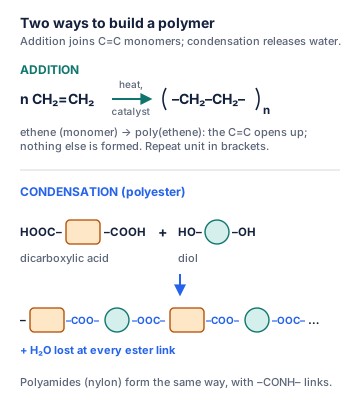
- Addition polymerization: monomers with a C=C double bond join; the double bond opens and nothing else is formed.
- Condensation polymerization: monomers with two functional groups each join, and a small molecule (usually water) is released at every link.
Key idea
An addition polymer has the same empirical formula as its monomer, because all the atoms are kept. A condensation polymer contains fewer atoms than the monomers that made it, because water is lost at every link.
Why does it matter?
- Materials. Poly(ethene) bags, PVC pipes, PTFE non-stick coatings, polyester and nylon clothing, and car tyres are polymers designed for particular properties.
- Life. Proteins (from amino acids), DNA (from nucleotides) and starch and cellulose (from glucose) are natural condensation polymers.
- Environment. Most plastics are not biodegradable, so their disposal, recycling and replacement are major environmental issues.
How does it work?
1. Common addition polymers
| Monomer | Polymer | Repeat unit | Uses |
|---|---|---|---|
| ethene, | poly(ethene) | –[CH₂–CH₂]– | bags, bottles |
| propene, | poly(propene) | –[CH₂–CH(CH₃)]– | ropes, crates |
| chloroethene, | poly(chloroethene), PVC | –[CH₂–CHCl]– | pipes, window frames |
| tetrafluoroethene, | PTFE | –[CF₂–CF₂]– | non-stick coatings |
2. From monomer to repeat unit (and back)
- Draw the monomer with the C=C in the middle and the other groups above and below.
- Change the C=C to a C–C single bond.
- Add a bond sticking out from each carbon, through a pair of brackets, and write n after the closing bracket.
To find the monomer from a repeat unit, reverse this: take the two main-chain carbons, remove the end bonds and put back the C=C.
3. Condensation polymers
Each monomer needs two reactive groups, one at each end, so the chain can keep growing in both directions:
- Polyesters (such as PET, used for drinks bottles and fleece): a dicarboxylic acid + a diol, joined by ester links (–COO–).
- Polyamides (such as nylon-6,6): a dicarboxylic acid + a diamine, joined by amide links (–CONH–):
(Here is one repeat unit of the chain, with its two amide links.)
- Proteins: amino acids (each with an –NH₂ and a –COOH group) joined by amide links, called peptide links.
4. Properties and disposal
- Thermoplastics (poly(ethene), PVC) are made of separate chains that slide past each other when heated, so they soften and can be remelted and recycled.
- Thermosets have cross-links (covalent bonds between chains), so they do not melt; they char when heated.
- Addition polymers have only strong, unreactive C–C and C–H bonds, so they are not biodegradable and persist for centuries. Condensation polymers can be broken down by hydrolysis at their ester or amide links, and some are designed to be biodegradable.
- Incineration recovers energy but releases ; burning PVC also releases toxic gas.
Think of it like this
Addition polymerization is like a line of people holding hands: each person (monomer) offers both hands (the C=C opens into two bonds), and nobody is left out. Condensation polymerization is like making a chain of paper clips where each join needs a small clip removed and thrown away: the water molecule lost at every link.
More precisely
Real polymer samples contain chains of many different lengths, so their molar mass is an average, and n is an average degree of polymerization. The properties depend on chain length, branching and the forces between chains: low-density poly(ethene) has branched chains that pack loosely, while high-density poly(ethene) has straight chains that pack closely and are stronger. Nylon is strong because its amide groups form hydrogen bonds between neighbouring chains.
Visualise it
Worked example
Worked example: Repeat units and monomers
Question: (a) Draw the repeat unit of the polymer made from chloroethene, . (b) Name the monomer of the polymer with repeat unit –[CF₂–CF₂]–.
- (a) Open the C=C and add a bond at each end: –[CH₂–CHCl]ₙ–, poly(chloroethene) (PVC).
- (b) Take the two carbons and restore the double bond: , tetrafluoroethene.
Worked example: Degree of polymerization
Question: A sample of poly(ethene) has an average molar mass of 1.40 × 10⁵ g/mol. How many repeat units are in an average chain? (repeat unit = 28.05 g/mol)
- 4.99 × 10³ repeat units (the units cancel)
Worked example: Chlorine in PVC
Question: (a) What is the percentage by mass of chlorine in PVC? (b) What mass of HCl could form if all the chlorine in 1.00 kg of PVC were released on burning? (repeat unit = 62.49 g/mol; HCl = 36.46 g/mol)
- (a) Each repeat unit has one Cl: 56.7 %
- (b)
- One HCl per repeat unit:
- 583 g, which is why PVC must not be burned in the open.
Common mistake
Common mistake: Keeping the double bond in the repeat unit
In an addition polymer the C=C has opened: the repeat unit has a C–C single bond, with bonds extending through the brackets. –[CH₂=CH₂]– is wrong; –[CH₂–CH₂]– is right.
Common mistake: Putting side groups into the main chain
In poly(propene) the group is a branch on the chain, not part of it: the main chain has only two carbons per repeat unit, –[CH₂–CH(CH₃)]–.
Common mistake: Forgetting the small molecule in condensation
Every new ester or amide link releases one water molecule. Leave it out and the equation does not balance, and the polymer is wrongly given the full mass of the monomers.
Notation note
- Polymer names put the monomer name in brackets after “poly”: poly(ethene), poly(propene). Common names: polyethylene, polypropylene, polyvinyl chloride (PVC), Teflon (PTFE), polystyrene.
- The n after the brackets is the degree of polymerization, usually a large number (an average).
- Nylon-6,6 is named from the six carbons in each of its two monomers.
Remember this
Remember this
- Polymer = many monomers joined; repeat unit in brackets with n.
- Addition: alkene monomers, C=C opens, no by-product; same empirical formula as the monomer.
- Condensation: two functional groups per monomer; water lost at every link; polyesters (–COO–), polyamides and proteins (–CONH–).
- n = polymer molar mass ÷ repeat-unit molar mass.
- Thermoplastics remelt; thermosets are cross-linked. Addition polymers are not biodegradable; burning PVC gives HCl.
Test yourself
Check your understanding before moving on.
Flashcards
Polymers: Flashcards
- QuestionWhat are a monomer and a polymer?Answer
A monomer is a small molecule; a polymer is a very large molecule made by joining many monomers.
- QuestionWhat is a repeat unit?Answer
The section of the chain that repeats, drawn in brackets with n, with bonds extending through the brackets.
- QuestionWhat is addition polymerization?Answer
Alkene monomers join as their C=C bonds open; no other product forms.
- QuestionRepeat unit of poly(propene)?Answer
–[CH₂–CH(CH₃)]–: the CH₃ is a branch, not part of the main chain.
- QuestionMonomer of PVC?Answer
Chloroethene, CH₂=CHCl (vinyl chloride).
- QuestionWhat is condensation polymerization?Answer
Monomers with two functional groups join, releasing a small molecule (usually water) at every link.
- QuestionMonomers of a polyester and of a polyamide?Answer
Polyester: dicarboxylic acid + diol (–COO– links). Polyamide (nylon): dicarboxylic acid + diamine (–CONH– links).
- QuestionHow are proteins related to polymers?Answer
They are condensation polymers of amino acids, joined by amide (peptide) links.
- QuestionThermoplastic vs thermoset?Answer
Thermoplastics soften on heating and can be remelted. Thermosets are cross-linked and do not melt.
- QuestionWhy are addition polymers not biodegradable?Answer
Their chains have only strong, unreactive C–C and C–H bonds, which microbes cannot easily break.
Tip: press Space to flip and ← → to move between cards.
Quiz
Polymers: Quiz
7 questions
Addition polymerization needs a C=C double bond; only propene has one.
Show answer
Answer: propene
Addition polymerization needs a C=C double bond; only propene has one.
The C=C opens into a single bond; the CH₃ stays as a branch. A three-carbon main chain is wrong.
Show answer
Answer: –[CH₂–CH(CH₃)]–
The C=C opens into a single bond; the CH₃ stays as a branch. A three-carbon main chain is wrong.
Nylon forms from a dicarboxylic acid and a diamine with loss of water. The others are addition polymers of alkenes.
Show answer
Answer: nylon-6,6
Nylon forms from a dicarboxylic acid and a diamine with loss of water. The others are addition polymers of alkenes.
Each ester link forms from –COOH and –OH, releasing one water molecule.
Show answer
Answer: H₂O
Each ester link forms from –COOH and –OH, releasing one water molecule.
–NH₂ and –COOH groups join to form amide (–CONH–) links. A diol and a diacid give a polyester.
Show answer
Answer: a diamine and a dicarboxylic acid
–NH₂ and –COOH groups join to form amide (–CONH–) links. A diol and a diacid give a polyester.
n = 6.25 × 10⁴ g/mol ÷ 62.49 g/mol = 1.00 × 10³.
Show answer
Answer: 1.00 × 10³
n = 6.25 × 10⁴ g/mol ÷ 62.49 g/mol = 1.00 × 10³.
Covalent cross-links between chains in thermosets stop them melting; they char instead.
Show answer
Answer: thermoplastic chains are separate and slide apart on heating; thermosets are cross-linked
Covalent cross-links between chains in thermosets stop them melting; they char instead.
Notes and downloads
Worksheet
Polymers Worksheet
9 questions on monomers, repeat units, addition and condensation polymers, degree of polymerization, composition and disposal. Answer key included.
References
- Brown, T. L.; LeMay, H. E., Jr.; Bursten, B. E.; Murphy, C. J.; Woodward, P. M.; Stoltzfus, M. W. Chemistry: The Central Science, 15th ed.; Pearson, 2022.
Practise this topic with flashcards and a quiz at chemistryclarity.com/chemistry/polymers/
Spotted a mistake? Let us know and we'll fix it.