Worksheet
Batteries, Fuel Cells and Corrosion Worksheet
8 questions on batteries, fuel cells, the electrochemistry of rusting, corrosion protection and battery-capacity calculations. Answer key included.
- Type
- Worksheet
- Level
- Intermediate
- Format
- PDF, ready to print
Preview the questions
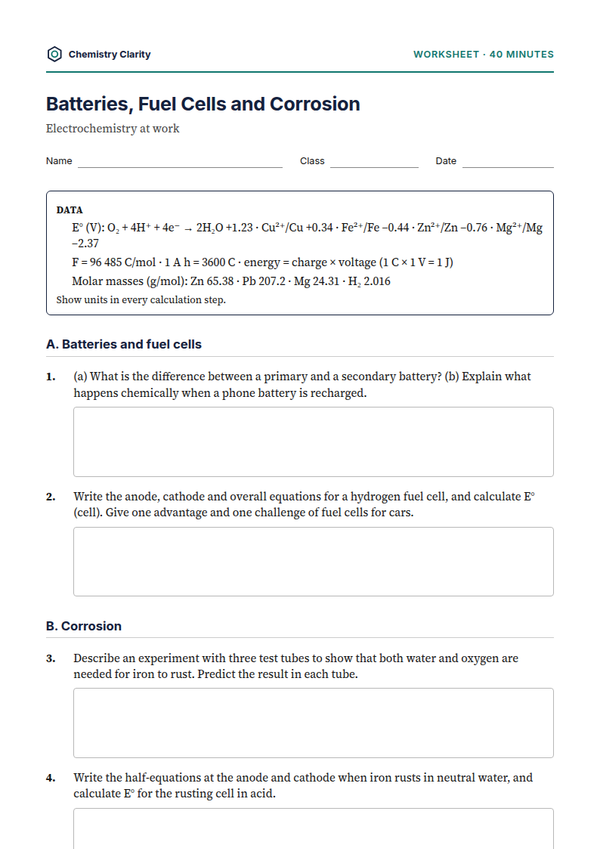
All the questions on this worksheet (about 40 minutes). Download the PDF to print it with space for working; the free answer key has full worked solutions.
A. Batteries and fuel cells
1.
(a) What is the difference between a primary and a secondary battery? (b) Explain what happens chemically when a phone battery is recharged.
2.
Write the anode, cathode and overall equations for a hydrogen fuel cell, and calculate E°(cell). Give one advantage and one challenge of fuel cells for cars.
B. Corrosion
3.
Describe an experiment with three test tubes to show that both water and oxygen are needed for iron to rust. Predict the result in each tube.
4.
Write the half-equations at the anode and cathode when iron rusts in neutral water, and calculate E° for the rusting cell in acid.
5.
Explain why (a) galvanized (zinc-coated) iron does not rust even when scratched (b) a scratched tin can rusts quickly.
C. Calculations
6.
An AA alkaline cell supplies 2500 mAh at 1.5 V. Calculate (a) the charge in coulombs (b) the moles of electrons (c) the mass of zinc oxidized () (d) the energy delivered.
7.
A fuel cell delivers a steady current of 1.00 A for 1.00 h. Calculate the mass of hydrogen consumed ().
D. Challenge
8.
A 5.00 kg magnesium sacrificial anode protects a pipeline by supplying a steady current of 0.50 A (). Estimate how many years it lasts.