Screening the plant kingdom
In 1960 the US National Cancer Institute (NCI) began testing extracts from thousands of plants for anticancer activity. In August 1962 the botanist Arthur Barclay collected bark from a Pacific yew tree in a forest in Washington State. Two years later its extract killed cancer cells in the laboratory. At the Research Triangle Institute in North Carolina, Monroe Wall and Mansukh Wani spent years separating the active compound from the bark’s many components, and in 1966 they isolated it and named it taxol.
A molecule of extraordinary complexity
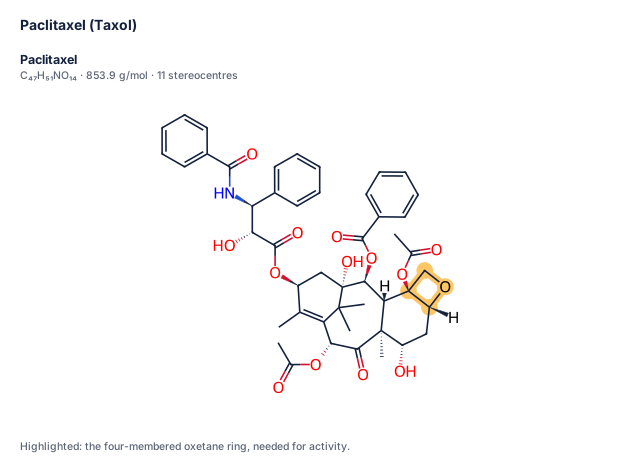
Paclitaxel, , has a core of fused six- and eight-membered rings, 11 stereocentres, a rare four-membered oxetane ring, and many functional groups: esters, alcohols, a ketone, an amide and three benzene rings. Its structure, published in 1971, was a triumph of chemical analysis and X-ray crystallography. Making it in the laboratory took more than twenty more years: the first total syntheses, by Robert Holton and K. C. Nicolaou, were both completed in 1994, each needing dozens of steps.
A new way to stop cancer cells
When a cell divides, protein fibres called microtubules form a spindle that pulls the copies of the chromosomes apart, then dismantle. In 1979 Susan Horwitz discovered that paclitaxel works in an unexpected way: instead of breaking microtubules down, it binds to them and stabilizes them, so the spindle cannot be dismantled and the cell cannot finish dividing. Rapidly dividing cancer cells are hit hardest.
Key idea
Many drugs work because their 3D shape fits a biological target. Paclitaxel’s rigid ring system holds its functional groups in exactly the positions needed to bind tubulin, the protein of microtubules.
Saving the yew
The bark contains very little paclitaxel, and stripping it kills the slow-growing Pacific yew. Treating every patient would have needed bark from several mature trees, threatening the species. Chemistry provided the solution: in 1988 a semi-synthesis was developed from a related compound, 10-deacetylbaccatin III, which is plentiful in the needles of the common European yew and can be harvested without killing the tree. Since the 2000s much of the world’s supply has been made by growing yew cells in fermentation tanks.
More precisely
“Taxol” is a registered trademark of Bristol Myers Squibb, so the compound’s generic name is paclitaxel. Related drugs such as docetaxel are made from the same needle extract. Paclitaxel has severe side effects, including hair loss and nerve damage, and its poor water solubility makes it difficult to formulate, so it is given as an infusion under specialist care.
Timeline
- 1962Botanist Arthur Barclay collects Pacific yew bark in Washington State for the National Cancer Institute's plant-screening programme.
- 1964Extracts of the bark are found to kill cancer cells in laboratory tests.
- 1966Monroe Wall and Mansukh Wani isolate the active compound and name it taxol.
- 1971Wall and Wani publish the structure, a complex ring system decorated with many functional groups.
- 1979Susan Horwitz discovers its unique mechanism: it stabilizes microtubules instead of breaking them down.
- 1988A semi-synthesis is developed from 10-deacetylbaccatin III, extracted from the needles of the European yew, a renewable source.
- 1992The US FDA approves paclitaxel (Taxol) for ovarian cancer.
- 1994Robert Holton and K. C. Nicolaou independently complete the first total syntheses; FDA approval for breast cancer follows.
- 2000sProduction switches to plant cell fermentation, so no trees need to be cut down.
Sources and further reading
Explore next
1996 Oseltamivir (Tamiflu) designed
Tamiflu: The Power of Star Anise
How a molecule from a kitchen spice became the starting material for an influenza drug.
How oseltamivir (Tamiflu) was designed in 1996 to block influenza neuraminidase, why its synthesis starts from shikimic acid in Chinese star anise, and the 2005 shortage.
1941 Centella saponins isolated
Madecassoside: The Aid of Centella asiatica
A wound-healing compound from a traditional herb of Asia and Madagascar, now found in skin creams.
Centella asiatica (gotu kola) in traditional medicine, the isolation of its saponins in 1941, the structure of madecassoside, and its use in wound healing and soothing skin products.
Spotted a mistake? Let us know and we'll fix it.