A healing herb
Centella asiatica is a small creeping plant with fan-shaped leaves that grows in damp places across tropical Asia, Africa and Madagascar. It has long been used in Ayurvedic and traditional Chinese medicine, and in Madagascar, to help wounds heal and to treat skin conditions. Tigers are said to roll in it to heal their wounds, which is why it is sometimes called “tiger grass”.
From plant to medicine
In 1941 the French pharmacist Jules Bontems reported isolating the plant’s active compounds, a family of triterpene saponins, starting with asiaticoside. In 1949 the Malagasy scientist Albert Rakoto Ratsimamanga, working with a French laboratory, developed Madecassol, a standardized Centella preparation for healing wounds and burns. The compound madecassoside, named after Madagascar, was later identified as one of the main active ingredients.
A molecule with two personalities
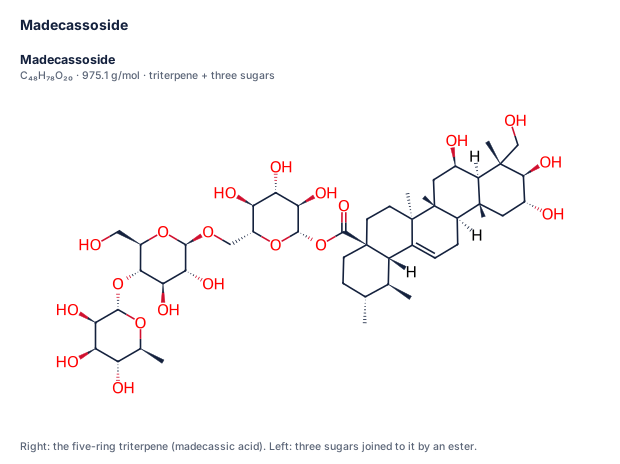
Madecassoside has two very different parts:
- a triterpene (madecassic acid): five fused carbon rings with 30 carbon atoms, mostly non-polar, like a fat;
- a chain of three sugar units with many –OH groups, very polar and water-loving.
The two are joined by an ester bond. A molecule with a non-polar part and a polar part is amphiphilic, like soap: saponins get their name from the Latin sapo, soap, because they foam when shaken with water.
Key idea
The sugar part makes the molecule more water-soluble and changes how it is absorbed, while the triterpene part carries much of the biological activity. Many natural products are glycosides built this way: salicin (in willow bark) is another example.
How it helps skin
Laboratory and animal studies suggest that madecassoside and its relatives stimulate skin cells to make collagen, reduce inflammation, and act as antioxidants, which together support wound healing. These properties explain its use in wound ointments and, more recently, in “cica” (from Centella asiatica) creams for sensitive or irritated skin.
More precisely
The amount of madecassoside and asiaticoside in Centella varies with where and how the plant is grown, so modern products use standardized extracts measured by chromatography. Evidence for the cosmetic benefits comes mainly from laboratory and small clinical studies; as with all skin products, results vary from person to person.
Timeline
- AncientCentella asiatica is used in Ayurvedic and traditional Chinese medicine, and in Madagascar, to treat wounds and skin conditions.
- 1941Jules Bontems reports the isolation of the plant's active saponins, beginning with asiaticoside.
- 1949Malagasy scientist Albert Rakoto Ratsimamanga and the Laroche-Navarron laboratories develop Madecassol, a wound-healing preparation of Centella extract.
- 1960sMadecassoside and madecassic acid are isolated and characterized as further active triterpenes.
- 2010sCentella extracts and madecassoside become popular in "cica" creams for sensitive and irritated skin.
Sources and further reading
Explore next
1990s Blood-sugar research on pinitol begins
Pinitol: The Power of the Carob Tree Fruit
A sugar-like molecule from carob pods that is being studied for its effects on blood sugar.
D-Pinitol from carob pods: what inositols are, why pinitol is so soluble in water, and what research suggests about its effects on insulin resistance (a supplement, not an approved drug).
1962 Yew bark collected for cancer screening
Taxol: The Blessing of the Yew Tree
A cancer drug from the bark of the Pacific yew, and the chemistry that saved the trees.
How the US National Cancer Institute found paclitaxel (Taxol) in Pacific yew bark, why its structure was so hard to solve and synthesize, how it stops cancer cells dividing, and how it is made sustainably.
Spotted a mistake? Let us know and we'll fix it.