A drug designed, then built from nature
Tamiflu is different from most of the medicines in this series. It was not found by testing a plant extract: it was designed. In the 1990s scientists worked out the three-dimensional shape of neuraminidase, an enzyme on the surface of the influenza virus that cuts newly made virus particles free from an infected cell. Chemists at Gilead Sciences designed a molecule to fit snugly into the enzyme’s active site and block it. That molecule, made in 1996, was oseltamivir. Without working neuraminidase, new viruses stay stuck to the cell and the infection spreads more slowly.
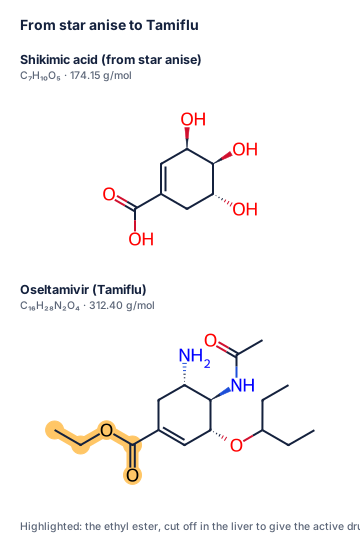
So where does nature come in? Oseltamivir has a six-membered carbon ring carrying three groups with precise 3D arrangements (three stereocentres). Building those from scratch is hard. But nature already makes a ring with the right shape: shikimic acid, which plants use to make aromatic amino acids. The richest commercial source is the fruit of Chinese star anise, the familiar star-shaped spice.
Key idea
Natural products are not only medicines in themselves; they are also chiral building blocks. Starting from a natural molecule that already has the right 3D shape can save many difficult steps in a synthesis.
A prodrug
Oseltamivir is a prodrug: the active form is the carboxylic acid, but acids are poorly absorbed from the gut. Chemists therefore made the ethyl ester, which is absorbed well; enzymes in the liver then hydrolyse the ester back to the active acid (oseltamivir carboxylate). This is the same ester chemistry as in the lesson on functional groups, and the same trick used in aspirin’s design.
Worked example: Moles in a capsule
Question: A Tamiflu capsule contains the equivalent of 75 mg of oseltamivir (312.40 g/mol). How many moles is this?
- , about 0.24 mmol
The star anise shortage
When the H5N1 bird flu spread in 2005, governments around the world ordered millions of doses of Tamiflu. Extracting shikimic acid from star anise has a low yield, and the spice became scarce and expensive. Chemists responded in two ways: producing shikimic acid by fermentation with engineered E. coli bacteria, and designing syntheses that do not need shikimic acid at all.
More precisely
Neuraminidase inhibitors work best when taken within about two days of the first symptoms, and how much they reduce serious complications is still debated. Influenza viruses can become resistant through small changes in the enzyme’s active site, so scientists keep monitoring circulating strains. Star anise used as a spice is safe, but the related Japanese star anise is toxic and must not be confused with it.
Timeline
- 1885Johan Fredrik Eykman isolates shikimic acid from Japanese star anise (shikimi), which gives the acid its name.
- 1990sThe 3D structure of the influenza enzyme neuraminidase guides the design of drugs that fit its active site.
- 1996Chemists at Gilead Sciences make oseltamivir; Gilead licenses it to Roche.
- 1999The US FDA approves Tamiflu (October), the first neuraminidase inhibitor taken as a pill.
- 2005Fear of an H5N1 bird-flu pandemic leads governments to stockpile Tamiflu; demand for star anise causes a temporary shortage.
- 2005Production of shikimic acid by fermentation with engineered E. coli bacteria begins to supplement star anise.
- 2009Tamiflu is widely used during the H1N1 influenza pandemic.
Sources and further reading
Explore next
1962 Yew bark collected for cancer screening
Taxol: The Blessing of the Yew Tree
A cancer drug from the bark of the Pacific yew, and the chemistry that saved the trees.
How the US National Cancer Institute found paclitaxel (Taxol) in Pacific yew bark, why its structure was so hard to solve and synthesize, how it stops cancer cells dividing, and how it is made sustainably.
1928 Penicillin discovered
Penicillin: The Miracle of Blue Mould
The first natural antibiotic, from a contaminated dish in 1928 to the medicine that changed the course of the Second World War.
How Fleming noticed penicillin in 1928, how Florey, Chain and Heatley turned it into a drug, why its β-lactam ring kills bacteria, and how resistance arose.
Spotted a mistake? Let us know and we'll fix it.