The carob tree
The carob tree grows around the Mediterranean, and its long brown pods have been eaten for thousands of years; the seeds were once used as standard weights for gold and gems, giving us the word carat. Today carob is best known as a chocolate substitute, but its pods also contain one of the richest natural supplies of D-pinitol.
A sugar that is not a sugar
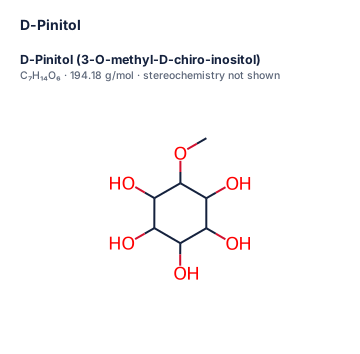
Pinitol belongs to the inositols (cyclitols): six-membered carbon rings with an –OH group on every carbon. In pinitol, one –OH is replaced by a methoxy group (–OCH₃, an ether). With five –OH groups, pinitol forms many hydrogen bonds with water, so it is very soluble and tastes slightly sweet, like a sugar, although it is not a carbohydrate in the strict sense. The different inositols differ only in which –OH groups point up or down from the ring: they are stereoisomers, and the body can tell them apart.
Key idea
Small differences in 3D shape matter in biology. Pinitol is related to D-chiro-inositol, a molecule involved in how cells respond to insulin, and may be converted into it in the body. That connection is why researchers became interested in pinitol for blood-sugar control.
What the research says
Studies in diabetic animals found that pinitol lowered blood glucose and appeared to make cells more sensitive to insulin. Several small trials in people with insulin resistance, prediabetes or polycystic ovary syndrome have reported modest improvements in blood glucose or insulin sensitivity, and research on carob extracts continues.
More precisely
Pinitol and carob extracts are sold as dietary supplements, not as approved medicines. The clinical studies so far are mostly small and short, and their results vary. Anyone with diabetes should not replace prescribed treatment with supplements, and should talk to a doctor before trying them. This story is a good example of how a natural product moves from traditional food to laboratory study to clinical trials, and why each step needs careful evidence.
Timeline
- 19th centuryPinitol is first found in the resin of pine trees, which gives it its name.
- 1980s–1990sResearchers show that inositol-containing molecules take part in insulin signalling inside cells.
- 1990sAnimal studies report that D-pinitol lowers blood glucose in diabetic rats.
- 2000s–2020sSmall clinical trials study pinitol and carob extracts in people with insulin resistance, prediabetes and polycystic ovary syndrome.
Sources and further reading
Explore next
1941 Centella saponins isolated
Madecassoside: The Aid of Centella asiatica
A wound-healing compound from a traditional herb of Asia and Madagascar, now found in skin creams.
Centella asiatica (gotu kola) in traditional medicine, the isolation of its saponins in 1941, the structure of madecassoside, and its use in wound healing and soothing skin products.
1940 Cannabidiol isolated
Cannabidiol: Cannabis for Medicine
How a non-intoxicating compound from cannabis became an approved epilepsy drug, Epidiolex.
Cannabidiol (CBD) from Cannabis sativa: its isolation (1940) and structure (1963), how it differs from THC, and the 2018 approval of Epidiolex for rare, severe childhood epilepsies.
Spotted a mistake? Let us know and we'll fix it.