An old plant, a new medicine
Cannabis has been used in traditional medicine for thousands of years, but its chemistry was a mystery until the twentieth century. The plant makes more than a hundred related compounds called cannabinoids. In 1940 the American chemist Roger Adams isolated one of them, cannabidiol (CBD), from wild hemp, but he could not determine its complete structure.
In 1963 the Israeli chemist Raphael Mechoulam and his colleague Yuval Shvo, at the Hebrew University of Jerusalem, published the structure of CBD, and in 1964 Mechoulam and Yehiel Gaoni isolated THC (Δ⁹-tetrahydrocannabinol) and showed that it, not CBD, is responsible for the “high” of cannabis.
Same formula, different molecules
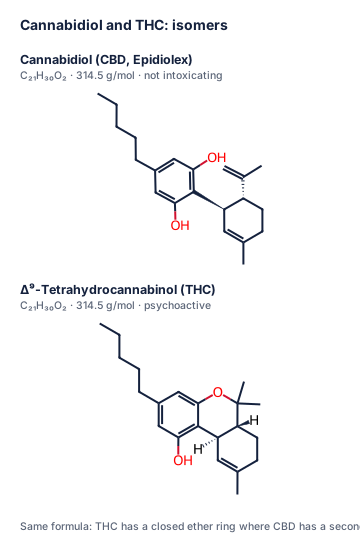
CBD and THC have exactly the same molecular formula, : they are isomers. In CBD, the benzene ring carries two –OH groups and is joined to a separate six-membered ring. In THC, one of those –OH groups has formed an ether link to the other ring, closing an extra ring. This small change alters the molecule’s shape and how it binds to cannabinoid receptors in the brain: THC strongly activates the CB1 receptor and is intoxicating, whereas CBD is not.
Key idea
Isomers can have completely different biological effects. Recognizing functional groups (here an alcohol versus an ether) helps explain why two molecules with the same formula behave so differently.
Epidiolex
Some children have rare, severe forms of epilepsy, such as Dravet syndrome and Lennox–Gastaut syndrome, in which seizures happen many times a day and standard medicines often fail. Reports from families using cannabis extracts led the British company GW Pharmaceuticals to develop Epidiolex, a purified, standardized CBD solution. In three randomized, placebo-controlled trials with more than 500 patients, it reduced seizure frequency. On 25 June 2018 the US FDA approved it for patients two years and older: the first FDA-approved medicine containing a purified substance from the cannabis plant.
More precisely
How CBD reduces seizures is still not fully understood; it appears to act on several targets rather than one receptor. A prescription medicine differs from shop-bought CBD products: its purity and dose are controlled and tested, whereas the content of unregulated products can differ widely from the label. CBD can also interact with other epilepsy medicines, so it must be used under medical supervision. Laws on cannabis products differ from country to country.
Timeline
- AncientCannabis is used in traditional medicine in China, India and elsewhere.
- 1940Roger Adams and his team at the University of Illinois isolate cannabidiol from wild hemp, but cannot determine its full structure.
- 1963Raphael Mechoulam and Yuval Shvo publish the structure of cannabidiol.
- 1964Yehiel Gaoni and Raphael Mechoulam isolate pure THC and determine its structure.
- 1980A small Brazilian clinical study tests cannabidiol in people with epilepsy.
- 2018The US FDA approves Epidiolex (25 June), the first FDA-approved medicine containing a purified substance from the cannabis plant.
- 2020Approval is extended to seizures caused by tuberous sclerosis complex.
Sources and further reading
Explore next
1804 Morphine isolated from opium
Morphine: The Gift of the Poppy
The first alkaloid ever isolated from a plant, still one of the most important painkillers in medicine.
From opium in ancient Mesopotamia to Sertürner's isolation of morphine in 1804, its complex structure (1925) and synthesis (1952), how it relieves pain, and why it is addictive.
1990s Blood-sugar research on pinitol begins
Pinitol: The Power of the Carob Tree Fruit
A sugar-like molecule from carob pods that is being studied for its effects on blood sugar.
D-Pinitol from carob pods: what inositols are, why pinitol is so soluble in water, and what research suggests about its effects on insulin resistance (a supplement, not an approved drug).
Spotted a mistake? Let us know and we'll fix it.