What is it?
Chromatography separates the substances in a mixture so that each one can be identified and measured. Every method has two phases:
- a stationary phase, which stays in place (paper, a thin layer of silica on a plate, or the inside of a column);
- a mobile phase, which moves through or over it (a solvent, or a gas).
As the mobile phase moves, each substance in the mixture is constantly shared between the two phases. A substance that is attracted more strongly to the stationary phase spends more time stuck there and moves slowly; one that prefers the mobile phase moves quickly. Different substances therefore travel different distances (or take different times) and come apart.
Key idea
Separation depends on the balance of attractions: stronger attraction to the stationary phase means slower movement. A pure substance gives one spot or peak; a mixture gives several.
Why does it matter?
- Identification. Forensic scientists identify inks, drugs and explosives; food chemists check for banned dyes.
- Purity. One spot on a plate is a quick check that a product is pure; chemists use columns to purify the compounds they make.
- Measurement. Gas and liquid chromatography measure pesticides in food, alcohol in blood and drugs in urine, often down to billionths of a gram.
How does it work?
1. Paper and thin-layer chromatography (TLC)
- Draw a baseline in pencil (ink would itself separate) about 1 cm from the bottom of the paper or plate.
- Put small spots of the mixture and of known standards on the baseline.
- Stand the plate in a little solvent, below the baseline (otherwise the spots would dissolve into the solvent), and cover the container so the air stays saturated with solvent vapour.
- Remove the plate before the solvent reaches the top, and mark the solvent front at once.
- Make colourless spots visible (for example under UV light) and measure the distances.
2. The retention factor, Rf
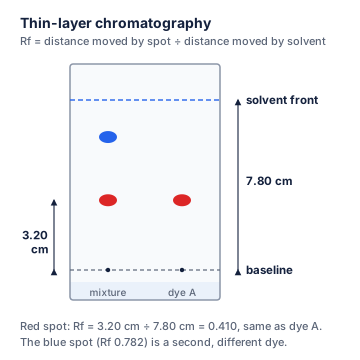
Both distances are measured from the baseline (to the centre of the spot) in the same unit, so has no unit and lies between 0 and 1. Under the same conditions (same stationary phase, solvent and temperature), a substance always has the same , so a spot can be identified by matching it to a standard run on the same plate.
3. The role of polarity
On a TLC plate of silica (very polar), polar compounds, such as those with –OH or –COOH groups, are held strongly and have low values; non-polar compounds, such as hydrocarbons, have high values. Using a more polar solvent pulls all the compounds further and raises every .
4. Gas chromatography (GC)
In GC the sample is vaporized and carried by an unreactive gas (such as helium) through a long, thin column coated with the stationary phase. A detector at the end records a peak as each substance comes out.
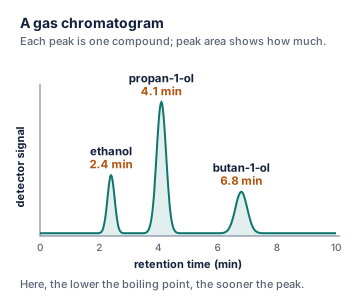
- The retention time, the time from injection to the peak, identifies a substance (compare with standards run under the same conditions).
- The area under a peak is proportional to the amount of that substance. For quantities, a calibration with standards is used, as in spectrophotometry.
Liquid chromatography (HPLC) works the same way, with a liquid mobile phase pumped through a packed column.
Think of it like this
Picture a crowd walking through a shopping street. Window-shoppers (strongly attracted to the shops, the stationary phase) stop often and move slowly; people hurrying to work (who prefer the moving crowd, the mobile phase) get through quickly. After an hour, the two groups are far apart, even though everyone set off together.
More precisely
A substance distributes between the phases according to its partition (or adsorption) equilibrium, which depends on intermolecular forces: hydrogen bonding, dipole–dipole forces and dispersion forces. In GC, volatility matters too: compounds with low boiling points spend more time in the gas and come out first. Two substances with the same or retention time under one set of conditions are not necessarily the same compound; confirming identity needs a second method, such as a different solvent or column, or mass spectrometry.
Visualise it
Worked example
Worked example: Calculating an Rf value
Question: On a TLC plate, the solvent front is 7.80 cm above the baseline and a red spot is 3.20 cm above it. Find .
- 0.410 (the cm cancel)
Worked example: Identifying a dye with replicate plates
Question: A food dye is run on three plates beside standards. Its values are 0.42, 0.44 and 0.43. Standards on the same plates: dye P 0.43, dye Q 0.52. Which dye is it?
- Mean:
- Standard deviation (sample, ):
- Report (). Dye P (0.43) lies within this spread; dye Q (0.52) is 9 standard deviations away.
- The dye is consistent with dye P. Running replicates shows the result is reproducible, not a one-off reading.
Worked example: Composition from GC peak areas
Question: A GC run of a solvent mixture gives peak areas of 1250 (ethanol), 3400 (propan-1-ol) and 850 (butan-1-ol), in the same arbitrary units. Assuming the detector responds equally to each, find the percentage of each component.
- Total area
- Ethanol: 22.7 %
- Propan-1-ol: 61.8 %
- Butan-1-ol: 15.5 %
- Check: 22.7 % + 61.8 % + 15.5 % = 100.0 %. ✓
Common mistake
Common mistake: Measuring from the bottom of the plate
Both distances in are measured from the baseline, not from the edge of the plate. Measuring from the edge makes every too large.
Common mistake: Comparing Rf values from different conditions
depends on the solvent, the stationary phase and the temperature. Only compare with standards run on the same plate, or under identical conditions.
Common mistake: Drawing the baseline in ink or below the solvent
Ink contains dyes that separate too; a baseline below the solvent level lets the sample dissolve away into the solvent instead of travelling up the plate.
Notation note
- is the retention factor (sometimes called the retardation factor); it is written without a unit.
- TLC = thin-layer chromatography; GC = gas chromatography; HPLC = high-performance liquid chromatography.
- The substance being analysed is often called the analyte; the mobile phase in GC is the carrier gas.
Remember this
Remember this
- Stationary phase stays put; mobile phase moves. Stronger attraction to the stationary phase = slower.
- = distance moved by spot ÷ distance moved by solvent front, both from the baseline; no unit; compare with standards on the same plate.
- On polar silica: polar compounds have low ; a more polar solvent raises all values.
- GC: retention time identifies; peak area measures amount. Measure in replicate and report mean ± standard deviation.
Test yourself
Check your understanding before moving on.
Flashcards
Chromatography: Flashcards
- QuestionWhat are the two phases in chromatography?Answer
The stationary phase (stays in place: paper, silica, column coating) and the mobile phase (moves: solvent or gas).
- QuestionWhy do substances separate?Answer
They have different attractions to the two phases; those held more strongly by the stationary phase move more slowly.
- QuestionDefine Rf.Answer
Distance moved by the spot ÷ distance moved by the solvent front, both from the baseline. No unit; between 0 and 1.
- QuestionWhy is the baseline drawn in pencil?Answer
Pencil (graphite) does not dissolve and move; ink contains dyes that would separate too.
- QuestionWhy must the solvent be below the baseline?Answer
Otherwise the spots dissolve into the solvent instead of travelling up the plate.
- QuestionOn a polar silica plate, which has the higher Rf: a polar or a non-polar compound?Answer
The non-polar compound: polar compounds are held strongly by the silica and move less.
- QuestionHow is an unknown spot identified?Answer
By matching its Rf with standards run on the same plate (same solvent, stationary phase and temperature).
- QuestionWhat is retention time in GC?Answer
The time from injection to the peak for a substance; under fixed conditions it identifies the substance.
- QuestionWhat does the area of a GC peak show?Answer
The amount of that substance; calibration with standards turns area into concentration.
- QuestionDoes one spot prove a sample is pure?Answer
Not on its own: two substances can share an Rf. Use a second solvent or method to confirm.
Tip: press Space to flip and ← → to move between cards.
Quiz
Chromatography: Quiz
7 questions
Rf = 3.60 cm ÷ 9.00 cm = 0.400. The units cancel, so Rf has no unit, and it is always less than 1.
Show answer
Answer: 0.400
Rf = 3.60 cm ÷ 9.00 cm = 0.400. The units cancel, so Rf has no unit, and it is always less than 1.
It spends more time held by the stationary phase, so it travels a shorter distance.
Show answer
Answer: moves slowly and has a low Rf
It spends more time held by the stationary phase, so it travels a shorter distance.
Silica is very polar. Hexane is non-polar, so it is held least and moves furthest. The others have polar O–H or N–H groups.
Show answer
Answer: hexane
Silica is very polar. Hexane is non-polar, so it is held least and moves furthest. The others have polar O–H or N–H groups.
Graphite is insoluble and stays put; ink dyes would move and add extra spots.
Show answer
Answer: ink contains dyes that would also separate
Graphite is insoluble and stays put; ink dyes would move and add extra spots.
Under fixed conditions each substance has its own retention time; peak area (not identity) tells how much is present.
Show answer
Answer: the retention time
Under fixed conditions each substance has its own retention time; peak area (not identity) tells how much is present.
Total = 600 + 1500 + 900 = 3000; B = 1500 ÷ 3000 × 100 % = 50.0 %.
Show answer
Answer: 50.0 %
Total = 600 + 1500 + 900 = 3000; B = 1500 ÷ 3000 × 100 % = 50.0 %.
A more polar mobile phase competes better with the polar silica for the compounds, so they all move further.
Show answer
Answer: raise all the Rf values
A more polar mobile phase competes better with the polar silica for the compounds, so they all move further.
Notes and downloads
Worksheet
Chromatography Worksheet
9 questions on phases, Rf values, TLC technique, polarity, gas chromatography, replicate measurements and peak-area calculations. Answer key included.
References
- Brown, T. L.; LeMay, H. E., Jr.; Bursten, B. E.; Murphy, C. J.; Woodward, P. M.; Stoltzfus, M. W. Chemistry: The Central Science, 15th ed.; Pearson, 2022.
Practise this topic with flashcards and a quiz at chemistryclarity.com/chemistry/chromatography/
Spotted a mistake? Let us know and we'll fix it.