What is it?
In a titration, a solution of known concentration (the standard solution or titrant, in the burette) is added to a measured volume of an unknown solution (the analyte, delivered by pipette as an aliquot) until the reaction is exactly complete: the equivalence point, shown by an indicator colour change (the end point).
The volume delivered from the burette is the titre. A rough titre is followed by accurate repeats until at least two or three concordant titres agree closely (usually within 0.10 mL). Their mean is used in the calculation, and the standard deviation shows how precise the titrations were.
Key idea
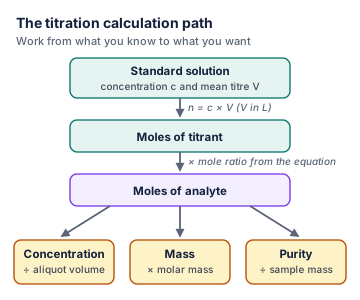
Every titration calculation follows the same path:
known solution (volume × concentration) → moles → mole ratio from the balanced equation → moles of unknown → concentration, mass or purity.
Why does it matter?
- Quality control. Titrations check the acidity of vinegar and wine, the vitamin C in juice and the purity of medicines.
- Precision chemistry. With a burette and pipette, results to 3 or 4 significant figures are routine.
- Exams and lab work. Titration calculations appear in almost every chemistry course and practical assessment.
How does it work?
1. Choosing the titres
Leave out the rough titre and any titre that does not agree with the others. Average the concordant ones, and calculate the standard deviation to report precision.
2. The basic calculation
with in litres. Always write the balanced equation: the mole ratio is often not 1 : 1. For example:
3. Dilutions and aliquots
If the original sample was diluted before titrating, scale the moles back up: a 25.00 mL aliquot from a 100.0 mL flask contains one quarter of the moles in the flask.
4. Back titration
When a substance doesn’t react quickly or doesn’t dissolve (such as limestone, ), add a known excess of acid, let it react completely, then titrate the leftover acid with a base. The acid that reacted = acid added − acid left over.
Think of it like this
A back titration is like finding out how much a friend ate from a full bag of sweets. You can’t count what they ate directly, but you know how many were in the bag and you can count what is left. Eaten = started with − left over.
More precisely
The end point (indicator change) and the equivalence point (exact stoichiometric amount) are not quite the same; a well-chosen indicator makes the difference smaller than the burette’s reading uncertainty. A titre is the difference of two burette readings, each uncertain by about ±0.05 mL, so the titre is uncertain by about ±0.10 mL; larger titres give a smaller percent uncertainty. Standard solutions are made from primary standards, very pure, stable solids such as sodium carbonate or potassium hydrogen phthalate.
Visualise it
Worked example
Worked example: Concentration from concordant titres
Question: 25.00 mL of NaOH is titrated with 0.1000 mol/L HCl. Titres: rough 24.10 mL, then 23.45 mL, 23.50 mL and 23.40 mL. Find the concentration of the NaOH.
-
Mean of the three accurate titres:
The standard deviation is 0.05 mL: the titres are precise.
-
Moles of HCl:
-
The mole ratio is 1 : 1:
so mol.
-
Concentration:
Worked example: A diprotic acid
Question: 20.00 mL of sulfuric acid needs 24.80 mL of 0.1500 mol/L NaOH. Find the concentration of the acid.
-
-
The mole ratio is 1 : 2:
so
-
Concentration:
Worked example: Dilution and an aliquot: vinegar
Question: 10.00 mL of vinegar is diluted to 100.0 mL. A 25.00 mL aliquot needs 17.60 mL of 0.1000 mol/L NaOH. Find the concentration of ethanoic acid in the original vinegar, and the mass of acid in 100 mL of vinegar.
-
Moles in the aliquot (1 : 1 reaction):
-
The flask holds aliquots: , all from the 10.00 mL of vinegar.
-
Concentration:
-
Mass in 100 mL (0.1000 L): , so the vinegar is about 4.2 % acid.
Worked example: A back titration: purity of limestone
Question: 0.500 g of limestone is added to 50.00 mL of 0.2000 mol/L HCl (an excess). The leftover HCl needs 12.40 mL of 0.1000 mol/L NaOH. Find the percent of in the limestone.
-
HCl added:
-
HCl left over (= NaOH used):
-
HCl that reacted with the limestone:
-
The mole ratio is 1 : 2:
so
-
Mass and purity:
Common mistake
Common mistake: Including the rough titre
The rough titre is only a guide to where the end point is. Average only the accurate, concordant titres.
Common mistake: Forgetting the mole ratio
Sulfuric acid is diprotic: 1 mol reacts with 2 mol NaOH. Using 1 : 1 doubles the answer.
Common mistake: Leaving volumes in mL
needs in litres when is in mol/L: 23.45 mL = 0.02345 L.
Notation note
- Record burette readings to two decimal places (e.g. 23.45 mL), and report the mean titre the same way.
- Concentrations from careful titrations are usually given to 4 significant figures.
Remember this
Remember this
- Use the mean of concordant titres (within about 0.10 mL); leave out the rough titre.
- Path: (known) → mole ratio → moles of unknown → , mass or purity.
- Scale up for dilutions: moles in flask = moles in aliquot × (flask volume ÷ aliquot volume).
- Back titration: reacted = added − left over.
Test yourself
Check your understanding before moving on.
Flashcards
Titration Calculations: Flashcards
- QuestionWhat is a titre?Answer
The volume of solution delivered from the burette to reach the end point.
- QuestionWhat are concordant titres?Answer
Accurate titres that agree closely, usually within 0.10 mL.
- QuestionWhy is the rough titre left out of the mean?Answer
It is only a quick guide to the end point and is usually overshot.
- QuestionGive the equation linking moles, concentration and volume.Answer
n = c × V, with V in litres.
- QuestionWhat is the mole ratio of H₂SO₄ to NaOH?Answer
1 : 2 (H₂SO₄ + 2NaOH → Na₂SO₄ + 2H₂O)
- QuestionWhat is the difference between the end point and the equivalence point?Answer
Equivalence point: exact stoichiometric amount added. End point: where the indicator changes colour.
- QuestionA 25.00 mL aliquot is taken from a 250.0 mL flask. How do you find the moles in the flask?Answer
Multiply the moles in the aliquot by 250.0 ÷ 25.00 = 10.
- QuestionWhat is a back titration?Answer
A known excess of reagent is added; the leftover is titrated to find how much reacted.
- QuestionIn a back titration, how do you find the moles that reacted?Answer
Moles added − moles left over (found by titration).
- QuestionWhat is a primary standard?Answer
A very pure, stable solid used to make a solution of accurately known concentration (e.g. Na₂CO₃).
Tip: press Space to flip and ← → to move between cards.
Quiz
Titration Calculations: Quiz
7 questions
Leave out the rough titre and average the three concordant ones: (23.45 + 23.50 + 23.40) mL ÷ 3 = 23.45 mL. 23.61 mL includes the rough titre.
Show answer
Answer: 23.45 mL
Leave out the rough titre and average the three concordant ones: (23.45 + 23.50 + 23.40) mL ÷ 3 = 23.45 mL. 23.61 mL includes the rough titre.
n = c × V = 0.1000 mol/L × 0.02345 L = 2.345 × 10⁻³ mol. The volume must be in litres.
Show answer
Answer: 2.345 × 10⁻³ mol
n = c × V = 0.1000 mol/L × 0.02345 L = 2.345 × 10⁻³ mol. The volume must be in litres.
n(NaOH) = n(HCl) = 2.345 × 10⁻³ mol (1 : 1); c = 2.345 × 10⁻³ mol ÷ 0.02500 L = 0.09380 mol/L.
Show answer
Answer: 0.09380 mol/L
n(NaOH) = n(HCl) = 2.345 × 10⁻³ mol (1 : 1); c = 2.345 × 10⁻³ mol ÷ 0.02500 L = 0.09380 mol/L.
n(NaOH) = 3.720 × 10⁻³ mol; H₂SO₄ : NaOH = 1 : 2, so n(H₂SO₄) = 1.860 × 10⁻³ mol; c = 1.860 × 10⁻³ mol ÷ 0.02000 L = 0.09300 mol/L. 0.1860 forgets the ratio.
Show answer
Answer: 0.09300 mol/L
n(NaOH) = 3.720 × 10⁻³ mol; H₂SO₄ : NaOH = 1 : 2, so n(H₂SO₄) = 1.860 × 10⁻³ mol; c = 1.860 × 10⁻³ mol ÷ 0.02000 L = 0.09300 mol/L. 0.1860 forgets the ratio.
The flask holds 100.0 ÷ 25.00 = 4 aliquots: 4 × 1.760 × 10⁻³ mol = 7.040 × 10⁻³ mol.
Show answer
Answer: 7.040 × 10⁻³ mol
The flask holds 100.0 ÷ 25.00 = 4 aliquots: 4 × 1.760 × 10⁻³ mol = 7.040 × 10⁻³ mol.
Reacted = added − left over = 1.000 × 10⁻² mol − 1.240 × 10⁻³ mol = 8.760 × 10⁻³ mol. 4.380 × 10⁻³ mol is the CaCO₃ it reacts with (1 : 2).
Show answer
Answer: 8.760 × 10⁻³ mol
Reacted = added − left over = 1.000 × 10⁻² mol − 1.240 × 10⁻³ mol = 8.760 × 10⁻³ mol. 4.380 × 10⁻³ mol is the CaCO₃ it reacts with (1 : 2).
An excess of acid is added so the solid reacts completely; the leftover acid is then titrated.
Show answer
Answer: CaCO₃ is insoluble and reacts slowly, so it can't be titrated directly
An excess of acid is added so the solid reacts completely; the leftover acid is then titrated.
Notes and downloads
Worksheet
Titration Calculations Worksheet
8 questions on concordant titres, standardisation, diprotic acids, dilutions and aliquots, back titrations and uncertainty. Answer key included.
References
- Brown, T. L.; LeMay, H. E., Jr.; Bursten, B. E.; Murphy, C. J.; Woodward, P. M.; Stoltzfus, M. W. Chemistry: The Central Science, 15th ed.; Pearson, 2022.
Practise this topic with flashcards and a quiz at chemistryclarity.com/chemistry/titration-calculations/
Spotted a mistake? Let us know and we'll fix it.