What is it?
A reaction mechanism is the sequence of elementary steps by which reactants turn into products. Each elementary step is a single event, a collision or a molecule falling apart, that happens exactly as written.
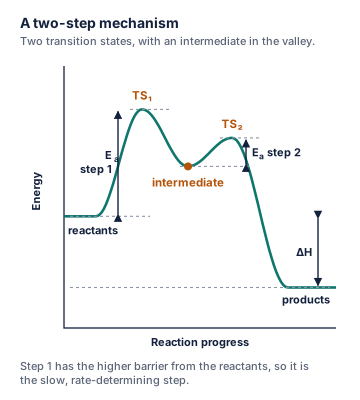
The Integrated Rate Laws lesson introduced the key ideas: the slowest step is rate-determining, and an intermediate is made in one step and used up in a later one. This lesson goes further: how to derive a rate law when the slow step comes second, how catalysts fit into a mechanism, and how enzymes, nature’s catalysts, behave.
Key idea
The rate law of an elementary step follows directly from its equation. The rate law of the overall reaction follows from the mechanism: it is set by the rate-determining step, written using only species that appear in the overall reaction (or a catalyst).
Why does it matter?
- Designing better reactions. Knowing which step is slow tells chemists what to change: a different catalyst, solvent or temperature.
- The ozone layer. Chlorine atoms from CFCs destroy ozone by a catalytic mechanism, which is why tiny amounts did so much damage.
- Industry. Most industrial chemicals, fuels and plastics are made with catalysts, from iron in the Haber process to zeolites in oil refining.
- Life and medicine. Every reaction in a cell is run by an enzyme. Many drugs work by inhibiting an enzyme, and enzymes are now designed for industry, as in the work of Frances Arnold.
How does it work?
1. Elementary steps and molecularity
The molecularity of an elementary step is the number of particles that react in it:
| Molecularity | Example step | Rate law |
|---|---|---|
| unimolecular | rate | |
| bimolecular | rate | |
| bimolecular | rate | |
| termolecular (rare) | rate |
Only for an elementary step can you write the rate law from the coefficients. Three particles colliding at exactly the same moment is very unlikely, so termolecular steps are rare, and steps with four or more particles are not seen.
2. A valid mechanism
A proposed mechanism must:
- add up to the overall balanced equation;
- give a rate law that matches the experimental rate law;
- be chemically reasonable (mostly uni- and bimolecular steps).
3. When the slow step comes second: the pre-equilibrium
If a fast, reversible first step comes before the slow step, the slow step’s rate law contains an intermediate. Replace it using the equilibrium of the fast step.
For :
-
Rate of the slow step: rate . But is an intermediate, so it can’t appear in the final rate law.
-
Step 1 is fast in both directions, so it stays at equilibrium:
so .
-
Substitute:
The reaction is second order in NO and first order in , third order overall, which matches experiment, without any three-particle collision.
4. Intermediates and catalysts
Both are absent from the overall equation, but they appear in the mechanism in opposite orders:
- An intermediate is made first, then used up.
- A catalyst is used first, then regenerated.
Chlorine atoms high in the atmosphere destroy ozone:
Cl is the catalyst (used, then given back), so one Cl atom can destroy many thousands of ozone molecules. ClO is an intermediate.
5. Surface (heterogeneous) catalysis
A solid catalyst works in four stages:
- Adsorption: reactant molecules bond to active sites on the surface.
- Weakening: bonds within the reactants are stretched or broken (for example, H–H on nickel).
- Reaction: the adsorbed species react on the surface.
- Desorption: the products leave, freeing the sites.
A good catalyst adsorbs strongly enough to weaken bonds, but weakly enough to let the products go. Catalysts are spread thinly over a large surface area (a catalytic converter coats a honeycomb with platinum, palladium and rhodium), and they can be poisoned by substances, such as lead or sulfur, that bind to the active sites permanently.
6. Enzymes
Enzymes are protein catalysts. The substrate binds to the enzyme’s active site, a pocket whose shape and chemical groups fit it closely (induced fit: the site adjusts its shape as the substrate binds):
- Specific: each enzyme acts on one substrate or a small group of similar ones.
- Fast: carbonic anhydrase converts about a million molecules per second at each active site.
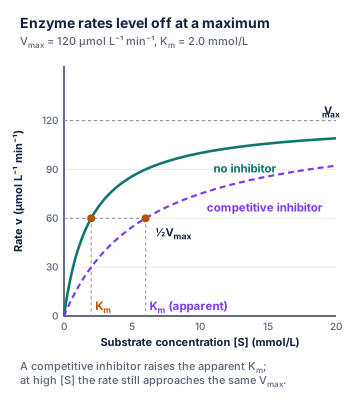
- Saturation: at low [S], the rate rises in proportion to [S]. At high [S], every active site is busy and the rate levels off at . This is described by the Michaelis–Menten equation:
- (the Michaelis constant) is the substrate concentration at which . A small means the enzyme works well even at low [S].
- Temperature and pH: the rate rises with temperature up to an optimum, then falls sharply as the protein denatures (loses its shape). Each enzyme also has an optimum pH.
- Inhibitors: a competitive inhibitor resembles the substrate and blocks the active site; adding more substrate overcomes it ( appears larger, unchanged). A non-competitive inhibitor binds elsewhere and changes the enzyme’s shape; it lowers , and more substrate doesn’t help.
Think of it like this
An enzyme is like a car wash with a fixed number of bays. When few cars arrive, doubling the arrivals doubles the number washed per hour. When the queue stretches down the road, every bay is busy and extra cars make no difference: the wash runs at its maximum rate (). A competitive inhibitor is a broken-down car parked in a bay: more customers push it out of the way eventually. A non-competitive inhibitor is a bay closed for repairs: more customers can’t help.
More precisely
The Michaelis–Menten equation comes from assuming that [ES] stays roughly constant during the reaction (the steady-state approximation), giving . At low [S] (), : first order in S. At high [S], : zero order. The turnover number, , is the number of substrate molecules each active site converts per second when saturated.
Visualise it
Worked example
Worked example: Deriving a rate law from a mechanism
Question: The reaction has the mechanism:
Step 1 (slow): · Step 2 (fast):
(a) Show that the steps add up to the overall equation. (b) Identify the intermediate. (c) Write the rate law.
- Add the steps: . Cl appears on both sides and cancels, giving . ✓
- Cl is made in step 1 and used in step 2: it is the intermediate.
- Step 1 is slow and unimolecular: rate , first order.
Worked example: Michaelis–Menten kinetics
Question: An enzyme has and mmol/L. (a) Calculate the rate at mmol/L. (b) The total enzyme concentration is 0.010 µmol/L. Calculate the turnover number in .
-
(a) First find the fraction of , with :
The mmol/L units cancel. At three times , the rate is three-quarters of .
-
(b) Turnover number:
Each active site converts 200 substrate molecules per second.
Common mistake
Common mistake: Writing the rate law from the overall equation
Coefficients in the overall equation do not give the orders. is first order in , not second. Only elementary steps can be read directly.
Common mistake: Leaving an intermediate in the rate law
If the slow step contains an intermediate, replace its concentration using the fast pre-equilibrium. A final rate law contains only reactants (and sometimes products or a catalyst), never an intermediate.
Common mistake: Mixing up catalysts and intermediates
Look at where the species appears first. Used, then regenerated: catalyst. Made, then used up: intermediate.
Common mistake: Thinking enzymes are destroyed by heat at once
Below the optimum, enzyme reactions speed up with temperature like any reaction. Above it, the rate falls because the protein denatures, not because the reaction itself becomes slower.
Notation note
- , , : rate constants of step 1 forward, step 1 reverse and step 2. .
- E, S, ES, P: enzyme, substrate, enzyme–substrate complex, product.
- : maximum rate; : Michaelis constant (a concentration); : turnover number.
Remember this
Remember this
- Elementary steps: the rate law follows the coefficients (uni-, bi-, rarely termolecular).
- A mechanism must add up, match the experimental rate law and be reasonable.
- Slow step second: replace the intermediate using the fast pre-equilibrium.
- Intermediate: made, then used up. Catalyst: used, then regenerated.
- Enzymes saturate: ; is [S] at half .
Test yourself
Check your understanding before moving on.
Flashcards
Reaction Mechanisms and Catalysis: Flashcards
- QuestionWhat is an elementary step?Answer
A single molecular event (one collision or one molecule breaking apart) that happens exactly as written. Its rate law follows its coefficients.
- QuestionWhat is molecularity?Answer
The number of particles reacting in an elementary step: unimolecular (1), bimolecular (2), termolecular (3, rare).
- QuestionGive three tests of a proposed mechanism.Answer
The steps add up to the overall equation; the predicted rate law matches experiment; the steps are reasonable (mostly uni- or bimolecular).
- QuestionHow do you handle an intermediate in the slow step?Answer
Use the fast, reversible step before it (pre-equilibrium): K₁ = [intermediate]/[reactants], then substitute into the slow step's rate law.
- QuestionHow do you tell a catalyst from an intermediate in a mechanism?Answer
A catalyst is used first and regenerated later. An intermediate is made first and used up later.
- QuestionName the four stages of surface catalysis.Answer
Adsorption onto active sites, weakening of bonds, reaction on the surface, desorption of products.
- QuestionWhat is catalyst poisoning?Answer
A substance (such as lead or sulfur) binds permanently to the active sites, blocking them.
- QuestionWrite the Michaelis–Menten equation.Answer
v = Vmax[S] / (Km + [S]). Km is the substrate concentration at which v = ½Vmax.
- QuestionWhy does an enzyme's rate level off at high substrate concentration?Answer
All the active sites are occupied (saturated), so extra substrate cannot be processed any faster: v approaches Vmax.
- QuestionHow do competitive and non-competitive inhibitors differ?Answer
Competitive: binds the active site; more substrate overcomes it (Km appears larger, Vmax unchanged). Non-competitive: binds elsewhere; lowers Vmax.
Tip: press Space to flip and ← → to move between cards.
Quiz
Reaction Mechanisms and Catalysis: Quiz
7 questions
For an elementary step the rate law follows the coefficients: two NO₂ molecules collide, so the step is second order in NO₂.
Show answer
Answer: rate = k[NO₂]²
For an elementary step the rate law follows the coefficients: two NO₂ molecules collide, so the step is second order in NO₂.
Cl is used in step 1 and regenerated in step 2. ClO, made then used up, is the intermediate.
Show answer
Answer: A catalyst
Cl is used in step 1 and regenerated in step 2. ClO, made then used up, is the intermediate.
The slow step is unimolecular, so the reaction is first order in NO₂Cl, even though the overall equation has a coefficient of 2.
Show answer
Answer: rate = k[NO₂Cl]
The slow step is unimolecular, so the reaction is first order in NO₂Cl, even though the overall equation has a coefficient of 2.
Rate = k₂[NOBr₂][NO], and [NOBr₂] = K₁[NO][Br₂] from the pre-equilibrium, so rate = k₂K₁[NO]²[Br₂].
Show answer
Answer: rate = k[NO]²[Br₂]
Rate = k₂[NOBr₂][NO], and [NOBr₂] = K₁[NO][Br₂] from the pre-equilibrium, so rate = k₂K₁[NO]²[Br₂].
When [S] = Km, v = ½Vmax = ½ × 80 µmol L⁻¹ min⁻¹ = 40 µmol L⁻¹ min⁻¹.
Show answer
Answer: 40 µmol L⁻¹ min⁻¹
When [S] = Km, v = ½Vmax = ½ × 80 µmol L⁻¹ min⁻¹ = 40 µmol L⁻¹ min⁻¹.
A competitive inhibitor competes for the active site, so a large excess of substrate outcompetes it and the rate approaches the same Vmax.
Show answer
Answer: Competitive
A competitive inhibitor competes for the active site, so a large excess of substrate outcompetes it and the rate approaches the same Vmax.
Heat disrupts the weak interactions that hold the protein in shape, so the active site no longer fits the substrate.
Show answer
Answer: The enzyme denatures and loses the shape of its active site
Heat disrupts the weak interactions that hold the protein in shape, so the active site no longer fits the substrate.
Notes and downloads
Worksheet
Reaction Mechanisms and Catalysis Worksheet
8 questions on elementary steps, testing mechanisms, pre-equilibria, catalysts and intermediates, surface catalysis and Michaelis–Menten enzyme kinetics. Answer key included.
References
- Brown, T. L.; LeMay, H. E., Jr.; Bursten, B. E.; Murphy, C. J.; Woodward, P. M.; Stoltzfus, M. W. Chemistry: The Central Science, 15th ed.; Pearson, 2022.
Practise this topic with flashcards and a quiz at chemistryclarity.com/chemistry/reaction-mechanisms-and-catalysis/
Spotted a mistake? Let us know and we'll fix it.