What is it?
Chemical kinetics is the study of how fast reactions happen. The rate of a reaction is the change in concentration of a reactant or product per unit time:
The minus sign makes the rate positive, because reactant concentrations decrease. Rates are usually given in M/s (mol L⁻¹ s⁻¹).
Key idea
A rate law links the rate to the concentrations: rate . The orders and must be found by experiment; they are not the coefficients of the balanced equation.
Why does it matter?
- Industry and safety. Chemists control rates to make products efficiently and to avoid runaway reactions.
- Medicine. Drug doses are spaced using the rate at which the body removes the drug (often a first-order half-life).
- Mechanisms. Rate laws give clues about the steps by which a reaction actually happens.
How does it work?
1. What changes the rate (collision theory)
Particles must collide with enough energy and the right orientation to react. A reaction is faster with:
- higher concentration (or pressure for gases): more frequent collisions;
- higher temperature: more frequent and, above all, more energetic collisions;
- larger surface area (smaller pieces of solid): more particles exposed;
- a catalyst: a lower-energy pathway (see Activation Energy and Catalysts).
2. Rates and stoichiometry
For , forms twice as fast as disappears. To give one rate for the reaction, divide by the coefficients:
3. Rate laws and orders
In rate :
- is the order with respect to A; is the order with respect to B; is the overall order.
- is the rate constant. It is fixed at a given temperature and increases as the temperature rises.
| Order in A | Doubling [A] multiplies the rate by |
|---|---|
| 0 | 1 (no change) |
| 1 | 2 |
| 2 | 4 |
4. Units of the rate constant
Because the rate is always in M/s, the units of depend on the overall order:
| Overall order | Rate law | Units of k |
|---|---|---|
| 0 | rate = k | M s⁻¹ |
| 1 | rate = k[A] | s⁻¹ |
| 2 | rate = k[A]² or k[A][B] | M⁻¹ s⁻¹ |
| 3 | rate = k[A]²[B] | M⁻² s⁻¹ |
5. First-order reactions and half-life
For a first-order reaction, the concentration falls exponentially:
The half-life, , is the time for the concentration to halve. For a first-order reaction it does not depend on the starting concentration, so every half-life is the same length.
Think of it like this
A ticket queue at a stadium: open more gates (higher concentration of “gates”, or a catalyst) and people get through faster. A first-order half-life is like a sale where half of the remaining stock sells every hour: 100 items, then 50, then 25, then 12.5, with each halving taking the same time.
More precisely
The rate measured over a time interval is an average rate; the instantaneous rate is the slope of the tangent to the concentration–time curve. The orders in a rate law reflect the reaction mechanism (its sequence of elementary steps), which is why they can’t be read from the overall equation. Second-order reactions have , which does depend on the starting concentration.
Visualise it
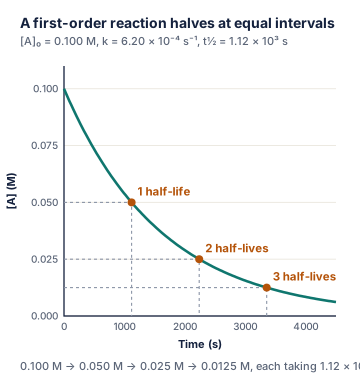
Worked example
Worked example: Average rate
Question: In , falls from 0.500 M to 0.400 M in 60.0 s. Find the average rate of disappearance of and the average rate of the reaction.
-
Rate of disappearance of :
-
Rate of reaction (divide by the coefficient 2): M/s
Worked example: The method of initial rates
Question: For :
| Experiment | [A] | [B] | Initial rate |
|---|---|---|---|
| 1 | 0.10 M | 0.10 M | 2.0 × 10⁻³ M/s |
| 2 | 0.20 M | 0.10 M | 8.0 × 10⁻³ M/s |
| 3 | 0.10 M | 0.20 M | 4.0 × 10⁻³ M/s |
Find the rate law and , with units.
-
Experiments 1 → 2: [A] doubles, [B] constant; the rate is multiplied by , so the order in A is 2.
-
Experiments 1 → 3: [B] doubles; the rate is multiplied by 2, so the order in B is 1.
-
Rate law: rate = k[A]²[B] (third order overall).
-
From experiment 1:
The units follow from M s⁻¹ ÷ M³ = M⁻² s⁻¹.
Worked example: Half-life
Question: A first-order decomposition has . Find its half-life.
That is min.
Common mistake
Common mistake: Taking orders from the balanced equation
For the rate law happens to be rate = k[NO]²[O₂], but that is an experimental result. Many reactions have orders that differ from their coefficients, so always use data.
Common mistake: Giving every k the same units
for a first-order reaction is in s⁻¹, but for a second-order reaction it is in M⁻¹ s⁻¹. Work out the units from the rate law every time.
Common mistake: Thinking every half-life doubles the time to finish
After 2 half-lives, of the reactant remains, not none. A first-order reaction never quite reaches zero.
Notation note
- M/s, M s⁻¹ and mol L⁻¹ s⁻¹ mean the same thing.
- “ln” is the natural logarithm (base e); ln 2 = 0.693.
- is the initial concentration; is the concentration at time .
Remember this
Remember this
- Rate = change in concentration ÷ time (M/s); divide by coefficients for one reaction rate.
- Rate = k[A]^m[B]^n; orders come from experiments (method of initial rates).
- Units of k: zero order M s⁻¹; first s⁻¹; second M⁻¹ s⁻¹; third M⁻² s⁻¹.
- First order: , independent of starting concentration.
Test yourself
Check your understanding before moving on.
Flashcards
Reaction Rates and Rate Laws: Flashcards
- QuestionWhat is the rate of a reaction?Answer
The change in concentration of a reactant or product per unit time, usually in M/s.
- QuestionName four factors that increase the rate of a reaction.Answer
Higher concentration (or pressure), higher temperature, larger surface area, a catalyst.
- QuestionIn rate = k[A]²[B], what are the orders?Answer
Second order in A, first order in B, third order overall.
- QuestionHow are reaction orders found?Answer
By experiment (e.g. the method of initial rates), not from the balanced equation.
- QuestionA reaction is second order in A. [A] is doubled. What happens to the rate?Answer
It is multiplied by 2² = 4.
- QuestionUnits of k for a first-order reaction?Answer
s⁻¹
- QuestionUnits of k for a second-order reaction?Answer
M⁻¹ s⁻¹ (because M s⁻¹ ÷ M² = M⁻¹ s⁻¹)
- QuestionHalf-life of a first-order reaction?Answer
, independent of the starting concentration.
- QuestionWhat fraction of a first-order reactant remains after 3 half-lives?Answer
(½)³ = ⅛ = 12.5%
- QuestionIn 2N₂O₅ → 4NO₂ + O₂, how does the rate of NO₂ formation compare with the rate of N₂O₅ loss?Answer
NO₂ forms twice as fast (4 mol NO₂ per 2 mol N₂O₅).
Tip: press Space to flip and ← → to move between cards.
Quiz
Reaction Rates and Rate Laws: Quiz
7 questions
More particles per litre means more frequent collisions. Energy per collision, Ea and k are unchanged.
Show answer
Answer: Collisions between particles happen more often
More particles per litre means more frequent collisions. Energy per collision, Ea and k are unchanged.
The reaction is second order in B, so the rate is multiplied by 3² = 9.
Show answer
Answer: It increases 9 times
The reaction is second order in B, so the rate is multiplied by 3² = 9.
k = rate ÷ [A]² = (M s⁻¹) ÷ M² = M⁻¹ s⁻¹.
Show answer
Answer: M⁻¹ s⁻¹
k = rate ÷ [A]² = (M s⁻¹) ÷ M² = M⁻¹ s⁻¹.
×4 for doubling means second order in A; no change means zero order in B, so [B] does not appear.
Show answer
Answer: rate = k[A]²
×4 for doubling means second order in A; no change means zero order in B, so [B] does not appear.
t½ = 0.693 ÷ 0.0231 min⁻¹ = 30.0 min. The answer 43.3 min is 1 ÷ k.
Show answer
Answer: 30.0 min
t½ = 0.693 ÷ 0.0231 min⁻¹ = 30.0 min. The answer 43.3 min is 1 ÷ k.
0.800 M → 0.400 M → 0.200 M → 0.100 M: (½)³ × 0.800 M = 0.100 M.
Show answer
Answer: 0.100 M
0.800 M → 0.400 M → 0.200 M → 0.100 M: (½)³ × 0.800 M = 0.100 M.
1 mol O₂ forms per 2 mol N₂O₅: 0.0060 M/s × (1/2) = 0.0030 M/s. The answer 0.012 M/s is the rate of NO₂ formation.
Show answer
Answer: 0.0030 M/s
1 mol O₂ forms per 2 mol N₂O₅: 0.0060 M/s × (1/2) = 0.0030 M/s. The answer 0.012 M/s is the rate of NO₂ formation.
Notes and downloads
Worksheet
Reaction Rates and Rate Laws Worksheet
9 questions on rates, rate laws, the method of initial rates, units of k and first-order half-life. Answer key included.
References
- Brown, T. L.; LeMay, H. E., Jr.; Bursten, B. E.; Murphy, C. J.; Woodward, P. M.; Stoltzfus, M. W. Chemistry: The Central Science, 15th ed.; Pearson, 2022.
Practise this topic with flashcards and a quiz at chemistryclarity.com/chemistry/reaction-rates/
Spotted a mistake? Let us know and we'll fix it.