Worksheet
Reaction Mechanisms and Catalysis Worksheet
8 questions on elementary steps, testing mechanisms, pre-equilibria, catalysts and intermediates, surface catalysis and Michaelis–Menten enzyme kinetics. Answer key included.
- Type
- Worksheet
- Level
- Advanced
- Format
- PDF, ready to print
Preview the questions
All the questions on this worksheet (about 50 minutes). Download the PDF to print it with space for working; the free answer key has full worked solutions.
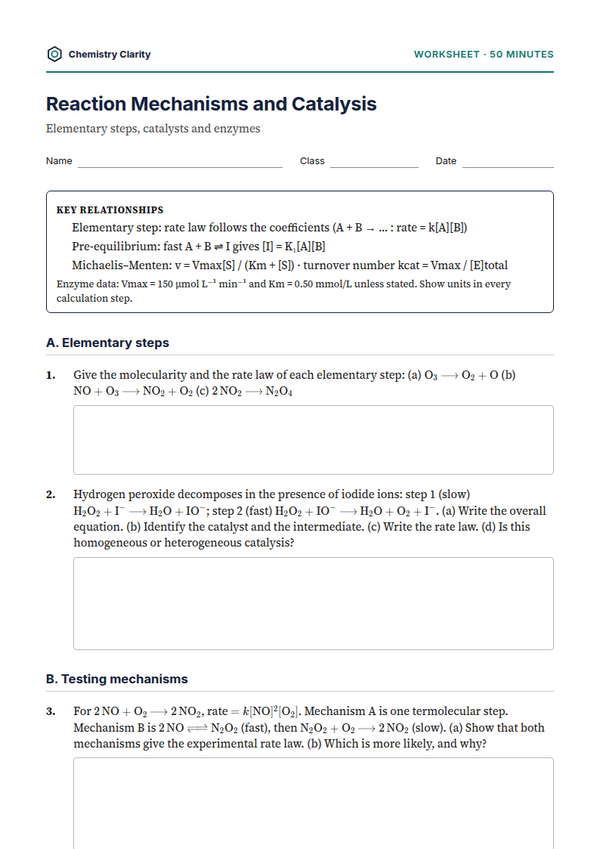
A. Elementary steps
1.
Give the molecularity and the rate law of each elementary step: (a) (b) (c)
2.
Hydrogen peroxide decomposes in the presence of iodide ions: step 1 (slow) ; step 2 (fast) . (a) Write the overall equation. (b) Identify the catalyst and the intermediate. (c) Write the rate law. (d) Is this homogeneous or heterogeneous catalysis?
B. Testing mechanisms
3.
For , rate . Mechanism A is one termolecular step. Mechanism B is (fast), then (slow). (a) Show that both mechanisms give the experimental rate law. (b) Which is more likely, and why?
4.
Ozone decomposes, , by: (fast), then (slow). Derive the rate law, and explain why adding slows the reaction.
C. Catalysts and enzymes
5.
Ethene reacts with hydrogen on a nickel catalyst. Describe the four stages of the catalysed reaction, and explain why the nickel is used as a fine powder.
6.
Using the enzyme data, calculate the rate at (a) mmol/L (b) mmol/L. (c) At what [S] is the rate 90 % of ? (d) At mmol/L, compare the exact rate with the low-[S] approximation .
D. Challenge
7.
Two inhibitors are tested at mmol/L. Inhibitor X is competitive (apparent mmol/L, unchanged). Inhibitor Y is non-competitive ( falls to 90 µmol L⁻¹ min⁻¹, unchanged). (a) Calculate the rate with no inhibitor, with X and with Y. (b) Explain how measuring the rates at mmol/L would tell the two inhibitors apart.
8.
The enzyme concentration in the experiment is 0.025 µmol/L. (a) Calculate the turnover number in . (b) Explain why the rate of the enzyme reaction first rises and then falls as the temperature is raised from 20 °C to 70 °C.