Worksheet
Quantum Numbers and Orbitals Worksheet
8 questions on the four quantum numbers, allowed sets, counting orbitals and electrons, orbital shapes and nodes. Answer key included.
- Type
- Worksheet
- Level
- Intermediate
- Format
- PDF, ready to print
Preview the questions
All the questions on this worksheet (about 35 minutes). Download the PDF to print it with space for working; the free answer key has full worked solutions.
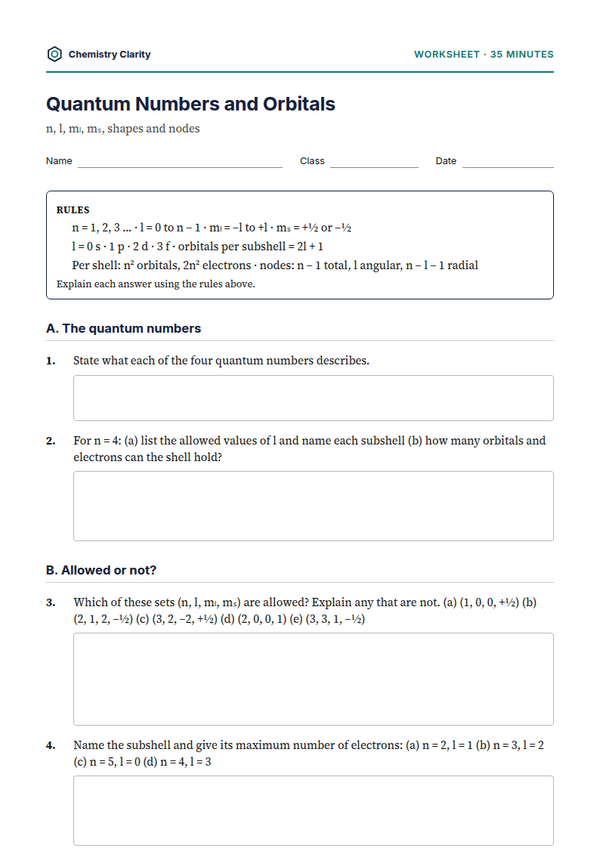
A. The quantum numbers
1.
State what each of the four quantum numbers describes.
2.
For n = 4: (a) list the allowed values of l and name each subshell (b) how many orbitals and electrons can the shell hold?
B. Allowed or not?
3.
Which of these sets (n, l, mₗ, mₛ) are allowed? Explain any that are not. (a) (1, 0, 0, +½) (b) (2, 1, 2, −½) (c) (3, 2, −2, +½) (d) (2, 0, 0, 1) (e) (3, 3, 1, −½)
4.
Name the subshell and give its maximum number of electrons: (a) n = 2, l = 1 (b) n = 3, l = 2 (c) n = 5, l = 0 (d) n = 4, l = 3
C. Electrons in atoms
5.
Give a possible set of four quantum numbers for: (a) the electron in a hydrogen atom in its ground state (b) the outermost electron in potassium (c) one of the 2p electrons in carbon
6.
Use the Pauli exclusion principle to explain why an orbital cannot hold three electrons.
D. Shapes and nodes
7.
(a) Sketch an s orbital and a orbital. (b) State the number of angular and radial nodes in a 2s, a 2p and a 3d orbital.
E. Challenge
8.
Explain how the numbers of orbitals in s, p, d and f subshells account for the widths (2, 6, 10 and 14 columns) of the blocks of the periodic table.